

 Post by
CMMI Level 3 staff augmentation is not a badge vendors collect to win bids. It is an independent appraisal of whether a company’s delivery processes actually work, and approximately 50 companies in all of India hold it. Most staffing agencies calling themselves “enterprise-grade” have ISO 9001 and CMMI Level 3 and ISO 27001:2013 listed on their websites. However, only a much smaller group has completed an authorized CMMI appraisal with results published in the CMMI Institute’s PARS database.
You are evaluating a staff augmentation partner because open engineering roles have been sitting unfilled for 60 to 180 days. Speed matters. But speed from a vendor without audited processes means an unvetted engineer on your team in two weeks, and a three-month productivity hole when it doesn’t work out. The right question is not “how fast can you deliver?” It is “what process guarantees that fast delivery will actually hold?”
What CMMI Level 3 Actually Means for Your Vendor Evaluation
“Defined” is the official name for CMMI Level 3. It describes a specific, verifiable state: the vendor’s processes are documented, standardized, and applied consistently across every engagement, not improvised per project by whoever happens to be available. At Level 2, a vendor manages processes at the project level. Level 3 shifts that to the organizational level. Every project runs on the same documented playbook, not the judgment of an individual account manager.
For an IT staff augmentation buyer, this distinction is practical, not academic. A Level 3 appraised vendor has documented:
- Sourcing and screening of candidates before you see them
- Structure and score of technical assessments
- Management of onboarding handoffs
- How replacement requests are handled within a defined SLA
- Escalating performance issues before they become your problem
An authorized CMMI Institute lead appraiser conducts the appraisal using the SCAMPI A (Standard CMMI Appraisal Method for Process Improvement) methodology. The CMMI Institute publishes the appraisal results in its publicly searchable PARS (Published Appraisal Results) database. No PARS entry means the appraisal either doesn’t exist or the vendor hasn’t opted to publish it. Treat either case the same way: ask the vendor directly for their PARS listing or appraisal certificate, since publication requires the appraised company’s permission.
This matters because fake and unauthorized CMMI claims are a documented market problem, discussed further below.
CMMI Level 3 vs Level 5: Which Should Enterprise Buyers Actually Require?
A vendor claiming CMMI Level 5 sounds more impressive than one claiming Level 3. The distinction is real but often misunderstood by procurement teams evaluating IT staffing partners.
Level 3 delivers standardized, documented, consistently applied processes across the organization. Level 5 adds statistical process control and continuous quantitative optimization on top of that foundation. The gap between them is not quality versus no quality; it is structured delivery versus data-driven optimization at industrial scale.
For most enterprise staff augmentation engagements, Level 3 is the appropriate and sufficient threshold. Level 5 is typically pursued by firms operating across hundreds of concurrent large-scale delivery programs where statistical deviation tracking across process areas generates measurable ROI. For a vendor deploying 10 to 60 engineers into your product team, the Level 3 “Defined” foundation is what prevents process variability. Level 5 is not what prevents a bad engineer from reaching your team unchecked.
The practical procurement question: require CMMI Level 3 as a baseline gate. If a vendor claims Level 5, verify the PARS entry; the same verification step applies regardless of the claimed level.
The retention rate is the real proof. A 95% client retention rate cannot be fabricated the way a certification badge on a website can. Process quality shows up in whether clients renew, not in what level a vendor has appraised.
How to Verify a CMMI Certified IT Staffing Vendor’s Claim is Genuine
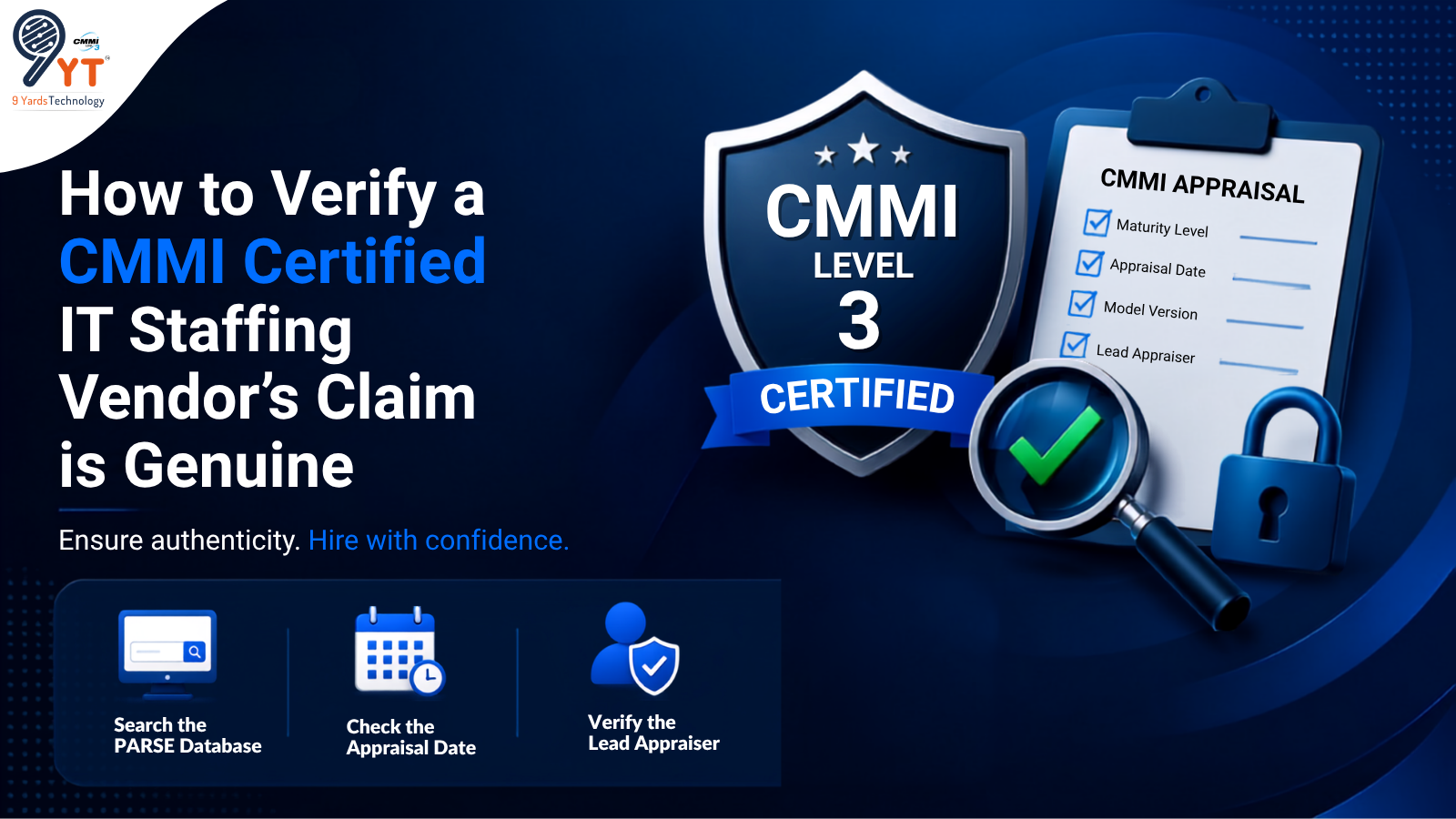
Fake and unauthorized CMMI certifications are a documented problem in the Indian IT vendor market. Third-party sites sell CMMI compliance documents for a few thousand rupees, with no involvement from any CMMI Institute-authorized appraiser. A vendor presenting one of these documents has not been appraised; they have purchased a photoshopped certificate.
Three steps every enterprise procurement team should take:
Step 1: Search the PARS database directly.
Go to sas.cmmiinstitute.com/pars/pars.aspx and search for the vendor’s legal company name. A genuine appraisal will appear with the maturity level, the appraisal date, the model version, and the name of the lead appraiser. No PARS entry doesn’t always mean the appraisal is fake. It can also mean the vendor hasn’t published it, since publication requires the company’s permission. Either way, ask the vendor directly for their PARS listing or appraisal certificate.
Step 2: Confirm the appraisal is current.
CMMI appraisals carry expiration dates, typically three years. An appraisal from 2019 with no renewal is not evidence of current process maturity. Check the date in PARS, not the date on the certificate the vendor emails you.
Step 3: Cross-reference the appraiser.
The lead appraiser that conducts the SCAMPI A assessment should themselves be licensed by ISACA’s CMMI Institute. Appraisals conducted by unlicensed individuals are not recognized, regardless of what the resulting document states.
This is not a niche concern. It is a routine vendor-risk step that takes under ten minutes and eliminates a category of fraud that is otherwise invisible in a standard procurement process.
ISO 9001 and CMMI Level 3 Certification: Why Holding Both Signals More Than Either Alone
ISO 9001 and CMMI Level 3 are frequently listed together on vendor credential pages, but they measure different things. Understanding the distinction protects you from treating them as equivalent alternatives.
ISO 9001 is a quality management system standard. It certifies that a vendor has documented quality policies and follows a plan-do-check-act cycle. An accredited certification body issues the certificate after an audit.
CMMI is not a certification in the ISO sense; it is an appraisal of process maturity against a model developed by Carnegie Mellon University’s Software Engineering Institute, now governed by ISACA. ISO 9001 asks “Does a quality management system exist?” CMMI Level 3 asks, “Are your processes repeatable, documented, and applied consistently across the entire organization?”
A vendor holding both ISO 9001 and CMMI Level 3 certification has passed two independent external evaluations measuring complementary dimensions: system existence and process maturity. That combination is a meaningfully stronger signal than either credential in isolation.
Organizations in BFSI, healthcare, and government procurement evaluate compliance documentation as rigorously as technical capability. As a result, they require both certifications as a defensible vendor-risk measure rather than an excessive qualification.
The Staffing-Specific Proof: What CMMI Level 3 Looks Like in Practice
Certifications describe process frameworks. The actual test is whether the certification correlates with delivery outcomes a client can measure.
SHL needed 60+ engineers across Product Engineering, QA, Performance Engineering, and Business Analysis. 9Yards Technology deployed all 60+ engineers within two months using a BOT (Build-Operate-Transfer) model, achieving a 70% improvement in hiring speed and a 20% reduction in talent acquisition costs. That partnership has run for five-plus years.
9YT Proof Point: When Talkdesk needed to establish an India engineering hub, 9Yards Technology deployed 45+ pre-vetted engineers across Engineering, QA, Security, ERP, and Business Analysis functions, and stood up the entire hub within three months. Hiring speed improved 80%. Talent costs dropped 50%. The CMMI Level 3 staff augmentation delivery process is what made a 3-month hub build operationally possible, not aspirationally possible.
These are not outcomes a vendor without audited delivery processes can reliably replicate. The CMMI Level 3 appraisal is the mechanism that transforms a deployment commitment into a repeatable, accountable process, one that holds at the 45-engineer scale as reliably as at the 5-engineer scale.
How to Evaluate CMMI Certified IT Staffing Companies in India: A Buyer’s Comparison Framework
Not all CMMI Level 3 certified IT staffing companies in India operate the same model. The appraisal confirms process maturity; it does not specify what SLAs a vendor is willing to put in writing, what their actual retention rate is, or whether they maintain a pre-vetted bench or source reactively when you send a requirement.
Use this table to structure your evaluation beyond the certification check:
| Evaluation Criterion | What to Require | Red Flag |
|---|---|---|
| CMMI appraisal verification | Confirmed PARS database entry, current within 3 years | Certificate provided by email only, no PARS match |
| Replacement SLA | Specific number of days in writing (e.g., 7 days) | “Flexible support” or no defined timeline |
| Client retention rate | Published percentage with methodology (e.g., 95%) | Testimonials only, no retention metric |
| Profile delivery speed | Specific hours committed (e.g., 48-72 hours) | “Fast turnaround” with no defined window |
| Engineer employment status | Full-time employees of the vendor, not contractor marketplace | Freelance or contractor model, no employer-of-record structure |
| ISO 9001 and CMMI Level 3 certification | Both credentials verified externally | CMMI claimed alongside ISO 9001 but only ISO 9001 verifiable |
| Engagement model flexibility | T&M, FTE, Fixed Price, BOT, Managed Services | Single model only with minimum term requirements |
| Government tender eligibility | CMMI Level 3 appraisal and compliance documentation available | Certification not verifiable through official registry |
A vendor that answers all eight criteria with evidence, not claims, is operating at the level your procurement team should require for any engagement involving sensitive systems, compliance-regulated industries, or teams of more than five engineers.
9Yards Technology is CMMI Level 3 certified, holds ISO 27001:2013 and ISO 9001:2015 certifications, and publishes a 7-day replacement SLA and a 95% client retention rate, all verifiable through the respective registries and documented client outcomes.
Need pre-vetted engineers in 48-72 hours? Talk to a 9YT specialist. No obligation, no generic shortlist.
Frequently Asked Questions
What is CMMI Level 3 certification?
An authorized CMMI Institute lead appraiser conducts a CMMI Level 3 process maturity appraisal using the SCAMPI A methodology rather than relying on a company’s self-declaration. The appraisal confirms that the organization documents, standardizes, and consistently applies its delivery processes across all projects instead of improvising them for each engagement. The CMMI Institute publishes the appraisal results in its publicly searchable PARS database. Approximately 50 companies in India hold this appraisal, making it a genuine differentiator in enterprise vendor evaluation.
What is the difference between CMMI Level 3 and Level 5?
CMMI Level 3 (“Defined”) confirms organization-wide standardized processes. CMMI Level 5 (“Optimizing”) adds continuous statistical process improvement on top of that foundation. For enterprise staff augmentation buyers evaluating, Level 3 is the standard threshold; it prevents delivery variability at the engagement level. Level 5 is typically relevant for firms managing hundreds of concurrent large-scale programs where quantitative process optimization delivers measurable ROI at industrial scale.
Why do enterprise clients require CMMI Level 3 certified vendors?
Enterprise procurement teams require CMMI Level 3-certified IT staffing companies because the appraisal provides third-party verification that a vendor’s processes are repeatable and auditable, not just claimed. For IT staff augmentation specifically, this translates to predictable candidate quality, enforceable SLAs, and documented replacement procedures. In BFSI, healthcare, and government sectors, CMMI Level 3 is often a mandatory tender qualification threshold, not a preference.
How do I verify if a staffing vendor’s CMMI certification is genuine?
Search the CMMI Institute’s Published Appraisal Results (PARS) database at sas.cmmiinstitute.com/pars/pars.aspx using the vendor’s legal company name. A verified appraisal will show the maturity level, appraisal date, model version, and the name of the authorized lead appraiser. Check that the appraisal date is within the past three years; CMMI appraisals expire. A missing PARS entry doesn’t always mean a fake appraisal. Publication requires the vendor’s permission, so a genuine appraisal can still go unlisted. Ask the vendor directly for their PARS listing or appraisal certificate either way.
