 Post by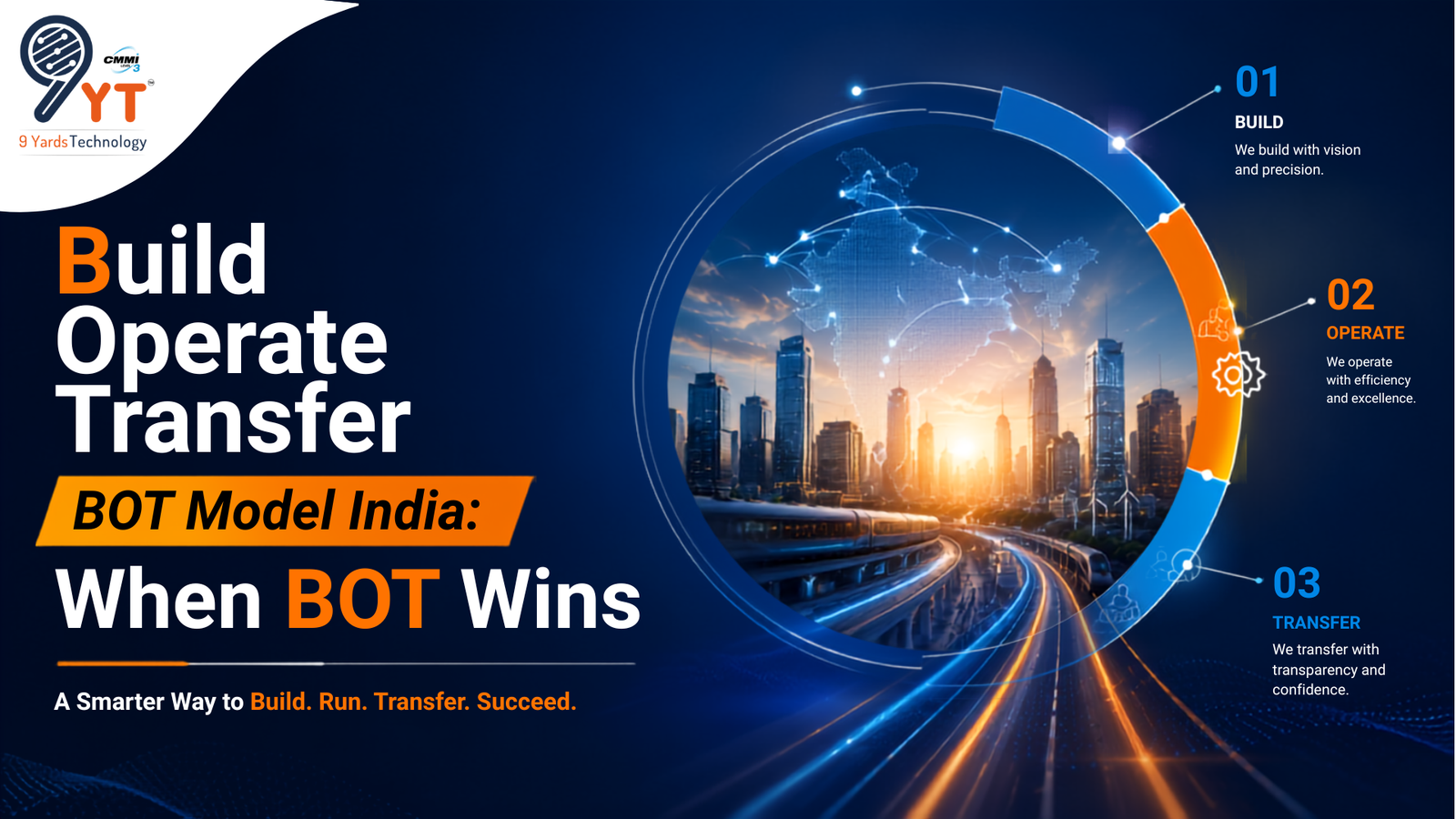
The BOT model India market has produced clear proof that offshore ownership does not require 12 months of entity setup risk. Talkdesk needed a functioning India engineering hub fast. 9YT built it in 3 months, deployed 45+ pre-vetted engineers, and cut Talkdesk’s talent costs by 50%. That engagement remains active and expanding.
You likely face two uncomfortable options: traditional hiring that cannot match your roadmap, and a full GCC buildout that feels premature given your current headcount and India experience. BOT exists for that gap. The question is whether your situation actually fits it, or whether a leaner IT staff augmentation model gets you there faster with lower commitment.
This article provides a concrete framework to answer that question.
What Is the BOT Model in IT Outsourcing?
Three words capture it: build, operate, transfer. A partner builds the offshore team and infrastructure, operates it against defined delivery benchmarks, then transfers full ownership to you at a contractually agreed point. You receive a running offshore operation, not a completed project.
The transfer covers employment contracts, where engineers move onto your direct payroll under Indian labour law. It includes all code repositories, IP, operational documentation, and the processes the team has developed. This structural difference separates BOT from traditional outsourcing, where vendor dependency continues indefinitely.
In India IT engagements, BOT sits between two cleaner but less flexible alternatives. Pure IT staff augmentation gives you pre-vetted engineers inside your existing team structure with no entity setup, no transfer mechanics, and profiles delivered in 48-72 hours. A direct GCC or captive center setup delivers full ownership from day one but requires absorbing all entity registration, compliance, HR infrastructure, and real estate complexity upfront.
BOT is the middle path. The partner absorbs early execution risk while you retain the ownership endpoint.
Most competitor articles miss a critical point: BOT only makes strategic sense if ownership is actually your goal. If you need engineers for 6 to 18 months with no plan to internalise the team, BOT is wrong for you. Staff augmentation with a 7-day replacement SLA is cheaper, faster, and carries less contractual complexity.
Build Operate Transfer Phases: What Each One Actually Requires
Phase one is the Build phase. Your partner handles legal entity registration, office infrastructure, compliance setup, and initial hiring. Most setup costs land here, and your partner’s pre-vetted bench quality determines whether you get 45 engineers in 3 months or 45 misaligned candidates.
Phase two is the Operate phase. The partner runs day-to-day operations under agreed performance benchmarks, maintaining documentation standards, process hygiene, and team culture alignment with the transfer in mind. This phase builds institutional knowledge and is where competitor content falls short; it is the hardest phase to standardise.
Phase three is the Transfer phase. Employment contracts, infrastructure, IP, and operational processes all move to the client. This is where BOT engagements most often fail. Talent attrition when engineers learn they are moving to a new legal entity, IP handover complexity, and documentation gaps that seemed manageable during operations create real problems post-transfer.
BOT model timelines vary widely. Industry sources cite 12 to 36 months end-to-end. 9YT’s Talkdesk engagement reached operational readiness in 3 months. The difference between these numbers comes largely from the pre-vetted bench quality the partner brings and the specificity of the transfer protocol agreed upfront.
BOT Model vs Traditional Outsourcing: The Real Distinction
Traditional IT outsourcing optimises for delivery cost. The vendor owns the team, processes, and institutional knowledge. You receive outputs. When the contract ends, you have nothing except the work product.
BOT optimises for ownership. The vendor’s role is explicitly time-bound, and their goal, if structured correctly, is to make themselves unnecessary.
This shapes every phase. In traditional outsourcing, thorough documentation reduces vendor leverage, so it rarely happens. In BOT engagements, documentation is the deliverable because it enables viable transfer.
Cost structure differs too. Traditional outsourcing has lower upfront friction but higher long-term cost as vendor fees compound annually with no endpoint. BOT requires more Build phase investment, but post-transfer costs drop to what you would pay running your own India team, with no vendor margin added.
For North America buyers, the comparison that matters most is BOT versus hiring locally. A senior software engineer in the US costs $160,000 to $200,000 annually. The same role through 9YT’s India delivery runs $40,000 to $55,000. For a 10-person senior team, that difference reaches $1,050,000 to $1,450,000 per year. BOT structures this savings into permanent ownership rather than ongoing vendor dependency.
BOT vs Staff Augmentation: Choosing the Right Starting Point
You have a team of 8 engineers and need 5 more to hit your Q3 roadmap. BOT is not your answer.
Staff augmentation delivers pre-vetted profiles in 48-72 hours and deploys engineers within 2-3 weeks. There is no transfer phase, entity setup, or minimum engagement threshold. If an engineer does not perform, the 7-day replacement SLA covers it. For teams scaling by fewer than 20 engineers, this path is faster and lower-risk.
BOT works when three conditions align. First, you need 30 or more engineers. Second, you plan to own that team directly within 2 to 5 years. Third, you lack the India operational infrastructure to build the team yourself without 6 to 12 months of entity and compliance work.
Below 30 engineers, BOT setup overhead does not justify the transfer endpoint. Above 200 engineers with a decade-long India commitment, a direct captive center warrants absorbing the upfront complexity.
BOT lives in the 30 to 200 engineer range, where ownership is genuinely important but direct setup complexity is prohibitive at your current scale.
BOT Model vs GCC: When to Use a Partner Instead of Building Direct
A Global Capability Center is an enterprise-owned offshore operation from day one. Your employees work for you. Your infrastructure, IP, and balance sheet are involved. You handle the build through your own legal entity and HR processes.
That control level is worth pursuing at the right scale with appropriate internal India expertise. Direct GCC is strategically sound for mature companies. Most firms evaluating India expansion for the first time lack both the scale and expertise.
BOT is a structured path to a GCC outcome without requiring full GCC capability upfront. The partner absorbs regulatory navigation, initial hiring, and operational complexity during Build and Operate. You reach Transfer with a functioning team, documented processes, and a clear handover protocol rather than a blank canvas.
For North America SaaS specifically, the captive center model makes sense with 100+ engineers already in India and local leadership with operational depth. Before that threshold, BOT delivers the same long-term outcome with materially lower early-stage risk.
The Talkdesk engagement exemplifies this. A US-headquartered SaaS company scaling rapidly needed an India engineering hub in a timeline that direct GCC buildout could not match. 9YT established the hub in 3 months, deployed 45+ engineers across Engineering, QA, Security, ERP, and Business Analysis, and enabled 80% faster hiring than Talkdesk’s US-based process.
BOT Model Risks: What the Transfer Phase Actually Demands
Build and Operate phases run relatively smoothly with most vendors. Transfer phase complexity is where most content falls short.
Attrition is the first risk. Engineers employed by the vendor entity for 2 to 3 years may not transition smoothly to a new employer relationship, especially if compensation structures, benefits, or cultural signals shift. A transfer clause without explicit retention incentives and compensation continuity is incomplete.
IP handover is the second risk. Code repositories and documentation transfer contractually. Institutional knowledge does not. If the Operate phase lacked rigorous documentation standards, the Transfer phase will expose those gaps immediately.
Legal complexity is the third risk. India’s labour law, entity structuring requirements, and tax implications of absorbing a team onto a newly registered Indian entity are substantial. The BOT partner’s legal infrastructure and transfer track record matter as much as their hiring speed.
A CMMI Level 3 certified partner addresses all three risks through audited process documentation across every phase, not just at transfer. This certification distinguishes partners who manage toward handover from those treating documentation as optional.
9YT Proof Point
Talkdesk needed a functioning India engineering hub, not a staffing arrangement. 9YT established it in 3 months using a BOT model, deploying 45+ pre-vetted engineers across Engineering, QA, Security, ERP, and Business Analysis. Hiring ran 80% faster than Talkdesk’s US process. Talent costs dropped 50% through offshore delivery. The team is still active and expanding across multiple functions.
BOT Model Decision Framework: The Threshold That Competitor Content Skips
Nearly every article ranking for this keyword describes the BOT model accurately. Most fail to specify the conditions under which it beats the alternatives.
Here is the framework 9YT uses in practice:
| Condition | Staff Augmentation | BOT Model India | Direct GCC / Captive Center |
|---|---|---|---|
| Team size needed | 1 to 30 engineers | 30 to 200 engineers | 100+ engineers, long horizon |
| Time to first engineer | 2 to 3 weeks | 6 to 12 weeks | 6 to 18 months |
| Ownership endpoint | No transfer needed | Full ownership in 2 to 5 years | Full ownership from day one |
| India entity required | No | Deferred to transfer phase | Required upfront |
| Upfront setup complexity | Low | Medium, absorbed by partner | High, absorbed by client |
| IP and team control post-engagement | Client retains IP, vendor retains team | Full transfer of team and IP | Full control throughout |
| Best fit company stage | Series B to C, scaling fast | Series C to D, building for 5+ years | Large enterprise with existing India ops |
| 9YT SLA commitment | 48–72 hour profiles, 7-day replacement | BOT deployment in 3 months | N/A |
If your situation matches row one, staff augmentation with 7-day replacement SLA and 48-72 hour profile turnaround is your answer. Row two indicates BOT is the right structure. Row three suggests you already have an India team and are evaluating internalisation.
Most staffing content avoids a truth: BOT is not for everyone. Selling it to a company needing 8 engineers in 6 weeks does not serve the client. 9YT’s 95% retention rate comes from matching the model to your actual situation, not from pushing the largest initial engagement.
Scale past 30 engineers with a 2-to-5-year ownership horizon? BOT is the right structure. Below that threshold, pre-vetted IT staff augmentation gets you running in 2 to 3 weeks with a 7-day guarantee behind every deployment.
The right model matches your stage, not its complexity.
Need pre-vetted engineers in 48-72 hours? Talk to a 9Yards Technology specialist, no obligation, no generic shortlist.
Frequently Asked Questions
How does BOT differ from traditional IT outsourcing?
Traditional IT outsourcing is open-ended: the vendor owns the team, the processes, and the institutional knowledge indefinitely. The BOT model is explicitly time-bound. The partner builds and operates the team to a proven standard, then transfers full ownership, employment contracts, IP, documentation, and infrastructure to the client. The vendor’s goal in a BOT engagement is to make themselves unnecessary. That structural difference changes how every phase is run, especially documentation and process hygiene during the Operate phase.
When should a company choose BOT instead of building a GCC directly or using traditional hiring?
BOT fits a specific window: 30 to 200 engineers, a 2-to-5-year ownership horizon, and limited India operational infrastructure to stand up an entity independently. Below 30 engineers, IT staff augmentation with a 7-day replacement SLA delivers faster at lower commitment. Above 200 engineers with a decade-long India strategy, a direct captive center is worth absorbing the upfront complexity. BOT is the middle lane: full ownership as the endpoint, without requiring full GCC capability at the start.
What are the three phases of the BOT model, and how long does each take?
The Build phase covers entity setup, infrastructure, compliance, and initial hiring. The Operate phase runs the team under defined delivery benchmarks, building the documentation and process maturity that make transfer viable. The Transfer phase moves employment contracts, IP, and operations to the client. Industry sources cite timelines ranging from 12 to 36 months end-to-end. 9YT’s Talkdesk engagement reached operational readiness in 3 months, with 45+ engineers deployed, a function of pre-vetted bench depth and a structured transfer protocol agreed upfront.
What is the difference between a BOT model and a Global Capability Center (GCC)?
A GCC is an enterprise-owned offshore operation from day one: the client owns the legal entity, employs the team directly, and controls all infrastructure upfront. The BOT model is a structured path to the same endpoint with the partner absorbing setup complexity during Build and Operate phases. The transfer phase converts the BOT engagement into an effectively owned GCC. For companies entering India for the first time without existing local operational infrastructure, BOT reduces early-stage risk without sacrificing the ownership endpoint.