

 Post by
Mid-level ML engineers in India earn 35-65 LPA, compared to US equivalents at $250-400K fully loaded. The cost arbitrage is real. What separates a bad hire from a transformational one is whether you’re vetting for resume fluency or production judgment.
Open AI/ML requisitions sit unfilled for 60-180 days while you scale engineering capacity. Offshore hiring from India solves the speed problem, but introduces a harder one: surfacing engineers who have actually shipped production systems instead of trained models on Kaggle.
This guide covers the skills that matter, cost math that holds up, how to vet for production experience versus resume claims, and how to structure teams so offshore engineers integrate like internal hires.
Hire AI/ML Engineers in India 2026: What You Actually Pay
The median ML engineer in India earns 28-42 LPA in 2026 at product companies, GCCs, and AI-first startups. Freshers start at 10-18 LPA. Senior engineers with LLM and foundation-model depth reach 1-2 Cr total compensation at top organizations. Mid-level engineers (5-8 years) command $45,000-$60,000 annually.
A US ML engineer at the same experience level costs $180,000-$220,000 annually. The Indian equivalent costs roughly 14-20% as much. For a 10-person senior-level team, annual savings typically range from $1,200,000 to $1,600,000 depending on role mix.
Salary is only half the equation. A low-cost hire who ships broken systems by day 90 becomes expensive by any measure. Vetting for production experience, not credentials, separates sound hiring decisions from costly ones.
LLM and GenAI Engineer Skills: What Actually Ships in Production
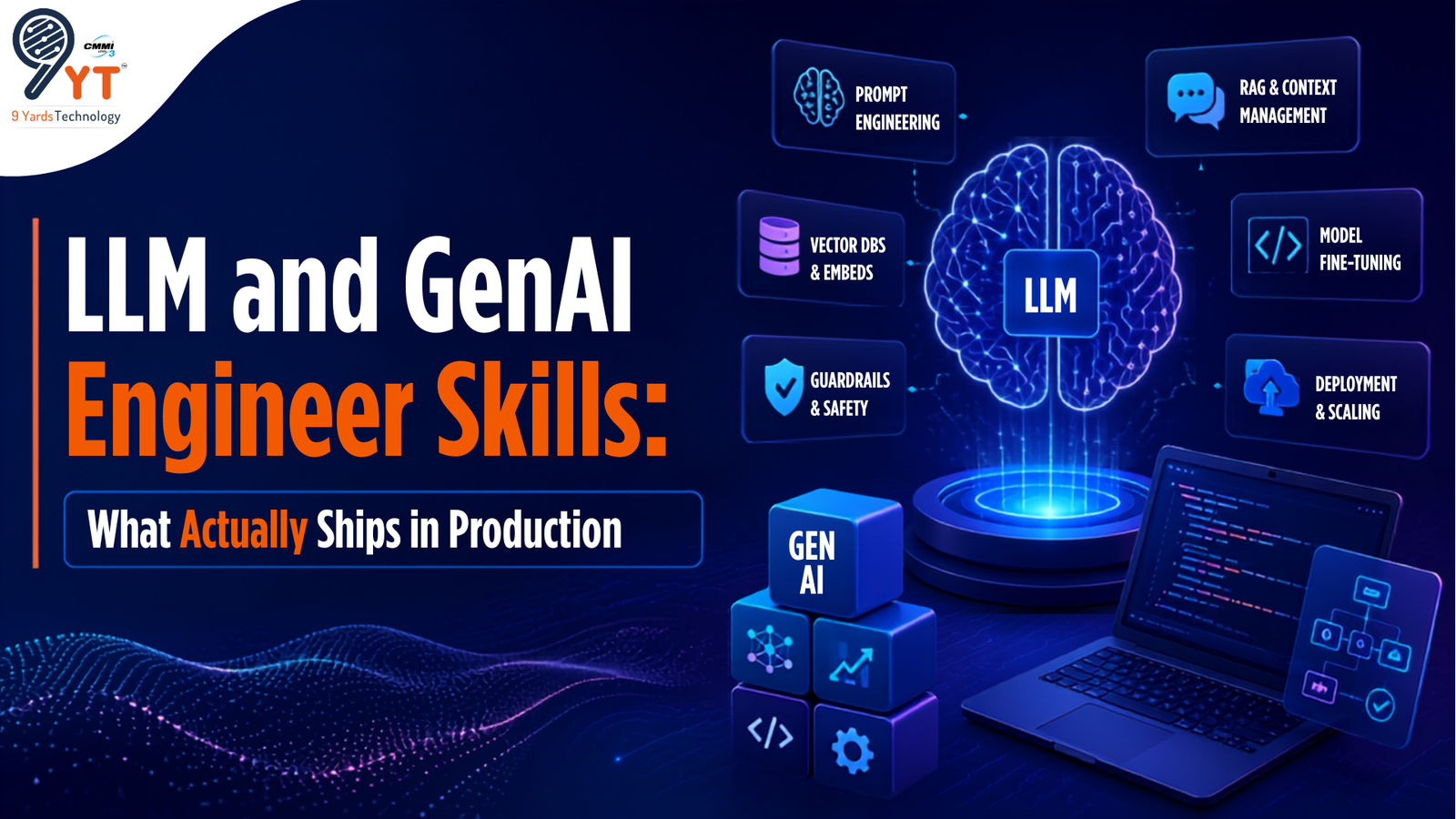
Demand for engineers who have actually shipped production AI far outstrips supply. Plenty of candidates list machine learning, but few have deployed LLM apps, RAG, or agents that real users hit and handled the hard parts: latency, cost, evals, and guardrails. This skill gap represents the single biggest hiring risk in 2026.
Production-ready AI engineers master Python at scale, PyTorch or TensorFlow for real workloads (not toy datasets), and MLOps fundamentals. That’s table stakes. Premium skills are specific: LLM fine-tuning, RAG implementation, agentic AI system design. Engineers with hands-on LLM fine-tuning, RAG, or LLMOps experience command a 20-40% salary premium over generalist ML engineers in 2026.
When vetting AI engineers, look for the failure signals that show up under pressure, not the polished answers that show up in a resume review. Weak candidates talk about agents, RAG, fine-tuning, and orchestration in broad strokes. They stumble when asked how a real system behaved, where it failed, or what tradeoffs they made.
Ask candidates: What latency issue did your RAG pipeline hit in production? How did you detect it? What changed to stabilize it? Engineers unprepared for production work can’t move from theory to failure recovery.
AI Engineer Vetting: Production Experience Over Credentials
Resume fraud in AI roles surged in 2024-25. Job boards overflow with engineers who list TensorFlow and PyTorch but have never deployed an inference service, monitored a live model for drift, or handled the operational reality of running ML at scale. For applied work, the kind most companies actually need in 2026, vet for shipped production experience, not coursework. The distinction matters because applied AI and research-flavoured ML are different jobs with different price tags.
9YT’s vetting process surfaces this difference through multi-stage technical assessments tied to real codebases, not whiteboard problems. Every engineer in the network has shipped production systems. That’s not a credential claim but a structural requirement backed by a 7-day replacement SLA: if an engineer doesn’t integrate into your team within the first weeks, we replace them with no renegotiation and no extra cost.
A replacement guarantee forces discipline on the vetting side before the engineer joins. If you’re betting real money on accountability, your sourcing process becomes very careful very fast. 9YT maintains a 95% client retention rate and a pre-vetted bench built specifically to match North American teams.
AI Talent Hubs India: Bangalore and Hyderabad Lead
When you hire AI/ML engineers in India, Bengaluru is the largest AI talent pool in India and the default first city to hire in. It anchors AI-first Indian startups (Sarvam AI, Krutrim, Yellow.ai, Glance AI, Hippocratic AI India), ML platform teams at unicorns (Razorpay, Swiggy, Zomato, Flipkart), substantial GCC AI organisations, and the Anthropic India office in Bengaluru. Hyderabad is second, anchored by Microsoft (one of its largest engineering campuses globally), Amazon, Salesforce, Google AI Cloud, and a fast-growing Telangana government-backed startup ecosystem.
Bengaluru concentrates roughly 36% of India’s global capability center workforce. Hyderabad is closing fast, particularly for GCC roles. Emerging ecosystems exist in Pune and Delhi NCR. Your hub choice affects timezone overlap and access to specific specializations.
| **Evaluation Criterion** | **What to Look For** | **Red Flag** |
|---|---|---|
| Production Deployment Experience | Shipped LLM apps, RAG systems, agents to real users with monitoring and ops responsibility | “Trained models” or “Kaggle projects” listed as primary accomplishment |
| Team Continuity & Retention | Published retention rates 90%+ with named clients and deployment timelines | Generic “pre-vetted” claim with no SLA or accountability mechanism |
| Vetting Rigor | CMMI Level 3 or equivalent audited process, not self-reported compliance | Certification claimed but unaudited by third party |
| Speed with Quality | Profiles delivered in 48-72 hours AND 95%+ retention, not speed that sacrifices fit | Sub-48-hour turnaround often signals shallow screening |
| Replacement Guarantee | Written SLA (7-day example) tied to actual cost commitment, not marketing language | “Flexible support” or “dedicated account manager” without specific timeframe |
How 9YT Structures AI/ML Deployments for North America Teams
Finding the right engineers to hire for AI/ML in India, ones who combine model training expertise with production engineering skills, is genuinely hard. 9YT has spent years building that bench: 20+ engineers across LLM fine-tuning, RAG systems, computer vision, NLP & MLOps, ready to solve this constraint at scale. 60+ engineers for SHL across Product Engineering, QA, Performance Engineering, and Business Analysis deployed in 2 months. 45+ engineers for Talkdesk across key functions in 3 months, establishing their India engineering hub from scratch.
The Talent Deployment Matrix guides every engagement:
- Requirement Received – Client submits role specification with stack, seniority, and production-experience requirements
- Talent Mapping – Internal matching against pre-vetted bench, not external marketplace sourcing
- Screening – Initial qualification against role requirements with technical depth assessment
- Technical Assessment – Structured evaluation against production system scenarios, not academic theory
- Client Interview – Direct evaluation of fit within 48-72 hours
- Deployment – Engineer joins your team and attends standups, sprints, and code reviews from day one
- Performance Monitoring – Ongoing tracking to ensure delivery quality with a 7-day replacement SLA backing any misfit
Profiles arrive in 48-72 hours. Deployment completes within 2-3 weeks without lengthy procurement cycles or 90-day hiring lag.
Offshore AI Engineers: Integration Into Your Team
The North America buyer’s real fear isn’t cost or talent availability. It’s whether a remote engineer in Bengaluru will actually integrate into the existing team or become a separate contract body. 9YT’s engineers join your existing team. They attend your standups, sprints & code reviews. Ramp up or down monthly. This execution model works.
9YT’s deployments function as team extensions, not separate offshore units. Engineers work in your Git repos, your deployment pipelines, your code-review processes. Timezone overlap is optimized for real-time collaboration during US business hours (evening IST for US Eastern, afternoon IST for UK). The engineer feels embedded, not remote.
For Talkdesk, this meant establishing a full India engineering hub in 3 months where engineers worked directly into US product roadmaps. That’s structural team integration that compounds over time.
Quick FAQ
Do I need a visa sponsor to hire AI engineers from India?
No. Engagement models like staff augmentation, contract, and Employer of Record eliminate visa dependency. The engineer works from India for your company. 9YT handles all payroll, compliance, and statutory requirements through an EOR or similar structure, depending on your preference.
How do I screen for actual production experience versus resume claims?
Ask candidates to walk through a production failure: What broke? How did they detect it? What changed to fix it? Resume-only candidates struggle here fast. Request a portfolio of shipped systems, not toy projects. Verify deployments with the companies where they worked if possible.
What’s the difference between an AI engineer and an ML engineer?
AI engineers work broadly across intelligent systems, bridging research and production application. ML engineers go deeper on model architecture, data pipelines, and training infrastructure specifically. Modern AI work requires both skill sets in one person. Specify the exact role you need before sourcing.
Can offshore engineers handle production on-call responsibilities?
Yes, with timezone coordination. A Bengaluru engineer can cover evening US hours and overnight monitoring, providing 24/7 coverage at lower cost than hiring two US engineers. Structure on-call rotations explicitly before deployment. 9YT’s engineers integrate into your standard on-call schedules.
AI/ML Proof Point: Talkdesk’s India Engineering Hub
9YT deployed 45+ engineers across engineering, QA, security, ERP, and business analysis functions, establishing Talkdesk’s entire India hub in 3 months. The result: 80% faster hiring compared to traditional US recruiting, 50% reduction in talent costs through offshore delivery, and seamless collaboration with US teams across time zones. That partnership remains active and expanding through ongoing deployments across multiple functions. This is active proof that offshore AI/ML engineers integrate at the product-company scale.
The Real Arbitrage: Shipped Systems, Not Just Salary
Whether you hire AI/ML engineers in India for cost or for speed, the honest answer is both, but they’re not equally important. The cost savings from hiring in India are real, but they’re the secondary benefit. Access to production AI talent at scale without burning 90-120 days in a US hiring cycle is the primary one. Talkdesk moved in 3 months. SHL moved in 2 months. That velocity compounds. Every week without an engineer, your roadmap slips. Every week you ship on time, you gain ground on competitors.
That’s why 9YT’s IT staff augmentation model works: verified, shipped-experience engineers deploy in weeks, not quarters. A 7-day replacement SLA backs every deployment because the vetting is rigorous. That confidence rests on 300+ engineers deployed, 95% retained, and named clients like SHL, with a partnership now in its sixth year, and Talkdesk, still active and expanding today.
Need pre-vetted AI/ML engineers in 48-72 hours? Talk to a 9YT specialist with no obligation and no generic shortlist.
Frequently Asked Questions
What specific skills command the highest AI/ML engineer salaries in India 2026?
LLM fine-tuning, RAG implementation, and agentic AI system design command the biggest premiums. Generalist ML engineers earn 25-40% less than engineers with hands-on LLM, foundation-model, or post-training experience. Production deployment experience matters more than PhDs. Engineers who have shipped systems that real users depend on carry the most weight in hiring decisions and compensation negotiation.
How do you vet AI engineers for production experience versus resume claims?
Ask candidates to describe a production failure: What broke, how they detected it, what they changed. Resume-only candidates struggle immediately. Request portfolios of shipped systems with references you can verify. Screen explicitly for latency troubleshooting, cost management, evaluation discipline, and guardrail implementation. These operational realities separate demo-capable engineers from production-ready ones who move the needle.
Can offshore AI engineers from India integrate directly into North America product teams?
Yes. 9YT structures deployments as team extensions. Engineers attend your standups, sprints, and code reviews, work in your Git repos and deployment pipelines, and maintain timezone overlap for real-time collaboration. The Talkdesk case study proves this at scale: 45+ engineers established a complete India hub in 3 months, integrating seamlessly with US product teams. Timezone coordination and structural integration design make the difference between ‘offshore body’ and ‘integrated teammate.’
What’s the realistic timeline to hire AI/ML engineers in India?
Profiles delivered in 48-72 hours. Full deployment within 2-3 weeks. This compares to a 90- 120-day US hiring cycle. The speed comes from maintaining a pre-vetted bench matched to specific skill sets, combined with direct technical screening rather than agency sourcing. Most delays in traditional hiring happen in the feedback loop between interviews, not sourcing. A structured Talent Deployment Matrix compressed that timeline by 80%.