

 Post by
Quick Answer: 9Yards Technology deploys pre-vetted cloud engineers across AWS, Azure, and GCP in 48–72 hours. Full deployment within 2–3 weeks. Unlike marketplace hiring, every engineer carries a 7-day replacement SLA and is vetted against production-grade standards, not just interview performance. For teams needing cloud architects, DevOps engineers, or FinOps specialists, this cuts traditional hiring timelines from 90+ days to 14–21 days.
You’re scaling infrastructure. Your AWS bill is growing. Your Azure setup needs security hardening. Or you’re building an India engineering hub and need 10 cloud engineers in the next quarter. But you’ve been burned before: agencies sent unqualified profiles, onboarding took weeks, and the engineer left after three months. India needs 14 million cloud professionals by 2026 but currently has far fewer, which means the talent exists, but screening it fast without wasting time on bad fits is the real problem.
Most staffing agencies optimize for speed of placement, not placement quality. Cloud engineers who add AI/ML skills (like deploying models on AWS SageMaker, Azure ML, or GCP Vertex AI) earn a 25–50% salary premium over standard cloud engineers, yet many agencies don’t distinguish between a certification-mill fresher and an engineer who has actually architected production systems. The gap between a 6 LPA fresher and a 15 LPA cloud engineer with the same years of experience isn’t luck. It’s selection rigor.
IT staff augmentation solves this by putting accountability into the hiring process. 9Yards Technology doesn’t sell headcount. We sell a pre-vetted bench, a Talent Deployment Matrix with published SLAs, and the willingness to replace an underperforming engineer within 7 days.
Hire Cloud Engineers In India: Why It Actually Works (When Done Right)
India has emerged as a global powerhouse for cloud engineering talent, positioning itself at the forefront of the digital transformation revolution. As organizations worldwide accelerate their migration to cloud platforms, the demand for skilled cloud engineers has reached unprecedented levels. Yet the confidence gap is real. A CTO in North America hears “offshore India engineer” and thinks marketplace freelancer, not enterprise-grade deployment with governance.
India’s tech ecosystem offers access to a vast talent pool of over 5 million IT professionals, with approximately 30% specializing in cloud technologies across AWS, Azure, and GCP platforms. That scale is real. The selection process is what separates 9Yards Technology from a body shop.
When SHL needed 60 engineers across Product Engineering, QA, Performance Engineering, and Business Analysis, they didn’t just need headcount. They needed people who could sit in their standups, join their Slack, attend their architecture reviews, and contribute from day-one velocity. 60 engineers in 2 months. Across three functional areas. With a 5-year ongoing partnership. That’s integration, not placement.
Read More: Why Hiring Cloud Engineers in India Actually Works
AWS, Azure, GCP: Certification vs. Experience, What Actually Separates Good Hires from Bad Ones
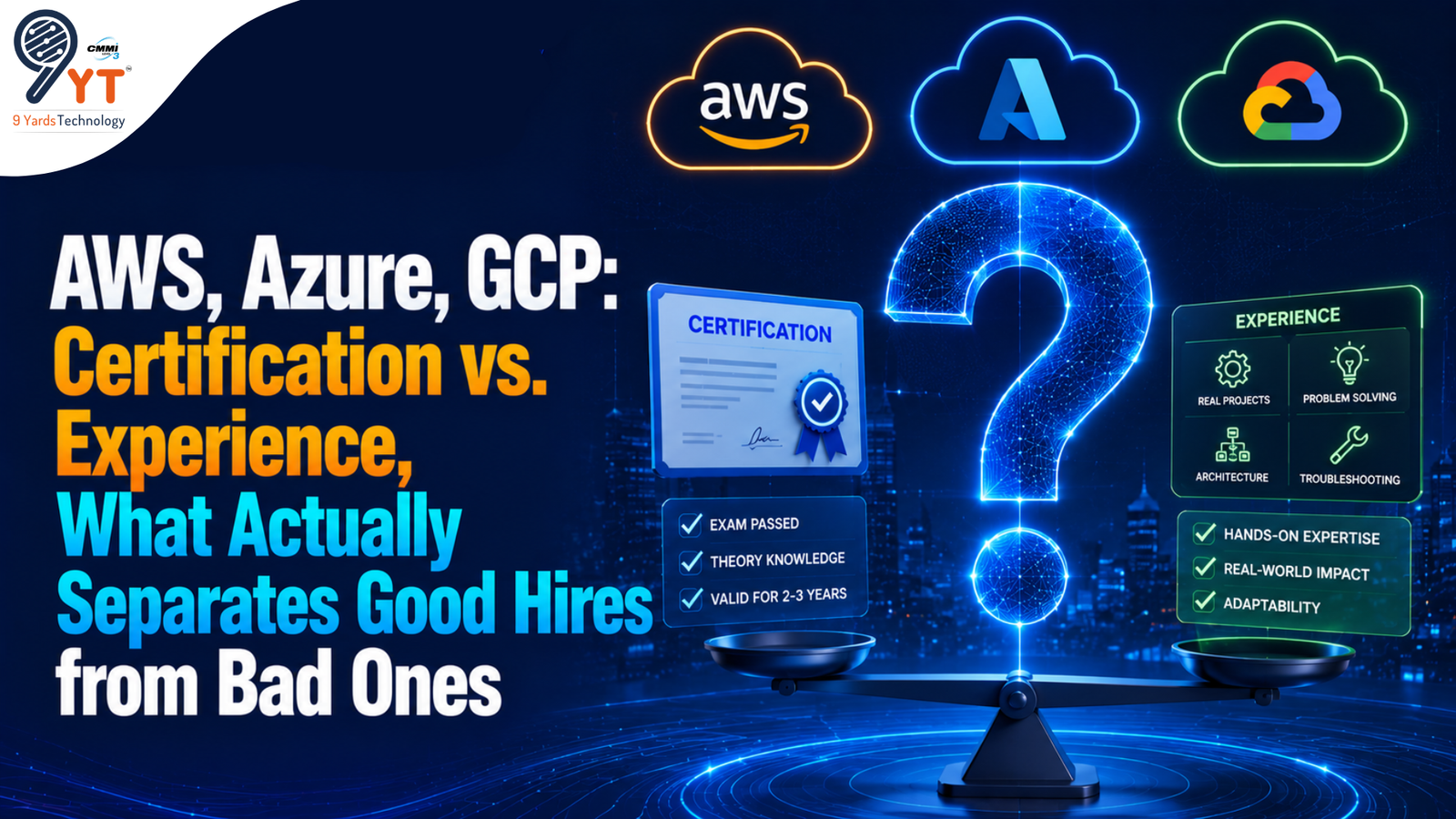
The AWS Certified Solutions Architect – Associate is the most impactful single credential in India’s cloud job market. Certified professionals consistently command 20–30% higher starting salaries compared to non-certified candidates with equivalent experience. Employers use certification as a reliable proxy for verified, structured knowledge. A certification is a floor, not a ceiling.
The market mistake is treating certifications as the primary differentiator. Theory does not pay well. Engineers who can demonstrate real portfolio projects, a deployed AWS architecture, a working CI/CD pipeline, and a containerized application on ECS or EKS negotiate from a position of strength. This is why project-based training programs consistently produce better salary outcomes than lecture-only courses.
When you evaluate a cloud engineer for a production role, ask for three things:
First, hands-on implementation experience. A certificate proves knowledge. A deployed application proves judgment. An engineer who has managed auto-scaling groups under load, debugged IAM permission cascades, or optimized a multi-region disaster recovery setup has lived through the specific friction points your team will face.
Second, specialization clarity. AWS DevOps engineers, Azure security engineers, and GCP data engineers are different people with different skills. AWS is favored by cloud-native SaaS companies; Azure is dominant in BFSI and enterprises with Microsoft ecosystems; GCP is preferred by data engineering, AI/ML companies, and analytics firms. Knowing where an engineer’s real depth is matters more than claiming multi-cloud expertise (which, in practice, usually means “I passed three exams”).
Third, time-zone alignment and communication style. This is not technical, but it is decisive. An India-based engineer who works 9am–6pm IST overlaps 11:30 pm-4:30 am US Eastern. Some roles need that. Others need a different band. Pre-vetted hiring means you know this upfront, not through two weeks of painful standups.
Hire Cloud Engineers In India- The Multi-Cloud Engineer Salary Premium: Why It Matters for Budgeting
Most large organizations adopt multi-cloud strategies for various reasons, avoiding vendor lock-in, leveraging best-of-breed services, or meeting diverse business unit requirements. However, professionals with genuine expertise across multiple cloud platforms remain scarce. While many candidates claim multi-cloud knowledge, deep operational experience across AWS, Azure, and GCP simultaneously is rare.
This creates a compensation puzzle. In India, salaries range from ₹6 LPA to ₹12 LPA for mid-level engineers, while experienced professionals can earn ₹20 LPA+. But those ranges hide a critical detail: a mid-level engineer with AWS-only expertise sits at the lower end; a multi-cloud architect with real infrastructure-as-code depth across AWS, Azure, and GCP sits at the upper end, or beyond.
When you hire through 9Yards Technology, we match the depth of expertise to your actual needs, not generic “cloud engineer” hiring. If you need a DevOps engineer comfortable with Terraform on AWS and basic Azure, we find that person at the right tier and cost. If you need a cloud architect who has designed redundancy across three cloud providers, we know who that is and can deploy them within 21 days.
Cloud FinOps Engineer India: A Growing Category You’re Probably Underhiring
Cloud costs scale faster than engineering attention. IBM Cloud Adoption Services is hiring for the emerging FinOps practice, helping enterprise clients reduce cloud bills by 20–40% through Apptio, CloudHealth, and native cloud cost tooling. This is not a niche. FinOps Certified Practitioner certification validates cloud financial management capabilities, becoming increasingly strategic as cloud costs escalate.
A FinOps engineer in India earns ₹10–16 LPA depending on experience and credentials, but commands a 20–30% premium over standard cloud engineers because the skill is both rare and directly revenue-impacting. One engineer who optimizes your cloud spend by 25% pays for themselves in the first quarter.
If you’re growing fast and cloud expenses are growing faster, this is a critical hire. 48–72 hours to profiles. 2–3 weeks to deployment.
Azure Engineers India BFSI Enterprise: Why Banking & Financial Services Buy Differently
BFSI organizations (Banking, Financial Services, Insurance) have non-negotiable constraints: compliance audits, NDA enforcement, and governance frameworks that generic staffing agencies can’t meet. Banks, insurance companies, and fintech platforms are investing heavily in cloud infrastructure for compliance, security, and digital transformation. Cloud engineers in BFSI earn a premium of 15–25% compared to equivalent roles in IT services, reflecting the complexity and criticality of the environments they manage.
Azure is dominant in BFSI and enterprises with Windows/Office infrastructure, particularly in India, where HDFC, ICICI, and SBI use Azure. An Azure engineer for a BFSI client is not a generic role. They need to understand Azure AD, managed identities, role-based access controls (RBAC), and compliance frameworks that most commodity staffing doesn’t vet for.
9Yards Technology backs every deployment with a 95% client retention rate and a 7-day replacement SLA. For BFSI clients, this is not a nice-to-have. It is table stakes. We’ve deployed engineers for Al Rajhi Bank, Arab National Bank, and other regulated institutions because the vetting rigor matches the stakes.
| Evaluation Criteria | What to Look For | Red Flag |
|---|---|---|
| Certification Status | AWS Solutions Architect Associate or equivalent Azure/GCP certification, earned or renewed within the last 2 years | Expired certifications or credentials obtained without real project experience |
| Hands-on Project Experience | Can clearly explain deployed infrastructure, CI/CD pipelines, architecture decisions, and disaster recovery strategies | Lists cloud tools on the resume but cannot explain implementation or architectural decisions |
| Multi-Cloud Experience (If Required) | Proven production experience across two or more cloud platforms | Claims multi-cloud expertise but has deep experience with only one platform |
| Time Zone Compatibility | Working hours and overlap with your engineering team are clearly confirmed | Provides vague “flexible hours” commitments that lead to impractical meeting schedules |
| Replacement Guarantee | Written replacement SLA for underperforming engineers | Only verbal replacement promises or no documented SLA |
| Compliance Readiness (BFSI) | Experience working in regulated industries with knowledge of audit trails and security frameworks | No demonstrated experience with compliance, governance, or security standards |
How 9Yards Technology Deploys Cloud Engineers: The Talent Deployment Matrix
Speed without process is gambling. Process without speed is bureaucracy. The Talent Deployment Matrix is neither.
- Step 1 is the requirement specification. You tell us: AWS DevOps engineer, Terraform and Kubernetes, 4+ years, time zone IST 9am–6pm, starting within 6 weeks. Not vague, not inflated.
- Step 2 is talent mapping. Our bench is continuously sourced and screened. We know who has what, and more importantly, we know who has actually done it in production, not just in labs.
- Step 3 is screening and technical assessment. We run structured evaluations. A Terraform assessment is not “can you explain Terraform?” It is “design a multi-environment infrastructure state using these constraints, and explain your trade-offs.”
- Step 4 is the client interview. You speak to shortlisted candidates. If you’re unsure, we’ll schedule a second round. This is your call, not ours.
- Step 5 is deployment. The engineer joins on the agreed date, integrated into your systems, tools, and processes.
- Step 6 is performance monitoring. We track retention, output, and fit. If an engineer is underperforming in the first weeks, we replace them within 7 days. No renegotiation. No, “they’re still ramping up.” Seven days.
Profiles in 48–72 hours. Full deployment in 2–3 weeks. That’s the SLA. It’s the only commitment that matters.
Cost Comparison: What You Actually Pay
| Role | US Annual Cost | India Annual Cost | Estimated Annual Savings |
|---|---|---|---|
| Senior Cloud Architect | $175,000–$215,000 | $48,000–$65,000 | $110,000–$150,000 |
| Senior AWS DevOps Engineer | $170,000–$210,000 | $42,000–$58,000 | $112,000–$152,000 |
| Senior Azure Security Engineer | $165,000–$205,000 | $38,000–$52,000 | $113,000–$153,000 |
| Senior GCP / Data Engineer | $165,000–$205,000 | $38,000–$52,000 | $113,000–$153,000 |
| Senior Cloud FinOps Engineer | $155,000–$195,000 | $38,000–$52,000 | $103,000–$157,000 |
Azure Security Engineer and GCP/Data Engineer roles currently command comparable senior-level rates in India — the overlap reflects market parity, not a data error.
For a 10-person senior cloud engineering team, annual savings typically range from $1,050,000 to $1,450,000, depending on role mix. That is not a rounding error. That is team growth without proportional cost scale.
9Yards Technology Proof Point
Talkdesk needed to establish a scalable India engineering hub while maintaining North American collaboration standards. They deployed 45+ engineers across Engineering, QA, Security, ERP, and Business Analysis in 3 months using a Build-Operate-Transfer model. Result: 80% faster hiring with pre-vetted talent, 50% reduction in talent costs through offshore delivery, and ongoing deployment supporting continued growth. Five years later, the partnership is still active. The hub is still growing. This is what integration looks like, not transactional staffing.
Closing Thoughts
India has exceptional cloud engineering talent. The problem is not availability. It is verification. Most hiring processes either move too slowly (90+ day search) or cut corners (marketplace platforms with zero accountability). We do neither.
When you hire through 9Yards Technology, you get a pre-vetted engineer, a published 7-day replacement SLA, and a 95% client retention rate backing every deployment. 48–72 hours to profiles. 2–3 weeks to full integration. 95% client retention because we don’t place people; we integrate engineers into teams.
Need pre-vetted engineers in 48–72 hours? Talk to a 9Yards Technology specialist with no obligation and no generic shortlist.
Frequently Asked Questions
How do I ensure a cloud engineer hired in India will integrate with my North American team?
Time-zone alignment and communication style are non-negotiable. We confirm working hours upfront and match engineers who have already worked with distributed North American teams. Pre-vetting includes a client interview where you assess fit directly. If integration fails in the first weeks, we replace the engineer within 7 days, which is how we back that confidence. Talkdesk deployed 45+ engineers this way across 3 months with 80% faster hiring.
What’s the difference between certification and real experience in cloud engineering?
Certification proves knowledge; experience proves judgment. A cloud engineer can pass the AWS Solutions Architect exam and still struggle with production trade-offs like multi-region redundancy or cost optimization under load. When we vet engineers, we evaluate hands-on project depth, not just credentials. Certified professionals with real implementation experience earn 20–30% more and deliver faster velocity.
Are Azure engineers’ India BFSI enterprise roles different from general cloud roles?
Yes, significantly. BFSI roles require compliance frameworks, audit-trail rigor, and security posture management that commodity staffing doesn’t screen for. Azure is dominant in Indian banking (HDFC, ICICI, SBI). We’ve deployed engineers for regulated institutions like Al Rajhi Bank and Arab National Bank because our vetting process is audited against the same standard for every client, regardless of scale. Expect a 15–25% salary premium for BFSI specialists.
What is a cloud FinOps engineer in India, and why is it becoming critical?
FinOps is cloud financial operations: optimizing cloud spend without sacrificing performance. As companies scale infrastructure, bills often grow faster than engineering attention. FinOps engineers use tools like Apptio and CloudHealth to reduce spend by 20–40%, often paying for themselves in one quarter. In India, FinOps specialists earn ₹10–16 LPA and command a 20–30% premium over standard cloud engineers because the skill directly impacts revenue.