
 Post by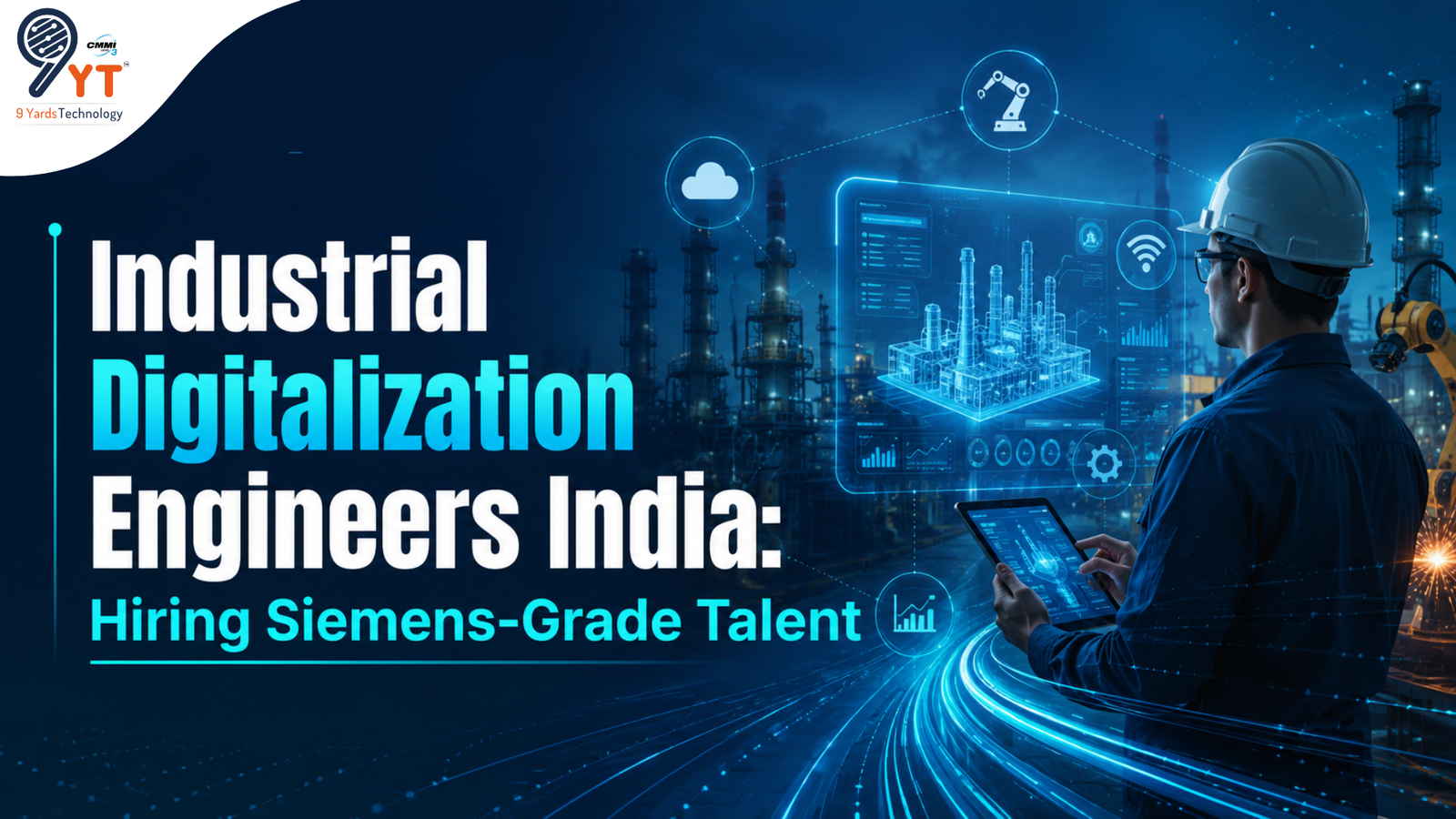
Quick Answer: Industrial digitalization engineers in India are available, but 40-50% of graduates lack the hands-on, vendor-specific expertise (Siemens TIA Portal, PLC programming, IIoT architecture) that manufacturing clients require. 9Yards Technology deploys pre-vetted industrial digitalization engineers in 48-72 hours with a 7-day replacement SLA and CMMI Level 3 process rigor, eliminating the typical 90-day hiring timeline.
Manufacturing companies scaling digital transformations face a brutal timeline problem. Your plant needs engineers who understand Siemens automation ecosystems today, not three months from now. India produces millions of engineering graduates annually, yet traditional hiring and generic staffing agencies still force you to choose between speed and quality.
The industrial digitalization market in India has fundamentally changed. It’s no longer a shortage of engineers; it’s a shortage of engineers with the right certifications, hands-on PLC experience, and production readiness. This article explains the real difference between a generic engineer and one who can step into a Siemens-heavy manufacturing environment on day one.
What Industrial Digitalization Engineers Actually Do
Industry 4.0, also known as the Fourth Industrial Revolution, is powered by automation, artificial intelligence, the Internet of Things (IoT), robotics, and data analytics, revolutionizing how products are manufactured, distributed, and maintained. An industrial digitalization engineer sits at the center of this transformation.
They configure and program PLCs using Siemens TIA Portal. Also, they design HMI (Human-Machine Interface) dashboards that operators depend on. Furthermore, they architect IIoT sensor networks that feed real-time production data into MES (Manufacturing Execution Systems). And they troubleshoot SCADA systems when production lines go down. None of these are theoretical exercises.
The depth required separates production-ready talent from interview-passing credentials. A Siemens TIA Portal certification means something concrete: the engineer has used TIA Portal in a real plant environment, not watched a YouTube tutorial. That distinction matters when your automation project sits on a critical path.
The Skill Gap: Why Most Graduates Don’t Make the Cut
Only about 40 to 50 per cent of Indian engineering graduates are considered employable, pointing to a significant gap between academic learning and industry expectations. The problem is specific to industrial digitalization roles. Universities teach PLCs in theory. Manufacturers need engineers who’ve debugged ladder logic under pressure, integrated vision systems into assembly lines, and managed plant-wide Ethernet networks.
Many Indian institutions still rely on outdated curricula that emphasise theoretical knowledge over practical application, with a lack of hands-on training, interdisciplinary exposure, and meaningful industry engagement, leaving many graduates to enter the workforce with limited exposure to actual industry environments. This is exactly the gap 9Yards Technology’s vetting process targets: we reject theoretical knowledge and deploy only engineers with production-floor credibility.
Vendor certifications matter more here than in generic software development. A Siemens-certified engineer has passed Siemens’ own assessment. They’ve proven proficiency in specific PLCs (S7-1200, S7-1500), safety logic, and system commissioning. Generic IT staffing agencies don’t differentiate here.
Industrial Digitalization vs. IT Staff Augmentation: Why the Difference Matters
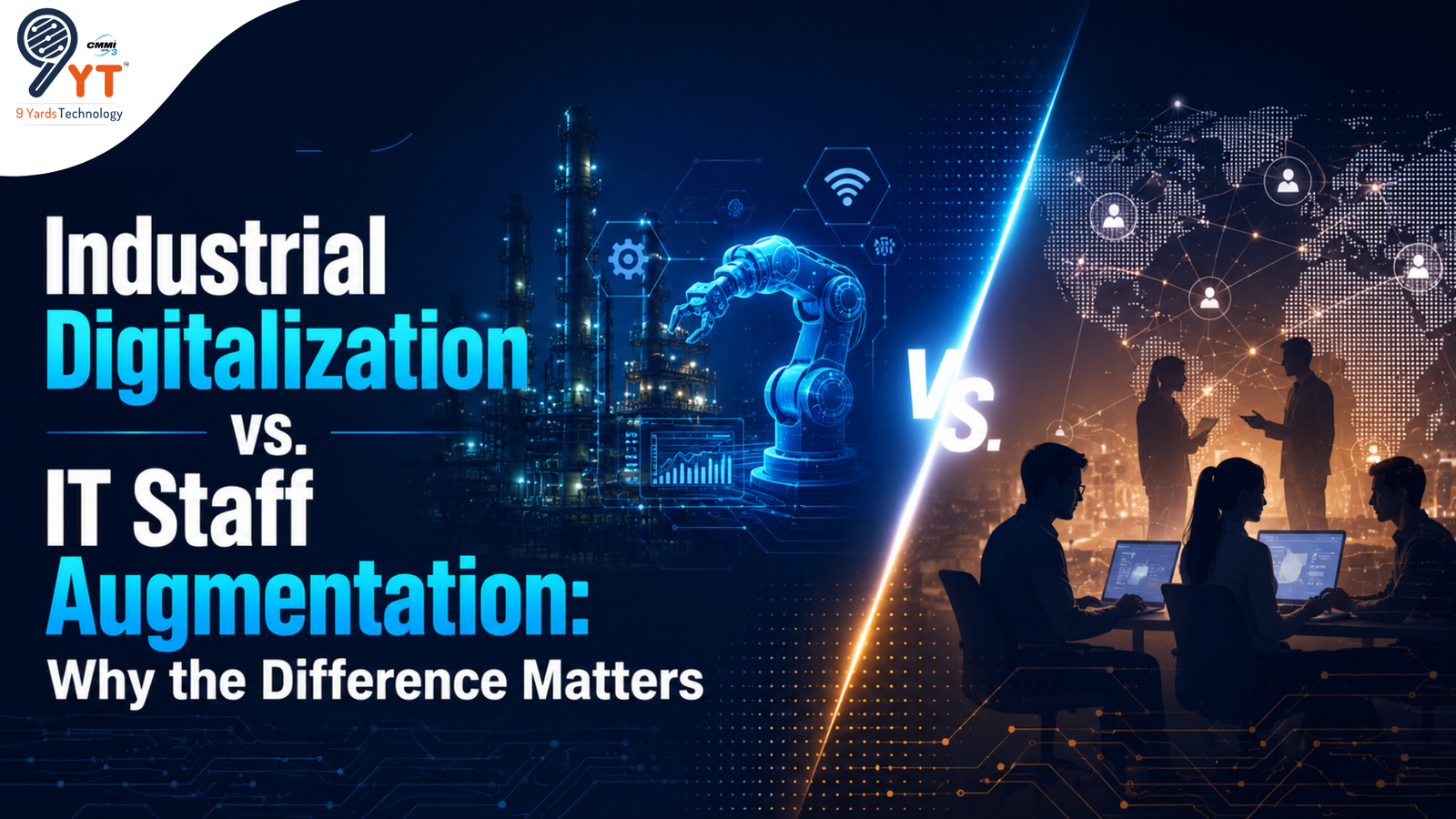
When you hire IT staff augmentation for a software product, velocity often trumps domain depth in the first month. You’ll retrain. With industrial digitalization, retraining means plant downtime. It means a production line stops because an engineer misunderstood Siemens safety protocols.
Industrial digitalization hiring demands a different vendor model. You need pre-vetting that includes hands-on technical assessment, not just a resume scan. You need engineers embedded in manufacturing, not cloud-native startups. Also, you need a vendor willing to guarantee quality through a documented, audited process.
9Yards Technology operates under CMMI Level 3 certification, meaning our talent assessment process is structured, repeatable, and verified by an external audit. Most staffing agencies, even large ones, operate on reputation and gut feel. CMMI Level 3 means you’re paying for process, not just promises.
Why India? The Manufacturing Talent Concentration
India hosts professionals working across IoT, Product Design, Materials, Mechanics, and System Design functions in Automotive, Aerospace, FMCG, Pharma/Medical Equipment Production, Energy, Metals and Mining, and Oil and Gas. The digital manufacturing industry is expected to reach $767.82 billion by 2025, with India viewing manufacturing as vital to the country’s digital transformation strategy, creating a need for professionals savvy with emerging technologies.
India’s manufacturing sector has been building automation expertise for decades. Bangalore, Pune, Hyderabad, and Ahmedabad host thousands of Siemens integrators, OEMs, and automation houses. Engineers there learned PLC programming not from online courses but in factories, on night shifts, commissioning production lines. They understand the constraints: regulatory compliance, uptime pressure, legacy system integration.
That depth doesn’t exist in equal concentration anywhere else. A North American company competing with global manufacturing timelines needs access to that talent pool without building an India office.
| Approach | Time to Profiles | Vetting Method | Replacement Guarantee | Cost |
|---|---|---|---|---|
| Local North America Hiring | 45–90 days | Resume-based screening | None | $160K–$220K annually |
| Generic Staffing Agency | 21–30 days | Phone screening + reference checks | Renegotiation required | $50K–$70K annually (India) |
| 9Yards Technology (Pre-Vetted, CMMI Level 3) | 48–72 hours to candidate profiles | Hands-on PLC + Siemens technical assessment | 7-day replacement, no renegotiation | $40K–$55K annually (India) |
The table above shows the trade-off most companies face. Speed without vetting is worthless. 9Yards Technology’s model compresses all three: 48- to 72-hour profile delivery, production-grade vetting through Siemens assessment, and a written 7-day replacement guarantee that forces rigour into the initial matching.
Technology Areas: PLC TIA Portal, IIoT, and Industrial Automation Vendor Certifications
When you specify “industrial digitalization engineers,” narrow the technology stack immediately. The three pillars:
Siemens PLC and TIA Portal. TIA Portal is a unified software environment developed by Siemens that integrates all automation components, allowing users to configure, program, and visualize control systems efficiently, and supports various Siemens products, including PLCs, Human-Machine Interfaces (HMIs), and drives. An engineer who knows TIA Portal knows ladder logic, function blocks, SCL (Structured Control Language), and the Siemens ecosystem. Don’t accept “PLC experience” alone; specify TIA Portal.
Industrial IoT (IIoT) architecture. This means MQTT protocols, OPC-UA, sensor integration, and data pipelines flowing into cloud platforms or on-premises MES systems. An IIoT engineer bridges the plant floor (the PLC layer) and the analytics layer (data warehouses, AI/ML pipelines). These skills are rarer than generic cloud engineering.
Industrial automation vendor certifications. Siemens, Allen-Bradley, Omron, Beckhoff, Phoenix Contact. An engineer with a Siemens certification has skin in the game. They’ve invested time and money in learning one ecosystem deeply. A manufacturer rolling out 200 S7-1500 PLCs across a plant doesn’t want a generalist.
How Pre-Vetting Saves You 60 Days and $100K
A traditional hiring process for a senior industrial automation engineer in North America takes 90 days and costs $15K-25K in recruiter fees and interview time alone, before counting the cost of the role sitting empty. By day 60, your project timeline has shifted. Your budget assumptions are stale.
Add the productivity cost of the role sitting empty for 90 days instead of 14, and the total easily clears $100K once lost project velocity is factored in; the recruiter fee is the smallest part of the bill.
9Yards Technology’s model inverts this. We maintain a pre-vetted bench of industrial digitalization engineers. When you specify your need (Siemens TIA Portal, 5+ years of plant experience, MQTT knowledge), we run a technical assessment within 48-72 hours and hand you a shortlist where every engineer has been vetted. The assessment includes a live Siemens simulation, not a multiple-choice exam.
Once you approve, deployment happens in 2-3 weeks. Your engineer is productive on day one because they’ve already proven they can navigate a PLC, read electrical schematics, and think like an automation integrator.
The Real Cost Comparison: Local vs. 9Yards Technology India Deployment
A senior industrial digitalization engineer in North America costs $160K-200K annually in total compensation. That same engineer, deployed from India through 9Yards Technology9Yards Technology, costs $40K-55K annually. For a 10-person team of senior engineers, the annual savings range from $1,050,000 to $1,450,000, depending on the role mix.
But the savings isn’t just money. It’s also speed. A North American hiring timeline of 90 days means a project that could have started in January now starts in April. At scale, that’s a revenue miss. 9Yards Technology eliminates that by collapsing the hiring cycle to 2-3 weeks.
A Real Example: Speed + Quality in Action
This is what the model looks like in practice: a manufacturing client needing multi-plant Siemens automation expertise on an aggressive timeline gets a pre-vetted shortlist in days, not months, because the vetting happened before the requirement ever arrived. That’s the structural advantage a maintained bench has over a search that starts from zero.
Why CMMI Level 3 Certification Matters in Industrial Hiring
CMMI Level 3 certification signals that your staffing partner operates a documented, repeatable, audited process. It’s not a vanity credential. Only approximately 50 companies in India hold CMMI Level 3. That rarity reflects the rigor required.
For industrial digitalization hiring specifically, CMMI matters because the stakes are high. A mismatched engineer in a manufacturing plant isn’t a productivity loss; it’s a safety risk and a revenue impact. CMMI Level 3 means you’re not depending on one account manager’s judgment. You’re depending on a certified process that other companies and auditors have verified.
Next Steps: Getting Pre-Vetted Engineers in Your Pipeline
The industrial digitalization talent market in India is deep, but it requires a vendor who understands the specific skill stack and can vet accordingly. Generic staffing agencies will send you resumes. What you need are engineers who’ve spent years on plant floors.
Start by defining your exact technical need: Which Siemens PLC models? Do you need IIoT expertise, or is that a phase-two requirement? What certifications matter for regulatory compliance in your industry? Once you’re clear, a CMMI Level 3 certified vendor can match precisely and compress your hiring timeline to weeks instead of months.
Need pre-vetted engineers in 48 hours? Talk to a 9Yards Technology specialist with no obligation and no generic shortlist.
Frequently Asked Questions
What is the difference between a generic automation engineer and an industrial digitalization engineer in India?
A generic automation engineer may know basic PLC programming. An industrial digitalization engineer in India has hands-on Siemens TIA Portal experience, plant-floor commissioning background, and often vendor certifications (Siemens, Allen-Bradley, etc.). They understand safety logic, MES integration, and production-line constraints, not theory. For manufacturing environments where downtime costs thousands per minute, this distinction is critical.
How long does it actually take to hire an industrial digitalization engineer from India?
Traditional recruiting takes 60-90 days. Pre-vetted models like 9Yards Technology compress this to 48-72 hours for profile delivery and 2-3 weeks for full deployment. The speed comes from maintaining a pre-assessed bench where candidates have already passed hands-on Siemens and PLC assessments. You’re not waiting for assessments to run; they’re already complete.
Are Industrial IoT (IIoT) engineers hiring in India and industrial automation different skill sets?
Overlapping but distinct. Industrial automation engineers focus on PLC logic, HMI configuration, and plant-floor control systems. IIoT engineers bridge automation and analytics: they design sensor networks, build MQTT pipelines, integrate MES systems, and connect plant-floor data to cloud analytics. Many engineers do both, but the IIoT side requires additional data engineering and cloud platform knowledge.
What industrial automation vendor certifications in India should I require?
Siemens certification is the gold standard for manufacturing. Others to prioritize: Allen-Bradley (for US automation legacy systems), Omron, and Phoenix Contact. A certification means the engineer has invested in that vendor’s ecosystem and passed that vendor’s assessment, not just completed an online course. For Siemens-heavy environments, insist on TIA Portal certification.