

 Post by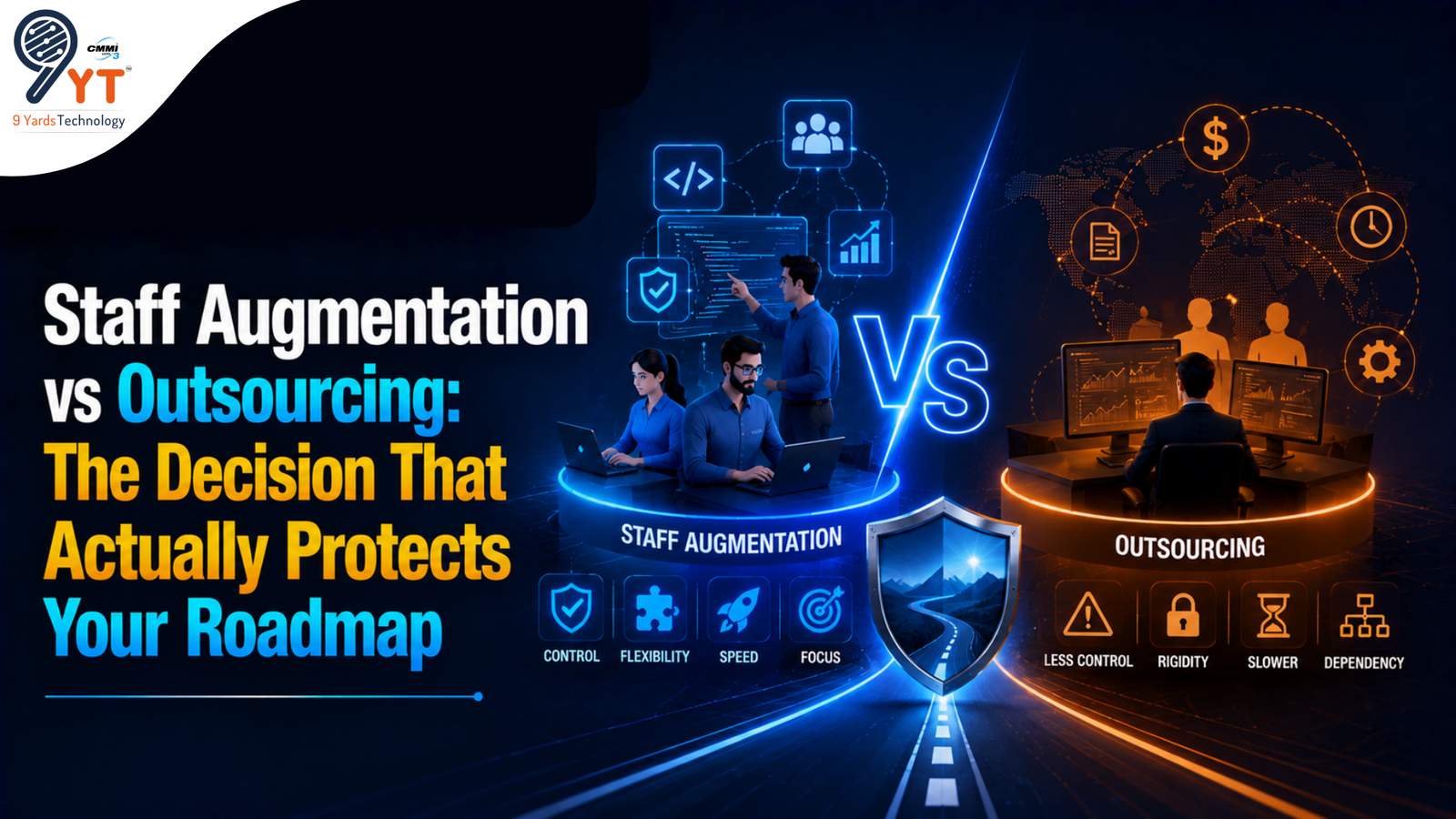
The staff augmentation vs outsourcing debate fills every vendor pitch deck, but most of those decks omit the thing that actually determines whether you get burned: the quality guarantee behind the model. Talkdesk chose staff augmentation to build its engineering hub in India. They deployed 45+ pre-vetted engineers through 9Yards Technology in 3 months and cut hiring costs by 50%. The model mattered. The offshore staffing structures that underpinned it mattered more.
You are reading this because you have open engineering requisitions, probably more than a few. Two vendors are in your inbox offering different things. One promises to “own the outcome.” The other promises engineers who slot into your sprint by Monday. Neither tells you what happens when quality falls short. That is the question this article answers.
What Staff Augmentation Actually Means (and What It Does Not)
Staff augmentation is a deployment model, not a staffing category. A pre-vetted engineer joins your team, reports to your engineering leads, uses your tools, attends your standups, and is accountable to your definition of done. Once the right person is deployed, the vendor’s ongoing role is limited to providing replacements if needed.
This is not a body-shop arrangement. A body-shop sells headcount. IT staff augmentation sells a vetting process: structured technical assessment, role-specific screening, and an accountability layer that stays active after deployment. The difference emerges at month three.
What staff augmentation does not mean: it does not transfer delivery ownership to a third party. Your engineering managers run the sprint. Your architects make design decisions. You retain intellectual property, daily visibility into progress, and the ability to course-correct immediately when priorities shift.
That control has a cost. If your internal management bandwidth is stretched thin, augmenting ten engineers without a strong onboarding process creates coordination overhead. Staff augmentation works best when you have clear role specs, an engineering lead who can onboard deployed talent, and a sprint cadence that new team members can attach to within the first two weeks.
Read More: Staff Augmentation Pros and Cons: What CTOs Need to Know
What Outsourcing Actually Means (and Where It Breaks)
Outsourcing transfers ownership of the outcome to the vendor. You hand over a scope of work, a defined project, an ongoing function like QA, or an infrastructure build. The vendor delivers against contractual milestones. You review outputs, not daily tasks.
This model works well for genuinely self-contained work with stable requirements: a clearly scoped data migration, a compliance audit, a mobile app build where the product specification is locked before day one.
It breaks in two specific situations, both common in product engineering.
First: scope creep. Outsourcing contracts are priced on fixed scope. When requirements shift, and in SaaS product development, they always do, every change becomes a renegotiation. According to McKinsey research on large IT programmes, scope changes are among the leading drivers of project overruns. A cost-efficient fixed-price contract in month one becomes expensive by month four.
Second: vendor deprioritisation. Your project competes for attention inside the vendor’s delivery organisation. If the vendor wins a larger account, your engineers may be reassigned, and your timeline slips, without any decision of your own. With staff augmentation, the engineers are deployed to you. They are not shared.
Read More: When to Use IT Staff Augmentation: 7 Signals
Staff Augmentation Models India: Why the Delivery Hub Changes the Economics

The staff augmentation models India offers have changed the cost calculus for engineering teams in North America and the Middle East. The table below shows verified annual cost comparisons for senior-level roles, pulled from current market benchmarks:
| Role | US Local Hire (Annual) | 9YT India Deployment (Annual) | Annual Saving |
|---|---|---|---|
| Senior Software Engineer | $160K–$200K | $40K–$55K | $105K–$160K |
| Senior DevOps / SRE Engineer | $170K–$210K | $42K–$58K | $112K–$168K |
| Senior Data Engineer | $165K–$205K | $38K–$52K | $113K–$167K |
| Senior AI/ML Engineer | $180K–$220K | $45K–$60K | $120K–$175K |
| Senior QA Automation | $120K–$150K | $28K–$40K | $80K–$122K |
| Senior Cloud Architect | $175K–$215K | $48K–$65K | $110K–$167K |
| Senior SAP Consultant | $155K–$195K | $40K–$55K | $100K–$155K |
For a 10-person senior engineering team, annual savings through India-based staff augmentation typically range from $1,050,000 to $1,600,000 depending on role mix. This is not a rounding-error saving; it is a budget line that changes what the rest of your engineering organisation can do.
Outsourcing to the same geography can yield similar per-seat cost savings. The comparison breaks down when you account for change-order costs, SOW renegotiation time, and the hidden cost of reduced control over product direction. The savings percentage across the seven roles above ranges from approximately 68–76% compared with US equivalents. Use the table above to verify the figure for your specific role mix rather than applying a single blended number.
Read More: Offshore Staff Augmentation Cost Savings: The Real Math
How the Vetting Process Determines Which Model Wins
Every staff augmentation vs outsourcing comparison assumes the vendor executes well. Most articles skip what happens when they do not.
The gap between a staffing agency that fills seats and one that deploys engineers is measurable. 9Yards Technology operates a 7-stage Talent Deployment Matrix: requirement received, talent mapping against a pre-vetted bench, screening, structured technical assessment, client interview, deployment, and ongoing performance monitoring. Profiles reach the client in 48–72 hours. Full deployment completes within 2–3 weeks.
The critical differentiator is the replacement SLA: any underperforming engineer is replaced within 7 days. This is not a goodwill gesture; it is a public bet on the vetting process.
No outsourcing contract offers a 7-day replacement equivalent because outsourcing contracts are scoped to deliverables, not to the people producing them. If a key developer on your outsourced project leaves mid-engagement, the vendor manages the transition on their timeline, not yours.
Retention is the real proof of quality. A 95% client retention rate, against an industry average of approximately 70%, reveals what testimonials cannot cherry-pick. According to LinkedIn Talent Solutions research on global hiring trends, retention is one of the top metrics talent acquisition leaders track as a proxy for quality of hire.
Types of Staff Augmentation: Matching the Engagement Model to the Situation
Not all staff augmentation engagements are structured the same way. Choosing the right engagement type is a separate decision from choosing between augmentation and outsourcing.
The core types of staff augmentation that apply to enterprise engineering work:
Time and Material (T&M): Engineers billed against actual hours worked. Best when scope shifts sprint to sprint and fixed-price predictability matters less than flexibility.
Full-Time Employee (FTE) extension: The deployed engineer operates exactly like an internal hire—dedicated, long-term, and integrated into your team. Best for roles where institutional knowledge accumulates and continuity matters.
Managed Services: The vendor provides engineers and manages daily execution, with SLA-level governance over a specific function such as QA or DevOps. The client retains strategic direction but hands off operational management. This sits between pure staff augmentation and full outsourcing.
Build-Operate-Transfer (BOT): The vendor builds and operates a dedicated team, then transfers ownership to the client’s own payroll after a defined period, typically 12 months. Offshore engineering hubs are increasingly common among scaling product companies, and BOT is the model that makes that transition permanent without losing continuity.
The SHL engagement used a BOT model: 60+ engineers deployed across Product Engineering, QA, Performance Engineering, and Business Analysis. Talkdesk used the same model to establish a complete engineering hub in India. Both are still active.
The Proof Point: What a Real Staff Augmentation Deployment Looks Like
9Yards Technology Proof Point: Talkdesk needed to establish an India engineering hub with specialized talent, aggressive timelines, and seamless collaboration with US-based teams. 9Yards Technology deployed 45+ pre-vetted engineers across Engineering, QA, Security, ERP, and Business Analysis. The hub was operational in 3 months. Hiring speed improved by 80%. Talent costs fell by 50%. The team is still active and expanding.
This is what staff augmentation with enterprise-grade governance and a BOT model produces. It is not a case study about a model in the abstract, but a verifiable, named outcome with specific numbers. Had Talkdesk outsourced their engineering function to a fixed-scope vendor instead, they would not own and control an India engineering capability today.
The same logic applied to SHL: 60+ engineers deployed in 2 months, 70% faster resource deployment, 60% improvement in hiring efficiency, a 20% reduction in talent acquisition costs, and a partnership now 5+ years old and still active. Speed and retention together, not one at the expense of the other.
How to Choose: A Decision Framework That Does Not Waste Your Time
Growth Stage Progression
The model that fits depends on where your company is. Pre-seed and Seed: staff augmentation fills specific gaps without long-term overhead. Series A: augmentation plus specialists as the product org matures. Series B and beyond: a dedicated team or BOT hub as the engineering function scales into a permanent capability.
Quality Drift
One thing most staff augmentation comparisons skip: quality drift. Long-running augmentation engagements typically show turnover-driven decline between months 12 and 18; engineers who integrated well get replaced by new faces who haven’t yet. A vendor with a 95% client retention rate and a written 7-day replacement SLA is specifically addressing this risk. An agency without either of those commitments is not
OpEx vs. CapEx Angle
Staff augmentation is treated as operating expenditure on the P&L, not capital expenditure. For a CFO reviewing headcount plans in 2026, that distinction matters: OpEx scales with the business and contracts without severance; a dedicated team hire carries quasi-capital obligations that don’t.
The right model depends on two variables: how stable your requirements are and how much daily control your team needs over the work.
Choose staff augmentation when:
- Requirements shift frequently at the sprint level with evolving product direction
- You need engineers who accumulate institutional knowledge over months
- Your internal engineering lead has capacity to onboard and direct deployed talent
- Time-to-hire is critical; open requisitions already delayed for 60–90 days cost you velocity you cannot recover
Choose outsourcing when:
- The scope is genuinely fixed and stable: a defined migration, a compliance build
- You do not have internal management bandwidth to direct day-to-day work
- The function is non-core, and you want to transfer delivery risk, not just cost
Read More: Staff Augmentation Engagement Models India: Choose Right
The question most buyers skip
What does this vendor put in writing to back up their quality? A vendor offering a 7-day replacement SLA is making a public bet on its vetting process. A vendor who does not is telling you something. Enterprise IT procurement teams consistently place SLA enforceability and a vendor’s willingness to put a specific performance guarantee in writing at the top of their evaluation criteria, ahead of cost, ahead of brand, and well ahead of vague assurances.
For an IT staffing models comparison, the model type is the starting point. The vendor’s governance, bench depth, and willingness to put a written guarantee behind their process is where the real evaluation begins.
The right staff augmentation partner does not just fill seats faster than outsourcing. They deploy pre-vetted engineers with a replacement guarantee and a retention rate that demonstrates they have done it before, at scale, for clients who have stayed.
Need pre-vetted engineers in 48–72 hours? Talk to a 9Yards Technology specialist with no obligation and no generic shortlist.
Frequently Asked Questions
What is the main difference between staff augmentation and outsourcing?
Staff augmentation embeds pre-vetted engineers directly inside your team, working under your management, using your tools, and accountable to your sprint. Outsourcing transfers ownership of a defined scope or function to a vendor who delivers against contractual milestones. The core distinction is control: with staff augmentation, you direct the work day-to-day. With outsourcing, you review outputs. For product engineering where requirements evolve, staff augmentation preserves the control that outsourcing removes.
What are the main types of staff augmentation engagements for enterprise teams?
Enterprise staff augmentation engagement types include Time and Material (T&M), where cost scales with hours worked; Full-Time Employee (FTE) extension, where a deployed engineer functions as an internal hire long-term; Managed Services, where the vendor handles operational delivery of a function under a defined SLA; and Build-Operate-Transfer (BOT), where the vendor builds and operates a dedicated team before transferring ownership to the client after typically 12 months. BOT is the model used in the SHL and Talkdesk engagements.
Are offshore staffing models in India reliable enough for North America enterprise teams?
Yes, when the vendor operates enterprise-grade governance and a pre-vetted bench. The Talkdesk India engineering hub, built in 3 months by 9Yards Technology and staffed by 45+ engineers, demonstrated 80% faster hiring and a 50% cost reduction while enabling seamless collaboration with US-based teams. The engagement is still active. The risk is not geography; it is vendor quality and the enforcement mechanism behind it. A 7-day replacement SLA removes the primary risk that North American buyers cite when evaluating offshore delivery.
How do staff augmentation models in India compare on cost to local US hiring?
Across senior engineering roles, India-based staff augmentation through 9Yards Technology costs approximately 68–76% less than US local hiring at the same seniority level. A Senior Software Engineer costs $160,000–$200,000 annually in the US market versus $40,000–$55,000 through 9Yards Technology’s India deployment. For a 10-person senior team, annual savings typically range from $1,050,000 to $1,600,000 depending on role mix. These figures are verified against current market benchmarks and are role-specific rather than blended estimates.