

 Post by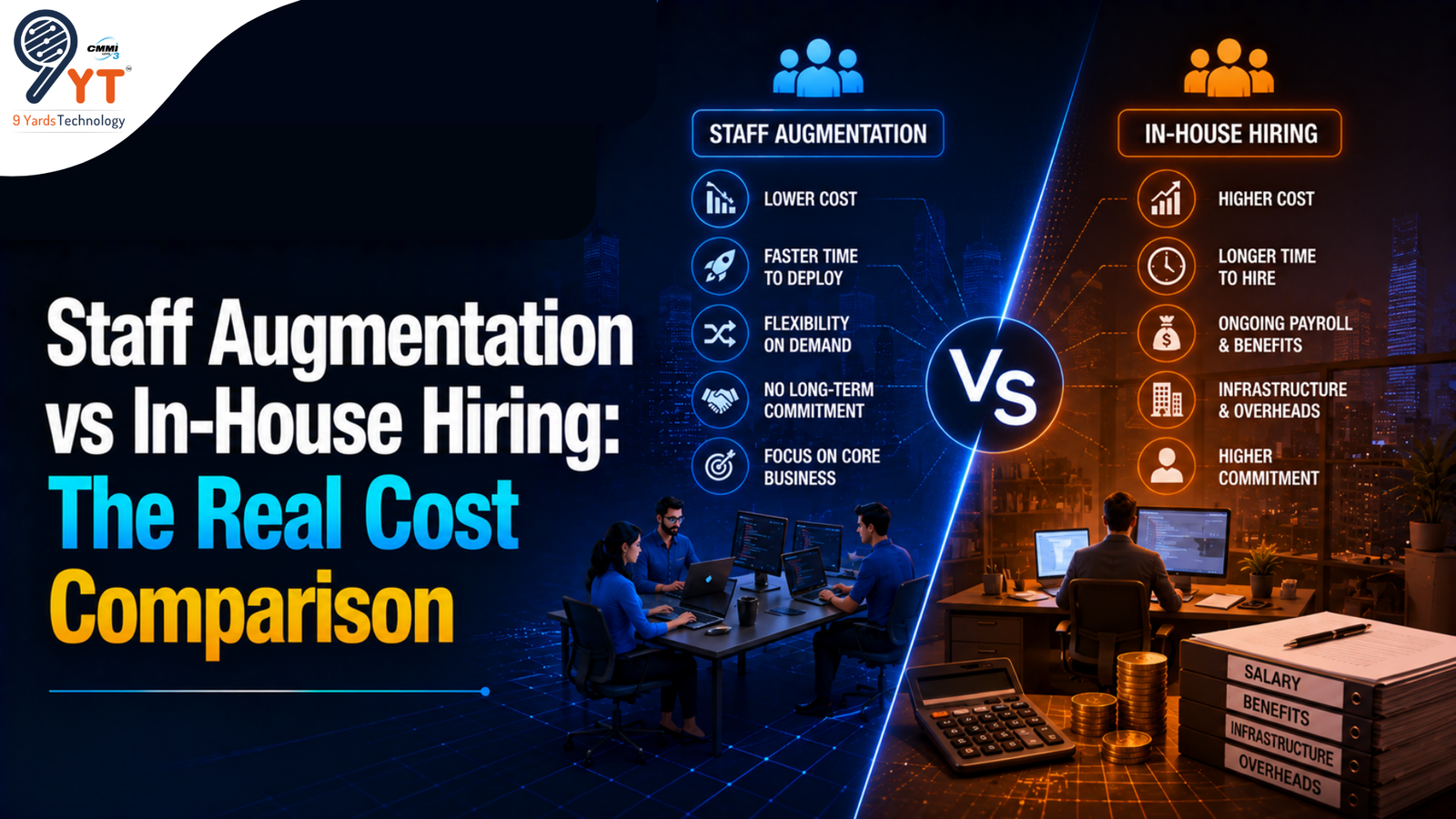
The cost comparison between staff augmentation vs in-house hiring looks simple until you price in the restart. A VP of Engineering who has burned three weeks on unqualified CVs from a generic agency knows the headline rate means nothing if the vetting fails. The real number is not the salary difference. It is the cost of a vacant senior engineering seat per day, multiplied by how long your hiring process actually runs.
For most US enterprise engineering teams, that clock runs 60-90 days before a seat is filled. For open requisitions stuck in approvals, it runs longer. The Bureau of Labor Statistics projects software developer employment to grow 15% through 2034, with roughly 129,200 new openings per year. Demand is not softening, and that vacancy clock is not getting shorter.
What Does Staff Augmentation Actually Mean?
Staff augmentation means a pre-vetted engineer, employed by the vendor, works directly within your team, using your tools, following your sprint cadence, and aligning with your technical direction. The legal employment relationship sits with the vendor. The day-to-day output belongs to your roadmap.
That distinction separates IT staff augmentation from outsourcing. Outsourcing hands a defined scope to an external team and delivers output at checkpoints, which causes you to lose visibility into code quality between milestones. Staff augmentation keeps the engineer inside your engineering organization, which is why it integrates rather than delegates.
The term also gets confused with body-shopping. A body-shop sells headcount. A genuine staff augmentation partner sells a vetting process, a delivery guarantee, and an audited methodology. If a vendor cannot tell you their client retention rate and cannot put a replacement SLA in writing, they are selling headcount with better branding.
Several engagement models exist within staff augmentation. Time and Material suits teams whose scope shifts sprint to sprint. Full-Time Employee deployment suits companies that want an engineer who functions exactly like an internal hire over the long term. Build-Operate-Transfer suits companies establishing an engineering hub in India from scratch who want eventual full internal ownership. Each model carries a different cost profile and commitment structure.
Read More: Product Engineering Staff Augmentation: How SHL Scaled 60 Engineers in 2 Months
The Hidden Costs of In-House Hiring That Never Appear in a Salary Table

Senior software engineers in the US earn a median of $132,270 per year according to BLS data, with senior roles in strong markets running $185,000 to $250,000 in base salary. Those figures are what most cost comparison articles use, but they are also the least useful numbers in the comparison.
The fully loaded cost at the senior end is closer to $230,000 once benefits, payroll taxes, equipment, and recruiting fees are added. A LinkedIn Talent Solutions report on hiring trends shows that engineering roles take significantly longer to fill than the cross-industry average, with senior roles taking well over 60 days.
Three costs almost no competitor article quantifies:
Vacancy cost. A fully loaded senior engineer at $230,000 annually represents approximately $880 of shipped work per day. A 90-day vacancy is $79,200 of engineering output that never shipped, before a single onboarding expense.
Mis-hire cost. The US Department of Labor puts the cost of a bad hire at 30% of first-year earnings. For a $180,000 engineer, that is $54,000 lost before the role is refilled. Most in-house hiring processes that produced the mis-hire then run the full 90-day cycle again.
Onboarding drag. New engineers in an unfamiliar codebase typically reach full delivery velocity over 4-8 weeks. Under in-house hiring, this period follows a 90-day acquisition cycle. Under staff augmentation with a pre-vetted bench, it follows a 14-21 day deployment cycle.
Flexible Engineering Teams: Where Staff Augmentation Wins Structurally
Building flexible engineering teams is not about having access to a marketplace of contractors. It is about having a vetted bench ready to map against a specific role the moment the requirement lands.
9Yards Technology’s Talent Deployment Matrix works in seven stages: requirement received, talent mapping, screening, technical assessment, client interview, deployment, and performance monitoring. The SLA commitments are specific: profiles in 48-72 hours, full deployment within 2-3 weeks, and a 7-day replacement guarantee if an engineer does not meet the client’s bar.
That 7-day replacement SLA is the most honest thing a staffing company can offer. It is a public bet on its own vetting process.
No competing vendor in this article’s research published an equivalent specific-day replacement commitment alongside a verifiable client retention rate. The two numbers belong together. A 7-day replacement SLA is only credible when paired with a 95% retention rate, because a high replacement rate would make the SLA commercially unsustainable. 9Yards Technology’s 95% retention rate, compared with an industry average of approximately 70%, is why the SLA is defensible, not just a marketing claim.
Flexible engineering teams built on pre-vetted talent also carry a different accounting treatment. Staff augmentation runs as operating expenditure. In-house hiring, especially at scale, behaves more like quasi-capital expenditure: recruiting fees are sunk costs, severance exposure accrues over time, and bench cost during slow periods is fixed regardless of output.
Read More: Staff Augmentation Engagement Models India: Choose Right
The Real Cost Comparison by Role: North America vs. India-Delivered Talent
The table below uses verified 9Yards Technology cost data for India-delivered senior talent against current US market benchmarks. Savings percentage is computed from the midpoints of each range, not estimated.
| Role | US Local Hiring (Annual) | 9YT India Deployment (Annual) | Annual Saving | Approx. Saving % |
|---|---|---|---|---|
| Senior Software Engineer | $160,000-$200,000 | $40,000-$55,000 | $105,000-$160,000 | ~71% |
| Senior DevOps / SRE Engineer | $170,000-$210,000 | $42,000-$58,000 | $112,000-$168,000 | ~72% |
| Senior Data Engineer | $165,000-$205,000 | $38,000-$52,000 | $113,000-$167,000 | ~72% |
| Senior AI/ML Engineer | $180,000-$220,000 | $45,000-$60,000 | $120,000-$175,000 | ~72% |
| Senior QA Automation | $120,000-$150,000 | $28,000-$40,000 | $80,000-$122,000 | ~71% |
| Senior Cloud Architect | $175,000-$215,000 | $48,000-$65,000 | $110,000-$167,000 | ~70% |
| Senior SAP Consultant | $155,000-$195,000 | $40,000-$55,000 | $100,000-$155,000 | ~71% |
For a 10-person senior engineering team, the annual savings across a typical role mix run from approximately $1,050,000 to $1,600,000. That figure does not include the vacancy cost recovered by cutting time-to-hire from roughly 90 days to 14- 21 days.
Note: These are annual cost figures. Hourly billing rates depend on utilization and margin assumptions that vary by engagement model, and are not comparable to these annual figures without a confirmed basis.
Why Vetting Quality Is the Number That Changes Everything
Every article on staff augmentation vs in-house hiring reaches the same conclusion: staff augmentation is cheaper and faster. Almost none of them ask the follow-up question that determines whether that conclusion holds: Cheaper and faster than what? Than a successful in-house hire, or than the full cycle including the failed hire that preceded it?
Speed without quality is the staffing industry’s biggest unspoken lie.
If a vendor sends three rounds of unqualified profiles before placing an engineer who leaves in month four, the total cost of that engagement, including the 90-day restart, may exceed the cost of a direct in-house hire made carefully the first time. The cost advantage of staff augmentation is structurally dependent on the vetting process.
This is why retention rate is the real proof of quality. A Stack Overflow Developer Survey shows that the majority of developers are open to new opportunities, meaning the competition for engineering talent is not only at the point of hiring but throughout the engagement. Testimonials can be cherry-picked. A 95% client retention rate across 300+ engineer deployments is not possible.
9YT Proof Point: Talkdesk needed to establish an India engineering hub fast. 9Yards Technology deployed 45+ pre-vetted engineers across Engineering, QA, Security, ERP, and Business Analysis functions. The hub was operational in 3 months. Hiring speed was 80% faster than Talkdesk’s previous process. Talent costs were reduced by 50%. The team is still active and expanding. That outcome is not a testimonial. It is a documented, named engagement with verified numbers.
When In-House Hiring Is Still the Right Answer
In-house hiring makes structural sense in three specific situations.
First: when the role requires deep institutional knowledge that cannot be transferred during a standard onboarding cycle. A Chief Architect who will own a 10-year infrastructure roadmap is a different hire from a senior engineer executing against a defined sprint.
Second, when the engagement involves IP so sensitive that even 100% NDA adherence and enterprise-grade compliance governance do not satisfy the client’s legal framework. This is rare in engineering execution roles but common in some regulated industries.
Third, when the company’s engineering leadership has enough time to run a careful, full-cycle in-house search without a vacancy cost problem. Series A companies that need two engineers and have a three-month runway to hire them carefully are not buyers of staff augmentation.
Series B and beyond companies with 60-180 days of unfilled senior engineering requisitions are. That situation describes most buyers contacting 9Yards Technology. At that stage, the vacancy cost alone, $880 per seat per day, makes a 69-day improvement in time-to-hire worth quantifying before the first conversation about bill rate.
For those teams, the Deloitte Insights research on talent strategy shows that speed to productivity, not base rate, is the dominant factor in engineering team ROI at scale.
The cost comparison between staff augmentation and in-house hiring becomes clear once vacancy cost, mis-hire cost, and vetting quality are factored in. The salary difference is real but secondary. The 69 days recovered per hire, at documented India senior engineer cost levels 71-72% below US equivalents, is what moves the CFO conversation. The 7-day replacement SLA and 95% retention rate are what make the math hold over time, not just on the first deployment.
Need pre-vetted engineers in 48-72 hours? Talk to a 9YT specialist with no obligation and no generic shortlist.
Frequently Asked Questions
What does staff augmentation mean compared to in-house hiring?
Staff augmentation means a pre-vetted engineer, employed by the vendor, works directly inside your team using your tools, processes, and sprint cadence. Unlike in-house hiring, you skip the 60-90 day recruitment cycle. Unlike outsourcing, you retain full technical direction. The vendor manages employment, compliance, and HR. You manage the engineering output. The team extension model gives you the control of an internal hire with the speed and cost profile of offshore delivery.
How much cheaper is staff augmentation than in-house hiring for engineering roles?
For senior engineering roles, India-delivered staff augmentation through 9Yards Technology runs approximately 71-72% below US local market equivalents. A Senior Software Engineer hired locally costs $160,000-$200,000 annually, fully loaded; the equivalent 9YT India deployment runs $40,000-$55,000. For a 10-person senior team, the annual savings range from $1,050,000 to $1,600,000 depending on role mix. These are annual cost figures computed from verified benchmarks, not estimated ranges.
What are the risks of using a team extension model instead of hiring in-house?
The main risk is vetting quality. If the vendor’s pre-screening is weak, you absorb the cost of a failed deployment and then restart the clock, eliminating the speed advantage that makes staff augmentation attractive in the first place. The mitigation is a vendor with a published replacement SLA and a verifiable retention rate. 9Yards Technology’s 7-day replacement SLA and 95% client retention rate exist specifically to make this risk quantifiable before the engagement starts.
How do flexible engineering teams scale faster than traditional in-house teams?
Flexible engineering teams built on a pre-vetted bench skip the sourcing, screening, and interview scheduling that account for most of the 90-day industry-average time-to-hire. 9Yards Technology delivers profiles in 48-72 hours and completes full deployment within 2-3 weeks. The 69-day difference between that timeline and the 90-day US hiring average represents approximately $60,720 in recovered engineering output per senior seat, based on a fully loaded daily cost of $880.