

 Post by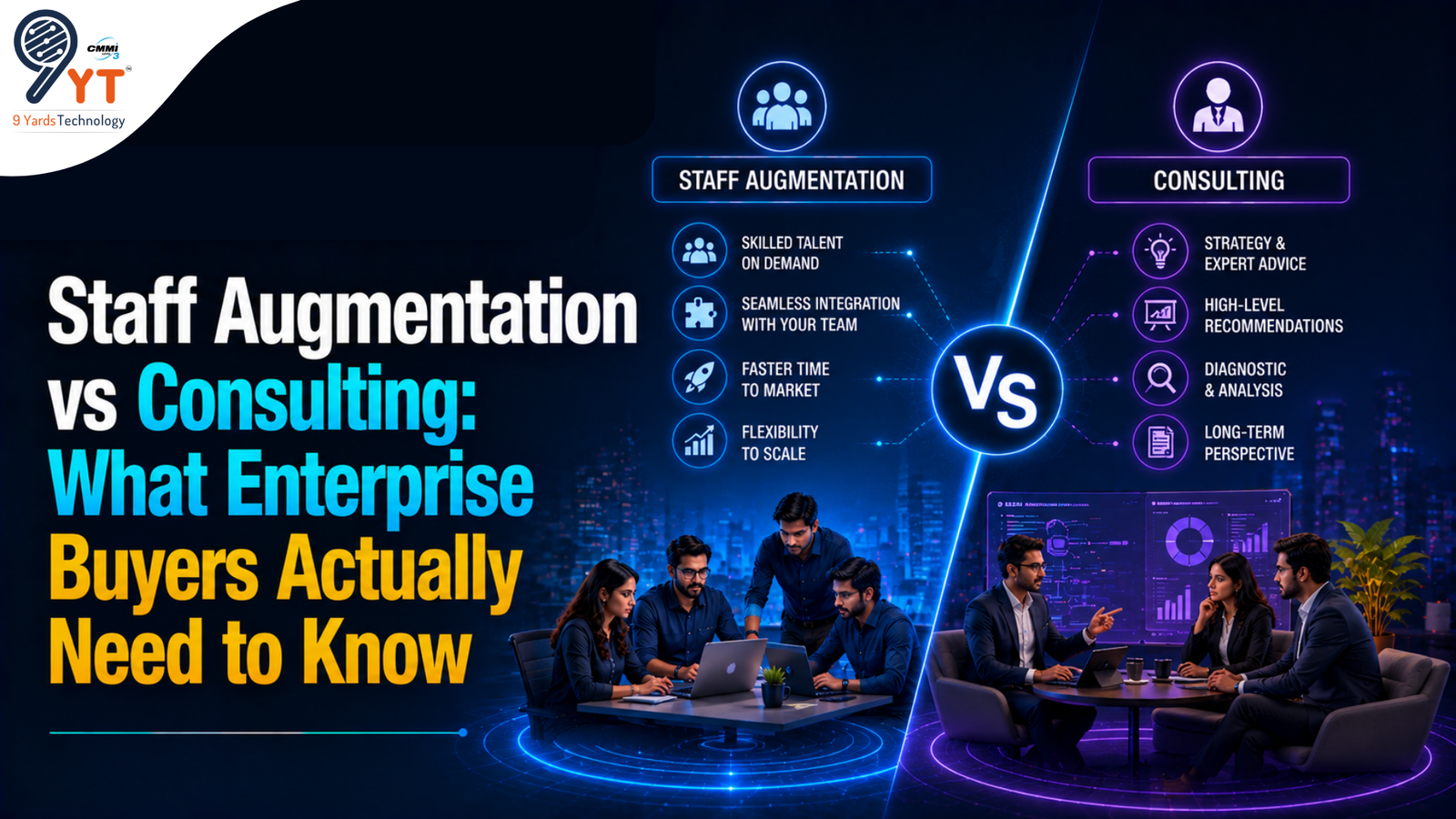
Every article on staff augmentation vs consulting answers the same question: which model fits your situation? That is the wrong place to start. The more expensive mistake enterprise buyers make is choosing the right model and then selecting a vendor who cannot enforce their own promises. A staff augmentation partner who sends unqualified CVs for three weeks and replaces no one costs more than a consultant who delivers a clear recommendation and leaves.
If your engineering requisitions have been open for 60–180 days, the model debate is probably settled. What is not settled is whether the partner you are evaluating can actually close those roles, with pre-vetted engineers, on a documented timeline, and with an accountability mechanism if it goes wrong.
What Staff Augmentation Actually Means (and What It Does Not)
Staff augmentation, meaning, stripped of vendor marketing, is this: a third party sources, screens, and supplies an engineer who then works under your management, inside your processes, on your roadmap. You direct the work. The vendor is accountable for the quality of the person, not the outcome of the project.
That last distinction is where most enterprise buyers get confused. Staff augmentation does not transfer delivery risk. It transfers hiring risk. The vendor bets that their vetting process will produce an engineer who performs. If they do not put that bet in writing, with a specific replacement SLA, they do not believe in their own vetting process.
At 9Yards Technology, that bet is documented at seven days. Any underperforming engineer is replaced within seven days of escalation. No renegotiation, no additional cost. That SLA exists because 9Yards Technology carries a pre-vetted bench, not because we improvise a new search after a problem surfaces.
Staff augmentation is not outsourcing. The client retains full engineering direction. It is not a body shop. A body shop sells headcount; a genuine IT staff augmentation partner sells a vetting process and the governance infrastructure to back it.
What Consulting Is, and When It Actually Fits
Consulting is the purchase of judgment. A consulting engagement is appropriate when the buyer cannot yet specify what needs to be built, or when the problem spans organisational units and requires external authority to drive alignment. A consulting firm analyses, recommends, and, in managed-services variants, executes against a defined outcome. They own the method. You own the approval.
The fee structure reflects that ownership transfer. The Deloitte 2024 Global Human Capital Trends report identifies this directly: organisations are restructuring how they source and deploy talent to separate execution capacity from strategic judgment. Consulting engagements price the judgment. Staff augmentation prices the capacity. The two bills look different because they are buying different things.
Consulting fits when the problem is ambiguous. It does not fit when the problem is clear and the bottleneck is capacity. Hiring a consulting firm to tell a CTO that they need more engineers is an expensive way to confirm what they already know. If the architecture decision is made, the technology stack is locked, and the sprint board has 90 open tickets, that is a staff augmentation situation.
The signal is simple: if you can write a job description, you need staff augmentation. If you cannot, you may need a consultant first.
The Criterion Every Comparison Article Ignores: Vendor Enforcement

Competitor articles on this topic stop at model selection. None of them address what enterprise buyers should demand once they have selected staff augmentation as the right model: proof that the vendor can actually enforce their own quality claims.
Three enforcement criteria matter.
First: a documented replacement SLA. If a vendor will not commit to a specific number of days to replace an underperforming engineer, they are pricing in the possibility that they will not replace them at all. A “flexible replacement policy” is not an SLA. Seven days is an SLA.
Second: a verifiable retention rate. Testimonials are cherry-picked. A 95% client retention rate across a live portfolio of 300+ deployed engineers cannot be. Gartner’s research on vendor performance management consistently identifies retention as the leading lagging indicator of vendor quality, not client satisfaction scores, which measure the honeymoon period.
Third: a named process, not a vague promise. Ask the vendor to walk you through their Talent Deployment Matrix step by step. Requirement received, talent mapping against a pre-vetted bench, screening, technical assessment, client interview, deployment, performance monitoring. If they cannot name each stage, they do not have a process. They have a workflow they improvise per engagement.
Speed without a documented process is the staffing industry’s most common unspoken failure. A vendor who sends profiles in 24 hours without a structured technical assessment is shifting risk onto the client, not removing it.
How the Decision Actually Breaks Down by Company Stage
Model choice is not purely about problem type. It also tracks company stage, which most comparison articles skip entirely.
At pre-seed and seed, staff augmentation dominates because burn rate discipline and scope volatility make a consulting engagement hard to justify. Whereas at Series A, the pattern shifts: augmentation for execution capacity, with a specialist consultant occasionally brought in to validate architecture decisions before they scale. At Series B and beyond, the right answer is usually a dedicated team model, staff augmentation that has matured into a structured, long-running offshore engineering hub.
The Talkdesk engagement is a direct illustration of this progression. Talkdesk needed to establish an Indian engineering hub quickly as a scaling US SaaS company. 9Yards Technology deployed 45+ engineers across Engineering, QA, Security, ERP, and Business Analysis functions, with the India hub fully operational in three months. Hiring was 80% faster than their previous process. Talent costs dropped 50% through offshore delivery. That engagement was not a consulting buy. The strategy was clear. The gap was execution capacity, and the delivery model was built around a documented process, not an improvised search.
A LinkedIn Talent Trends report notes that engineering roles now average significantly longer time-to-fill than other professional roles globally, which pushes more Series B+ companies toward pre-vetted augmentation over traditional hiring or consulting for execution capacity.
Read More: Staff Augmentation vs In-House Hiring: Real Cost Comparison
Comparison: Staff Augmentation vs Consulting, The Criteria That Matter
| Evaluation Criterion | Staff Augmentation | IT Consulting |
|---|---|---|
| Who directs the work? | Client’s internal management | Consulting firm (or jointly) |
| What you’re buying | Engineering capacity + vetting | Strategy, method, or managed outcome |
| Typical time-to-start | 2–3 weeks (9YT) vs. 60–90 days (traditional hiring) | 4–12 weeks for scoping and SOW |
| Contract-based hiring flexibility | High, add or release engineers per sprint | Low, SOW changes require amendment cycles |
| IP and process ownership | Remains entirely with the client | Shared or vendor-defined during engagement |
| Accountability mechanism | Replacement SLA (7 days at 9YT) | Deliverable-based milestones |
| Cost structure | Per-engineer, ongoing | Project fee or retainer, higher per-hour rate |
| Right signal to buy | You can write a JD; the bottleneck is capacity | You cannot yet specify the problem or solution |
| Quality verification pre-purchase | Retention rate + replacement SLA | Past case studies + references |
The Proof Point: When the Model Is Right, and the Vendor Can Execute
SHL needed 60+ engineers across Product Engineering, QA, Performance Engineering, and Business Analysis. Their internal hiring process was running for months per role. 9Yards Technology deployed all 60+ engineers within two months using a BOT model, delivering 70% faster resource deployment, a 60% improvement in hiring efficiency, and a 20% reduction in talent acquisition costs. The partnership is now 5+ years active. That outcome is not a consulting buy. The problem was defined. The bottleneck was capacity and vetting speed. The difference between a result like that and a six-week CV-forwarding exercise is the vendor’s process, not the model category.
Read More: Offshore Staff Augmentation Cost Savings: The Real Math
The Decision in Plain Terms
Staff augmentation vs consulting is a real distinction, but enterprise buyers who stop there are answering the easier half of the question. The harder half is: which vendor can actually enforce their own commitments once the model is chosen? A documented seven-day replacement SLA and a 95% client retention rate across 300+ deployed engineers are not marketing claims; instead, they are enforceable facts that reflect the confidence of a vendor who bets on their own vetting process.
Choose consulting when the problem is ambiguous and you need external judgment to define it. Choose staff augmentation when the problem is clear and the gap is capacity. Then hold your augmentation partner to a specific, written SLA, or keep looking.
Need pre-vetted engineers in 48–72 hours? Talk to a 9Yards Technology specialist with no obligation and no generic shortlist.
Frequently Asked Questions
What is the core difference between staff augmentation and consulting?
Staff augmentation embeds external engineers directly into your team under your management. You direct the work; the vendor is accountable for engineering quality. Consulting delivers strategy or outcomes managed externally, where the consulting firm owns the method. The simplest test: if you can write a job description for the role, you need staff augmentation. If you cannot yet define the problem, you may need a consultant first.
What does staff augmentation meaning look like in practice for an enterprise team?
In practice, staff augmentation means this: a vendor sources, screens, and deploys a pre-vetted engineer who joins your sprint cycles, uses your tools, reports to your engineering leads, and works on your roadmap. They are functionally indistinguishable from an internal hire. The vendor remains responsible for quality, which is why a documented replacement SLA, like a 7-day guarantee, is the single most important thing to verify before signing.
Is contract-based hiring through staff augmentation less risky than a consulting engagement?
Contract-based hiring through staff augmentation carries different risks, not necessarily fewer. Consulting transfers outcome risk to the vendor; staff augmentation keeps delivery ownership with the client but transfers hiring risk. The key variable is the vendor’s quality enforcement. A staff augmentation partner with a 7-day replacement SLA and a 95% retention rate has priced their own vetting confidence into the contract. One without these benchmarks has transferred risk back to you.
When should an enterprise choose consulting over staff augmentation?
Choose consulting when the problem is ambiguous: when you cannot specify what needs to be built, when the challenge spans departments and requires external authority to drive alignment, or when you need architectural or strategic validation before committing engineering resources. Once the strategy is defined and the roadmap is clear, the need typically shifts to staff augmentation, execution capacity delivered through pre-vetted engineers under your management.