

 Post by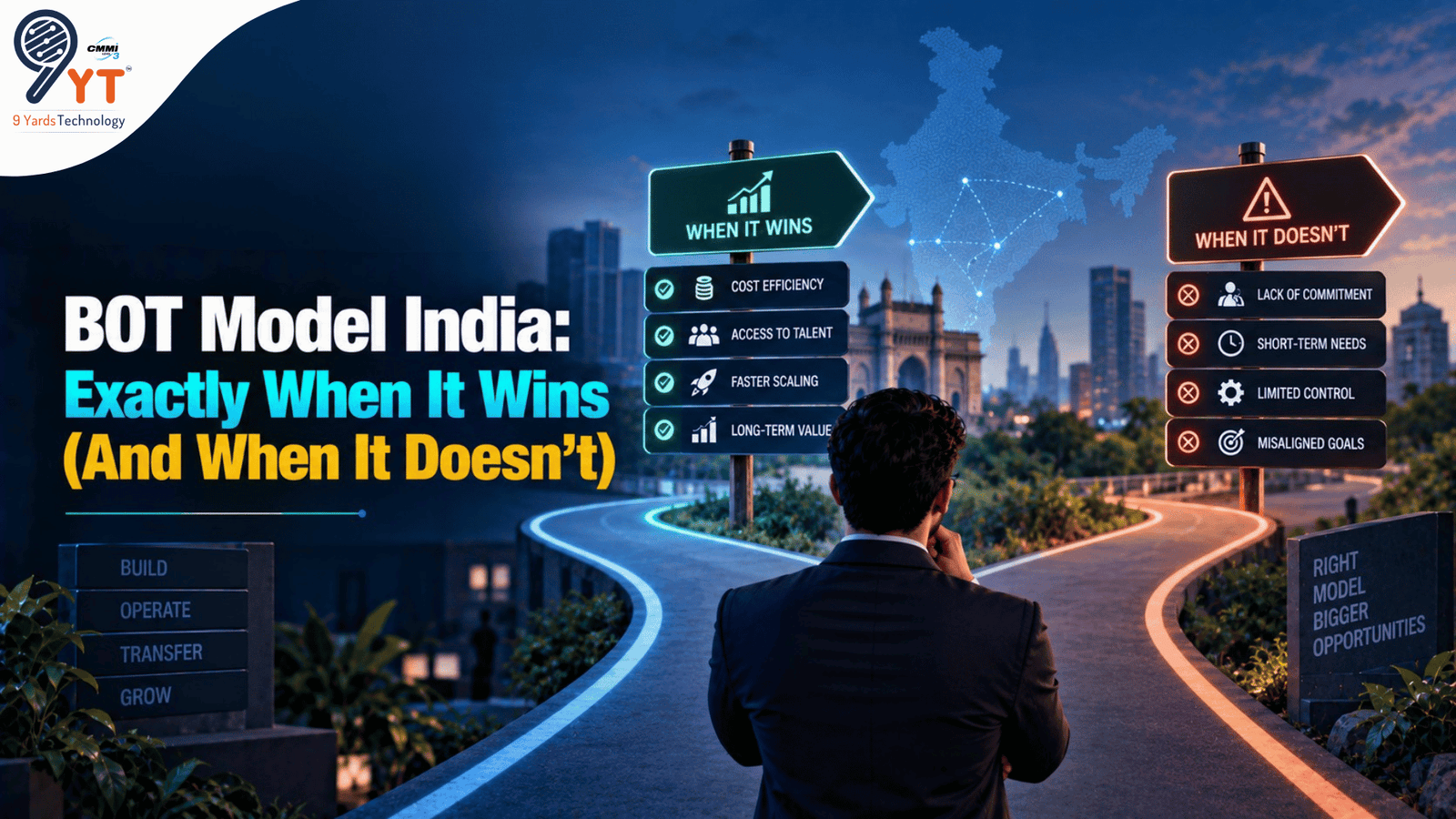
The BOT model India discussion fills dozens of pages online, yet almost none of them answer what a CTO actually asks: does this work faster than standing up my own entity, and what happens to quality during the Operate phase? Talkdesk found the answer in 3 months: 45+ pre-vetted engineers deployed across Engineering, QA, Security, ERP, and Business Analysis, an India hub live, and 80% faster hiring than their previous approach. That outcome did not happen by accident; it happened because the partner running the Operate phase had an active, pre-vetted bench, not a recruitment pipeline starting from zero the day you sign.
If your engineering team has open requisitions unfilled for 60 days or more, and your 3-year plan includes owning an India engineering function outright, the BOT model deserves serious evaluation. The real question is not whether it works. It is whether the conditions at your company right now make it the right fit versus IT staff augmentation or a straight FTE deployment.
What the BOT Model Actually Means (and What It Does Not)
Build-Operate-Transfer is a three-phase engagement where a partner builds your India engineering team under their own legal entity and infrastructure, manages HR, compliance, payroll, and delivery governance, and then transfers ownership to your India entity at a pre-agreed milestone, typically after 12 months.
Two points most explanations miss. First, “transfer” is optional in most well-structured engagements. Some clients run the Operate phase for 3-5 years and never transfer because the economics of continuing with a partner outweigh the overhead of running their own India entity. Second, the Build phase is not just recruitment; it includes statutory compliance setup, EPF and ESIC registration, data governance controls, and IT infrastructure. A partner who cannot handle all of these from day one creates a compliance liability that surfaces 6-12 months later.
The BOT model is not outsourcing. In outsourcing, the vendor owns the outcome and the team. In BOT, you direct the engineering work from day one while the vendor owns the operational wrapper until you choose to absorb it.
A clean 12-month transfer option, built into the contract before work begins, is the most honest differentiator a BOT partner can offer. Vague “seamless transition support” language signals that the transfer mechanics have not been thought through.
Which Staff Augmentation Models India Buyers Actually Choose (and Why)
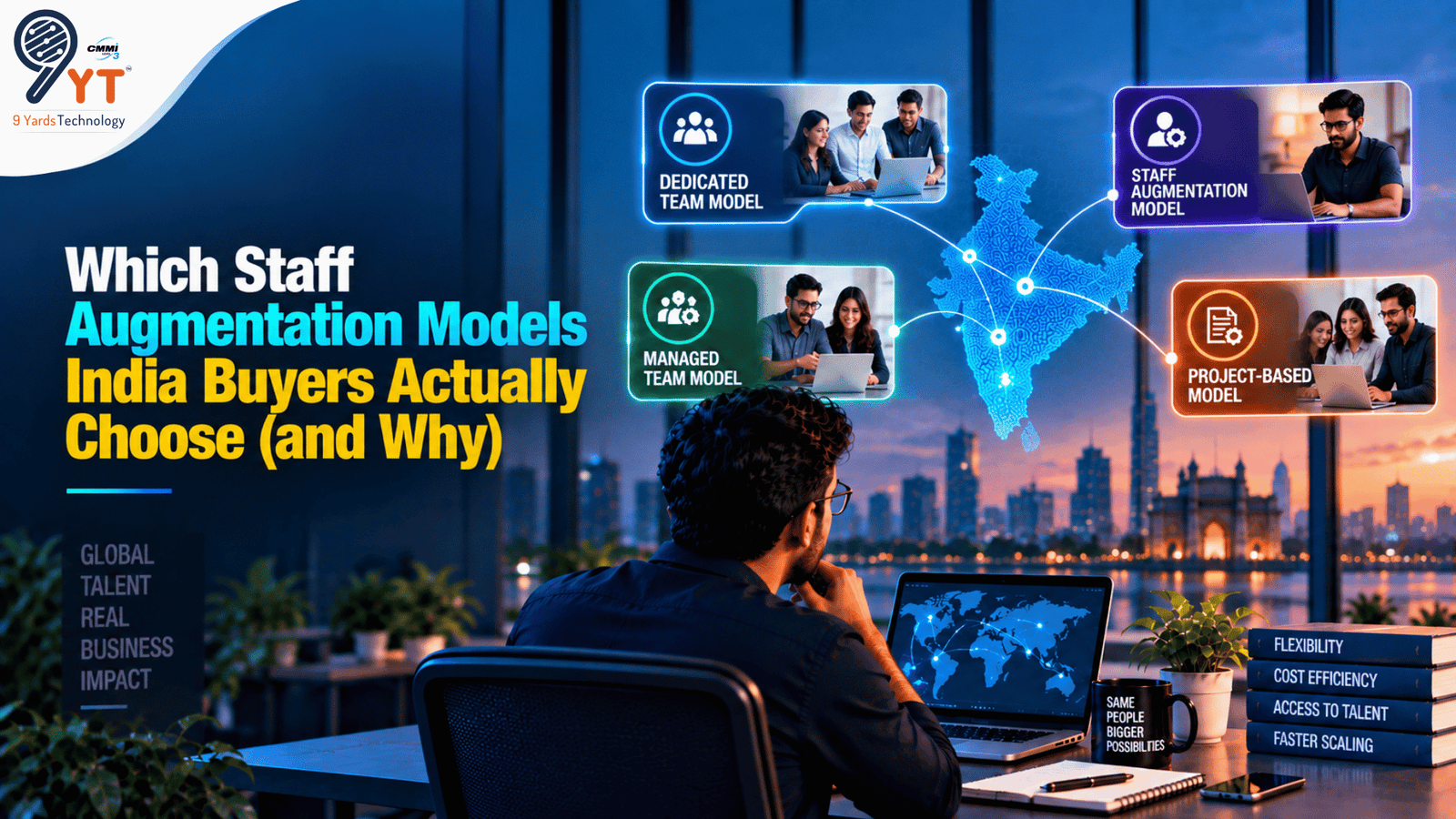
Three staffing models emerge when India-based buyers and North American companies compare options for scaling engineering teams quickly:
Staff Augmentation (T&M or FTE): An engineer deploys into your existing team, working under your processes and direction. No entity setup. No phased ownership. Fastest time-to-start. Right for teams that need 1-10 engineers quickly and do not have an India expansion mandate.
BOT Model: A partner builds and runs a dedicated team under their entity, with a transfer path to yours. Right for companies planning 20+ engineers and a 2-5-year India horizon. According to NASSCOM’s research on India’s GCC ecosystem, India now hosts over 1,700 Global Capability Centers, and BOT is the dominant entry model for new entrants.
Direct Subsidiary Setup: You register your own Indian entity, hire directly, and own operations from day one. This gives full control but carries a full compliance burden and a 6-12-month runway before your first engineer starts. Right for companies with dedicated India HR and legal resources.
The choice is not about which model is best. It is about what fits your team size, timeline, and 3-year plan. A 5-engineer team does not need BOT infrastructure, but a 60-engineer roadmap probably does.
Quality drift is the variable most buyers underweight when choosing between models. In a pure staff augmentation engagement running beyond 12-18 months, engineer turnover introduces institutional knowledge loss. BOT, when structured well, counters this by embedding knowledge transfer and retention incentives directly into Operate phase governance.
The 3 Conditions That Make BOT Model India the Right Call
Skip the generic lists. Here are the three conditions that, when all three are present, make the BOT model the correct choice:
Condition 1: Your team size target is 20 or more engineers. Below that, the setup overhead of a BOT engagement (entity work, compliance infrastructure, governance frameworks) costs more in time and partner fees than straight staff augmentation. The economics shift at scale. Engineering team growth at Series B+ companies consistently outpaces internal hiring capacity within 18 months of a product-market fit signal, which is exactly the inflection point where BOT makes financial sense over straight staff augmentation.
Condition 2: You want team ownership within 3-5 years. If your plan is to run offshore delivery indefinitely through a vendor, staff augmentation or managed services is a cheaper path. BOT’s cost advantage emerges at transfer. Before transfer, you pay a partner margin. That margin buys you speed, compliance, and operational certainty, not a permanent discount.
Condition 3: You cannot absorb 6-12 months of entity setup time. A direct India subsidiary is the right long-term answer for many large enterprises, but registering a Pvt. Ltd., standing up payroll, and navigating local employment law from a North American base takes time most engineering roadmaps cannot wait for. BOT lets your engineers start delivering within 2-3 weeks while the ownership question resolves itself over the following 12 months.
For context, traditional local hiring for a senior engineering role averages approximately 90 days. A direct India entity adds 6-12 months on top of that before the first engineer starts. BOT with 9Yards Technology delivers the first profiles in 48-72 hours and a full operating team in 2-3 months, no entity setup required.
When all three conditions are met, the BOT model for India is not just a reasonable choice. It is the correct one.
How 9Yards Technology Runs the Operate Phase (The Part That Actually Determines Outcome)
Every BOT explanation focuses on the Build phase, but the Operate phase is where engagements succeed or fail. Almost no competitor documentation addresses it with specificity.
At 9Yards Technology, the Operate phase runs on the Talent Deployment Matrix: a structured 7-step process that starts with requirement mapping against the pre-vetted bench, moves through technical assessment and client interview, and ends with active performance monitoring after deployment. That monitoring is not a quarterly check-in; it is continuous tracking against delivery quality indicators, with a 7-day replacement SLA backstopping the process.
The 7-day replacement SLA is a public bet on bench depth. An agency that cannot guarantee replacement in 7 days does not have a pre-vetted bench. They have a recruitment pipeline. Those are two different things, and the difference shows up when a key engineer leaves mid-Operate phase.
For Talkdesk, 9Yards Technology built an Indian engineering hub in 3 months, deploying 45+ engineers across Engineering, QA, Security, ERP, and Business Analysis. Talent costs dropped 50% through offshore delivery. Hiring speed improved by 80% compared to their prior process. That hub is still active and expanding without drift in the Operate phase.
Engineering teams that deploy through 9Yards Technology’s pre-vetted bench typically reach full productivity within 4-8 weeks. Teams assembled through open-market hiring without structured vetting typically take 12 weeks or longer; the difference is that pre-vetted engineers have already passed the technical assessment before day one, not after it.
BOT Model vs. Staff Augmentation: Choosing the Right Model for Your Stage
| Evaluation Criterion | BOT Model | Staff Augmentation (T&M / FTE) |
|---|---|---|
| Ideal team size | 20+ engineers | 1-20 engineers |
| Time to first engineer | 2-3 weeks (Operate phase start) | 48-72 hours (profiles), 2-3 weeks (deployed) |
| Ownership path | Client owns the team after 12+ months | Engineers remain on vendor rolls indefinitely |
| Entity setup required (client side) | Not at the start, required at transfer | Never required |
| Compliance and HR burden | Carried by the partner throughout the Operate phase | Carried by partner throughout engagement |
| Best for | Companies with a 2-5 year India mandate | Companies needing fast, flexible scale now |
| Replacement SLA (9YT) | 7 days | 7 days |
| Cost structure | Vendor margin during Operate, reduced post-transfer | Vendor margin throughout the engagement |
| Quality governance | Embedded in the Operate phase, SLA and monitoring | Continuous performance tracking |
The table above reflects a direct comparison for an enterprise evaluating both models at the same time. Neither is universally correct. Both are correct under the right conditions.
9YT Proof Point: Talkdesk needed a fully operational India engineering hub, fast, without a local India entity. 9Yards Technology deployed 45+ pre-vetted engineers across Engineering, QA, Security, ERP, and Business Analysis in 3 months, cutting hiring speed by 80% and talent costs by 50%. The engagement is still active. That outcome required a pre-vetted bench, structured governance, and an Operate phase with a real replacement SLA, not a promise. For a longer-horizon BOT deployment, SHL scaled across Product Engineering, QA, Performance Engineering, and Business Analysis, with 60+ engineers deployed in 2 months, 70% faster resource deployment, a 60% improvement in hiring efficiency, and a 20% reduction in talent acquisition costs. The partnership is now 5+ years active under the same BOT structure. That duration is the proof that the Operate phase holds quality over time, not just at launch.
What to Verify Before Signing a BOT Contract
Most buyers evaluate BOT partners on brand recognition and pricing. Three questions actually separate good BOT partners from expensive ones:
1. What is your bench depth right now for my required roles? A partner should share pre-vetted profiles within 48-72 hours of a requirement. If they need to “start the search,” they do not have a bench. They have a job board.
2. What is your written replacement SLA, and what does it cover? A 7-day replacement SLA is verifiable. “We’ll find a replacement quickly” is not. Procurement teams at enterprise clients increasingly treat a written replacement SLA as a minimum requirement, not a differentiator. It should be in the contract, not in a slide deck.
3. What are the exact transfer mechanics after 12 months? Who owns IP during the Operate phase? What triggers the transfer clock? What happens to engineers’ employment contracts at transfer? These are not administrative questions; they determine whether the BOT engagement actually ends in ownership or in a perpetual Operate phase with escalating partner fees.
A partner who cannot answer all three with specifics, not marketing language, is not ready to run a BOT engagement at enterprise scale. Deloitte’s analysis of offshore operating models consistently flags governance clarity at the contract stage as the primary predictor of BOT transfer success.
9Yards Technology’s BOT engagements include a written 12-month transfer option, a 7-day replacement SLA, and 100% NDA adherence across every deployed engineer. Those are not claims. They are contract terms.
Conclusion
The BOT model in India conversation usually starts and ends with cost savings and a three-phase diagram. The real decision is more specific: do your team size, timeline, and India ownership plan create the three conditions where BOT wins over pure staff augmentation or a direct subsidiary? When those conditions align, BOT delivers speed without cold-start risk and a clear path to full ownership. When they do not, a faster, lighter model will serve the engineering roadmap better.
The Operate phase is where the outcome is determined. Pre-vetted bench depth, a written replacement SLA, and contract-level transfer mechanics are not negotiable details. They are the whole point.
Need pre-vetted engineers in 48-72 hours? Talk to a 9YT specialist with no obligation and no generic shortlist.
Frequently Asked Questions
What is the BOT model in India for IT companies?
The BOT model in India is a three-phase engagement where a partner builds your India engineering team under their own entity, operates it with full HR and compliance governance, and transfers ownership to your entity at a pre-agreed milestone, typically after 12 months. It is the dominant entry model for companies establishing Global Capability Centers in India without absorbing the 6-12-month cold-start risk of a direct subsidiary setup. Pre-vetted bench depth during the Operate phase determines whether the model delivers or drifts.
How do staff augmentation models in India compare to the BOT model?
Staff augmentation models in India are best for teams needing 1-20 engineers quickly, with no entity setup required and a 48-72-hour profile turnaround. The BOT model is best for companies targeting 20+ engineers with a 2-5-year India ownership horizon. Both models can run with a 7-day replacement SLA from a quality partner. The key difference is ownership: staff augmentation keeps engineers on the partner’s rolls indefinitely; BOT transfers the team to the client’s entity after the Operate phase.
How long does a BOT model engagement take from start to transfer?
A structured BOT model engagement typically runs 12-36 months from first engineer deployment to team transfer, depending on team size and client entity readiness. The Build phase, including compliance setup and initial hiring, takes 2-6 months. The Operate phase runs until the client’s India entity is ready to absorb the team. 9Yards Technology’s BOT engagements include a written 12-month transfer option, so the clock and the terms are defined at the contract stage, not negotiated later.
What does FTE deployment mean in the context of BOT model staffing?
FTE deployment in a BOT engagement means engineers are deployed as full-time employees of the partner entity during the Operate phase, working exclusively on the client’s product and roadmap under the client’s direction. At transfer, those FTE contracts move to the client’s own India entity. This is distinct from contractor or marketplace models, where engineers may work across multiple clients simultaneously. FTE deployment during BOT protects institutional knowledge, IP continuity, and team stability across the full engagement lifecycle.