

 Post by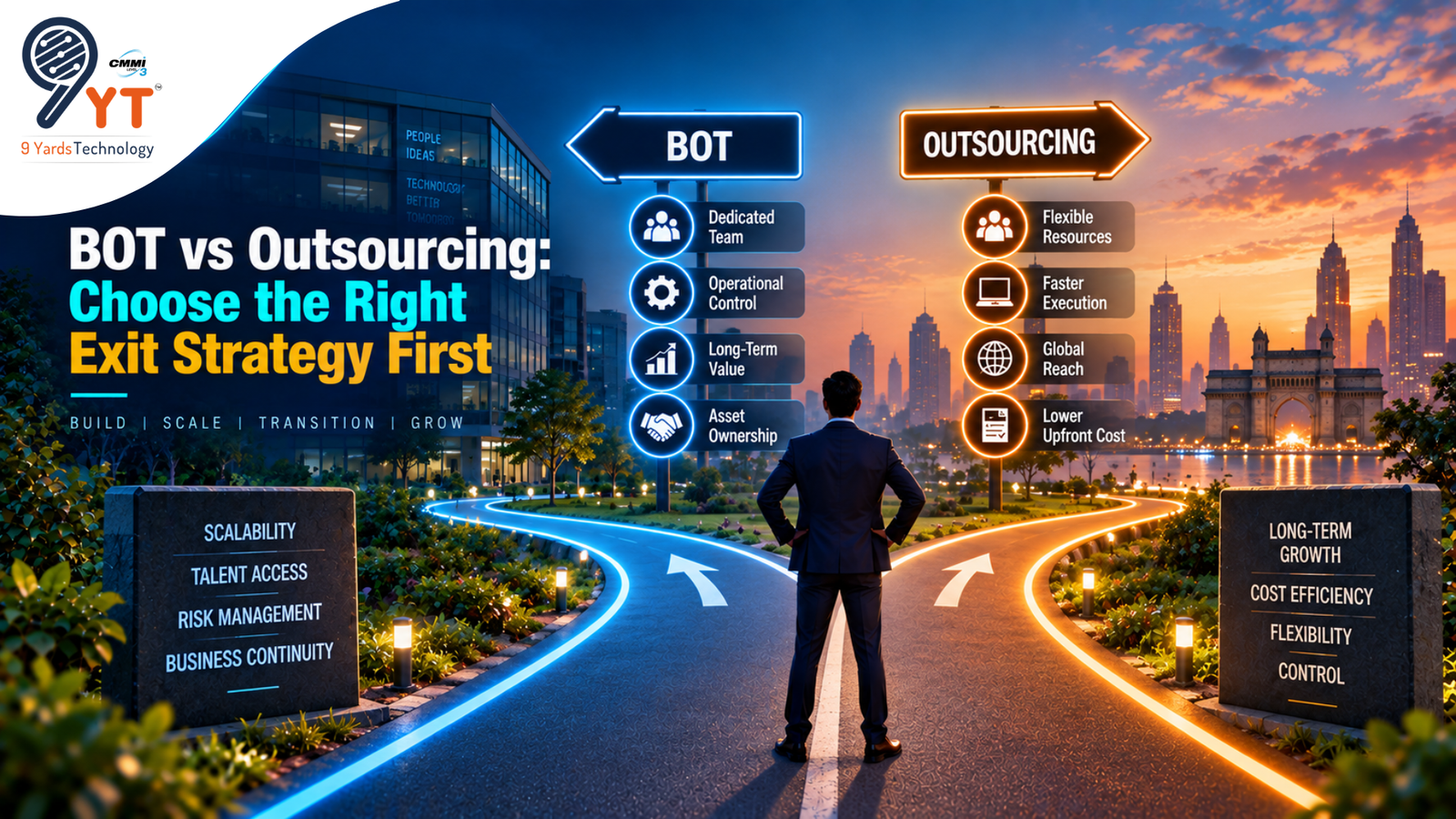
The BOT vs outsourcing debate trips up most CTOs because they frame it as a cost question. It is not. It is an exit-strategy question. The model you choose on Day 1 defines what you own, what you owe, and what your options are 18 months from now. Getting that decision backwards costs more than the fee difference between the two models ever would.
Most engineering leaders choosing between these two approaches are facing a specific situation: open requisitions that have been unfilled for 60 to 180 days, a product roadmap that is already slipping, and a board asking why internal hiring is taking so long. Both BOT and traditional IT staff augmentation can solve that problem. But they solve it differently, and the wrong choice creates a new problem the day the engagement matures.
What BOT and Outsourcing Actually Mean in Practice
The Build-Operate-Transfer model is a three-phase engagement. In the Build phase, the vendor recruits and onboards engineers, establishes infrastructure, handles HR compliance, and gets the team operating. In the Operate phase, the team runs under the vendor’s legal and operational umbrella while delivering fully to the client’s direction. In the Transfer phase, the client absorbs the team onto their own payroll and legal entity, typically after 12 months.
Traditional outsourcing hands off a function or a project to a vendor who manages it on their own infrastructure, under their own processes. The client buys output, not people.
IT staff augmentation sits differently from both. Pre-vetted engineers integrate directly into the client’s team and processes, working as a genuine extension of the client’s engineering organisation. The vendor remains the employer of record, but the client directs the work. There is no fixed transfer date. There is no infrastructure to absorb. The engagement scales up or down without a contractual ownership transition.
The critical distinction: BOT optimises for ownership. Outsourcing optimises for output. Staff augmentation optimises for integration.
All three can coexist within the same company at different maturity stages. Choosing one is not a permanent philosophical commitment. It is a question of what your organisation is operationally ready to absorb right now.
The IT Staffing Models Comparison Most Articles Skip
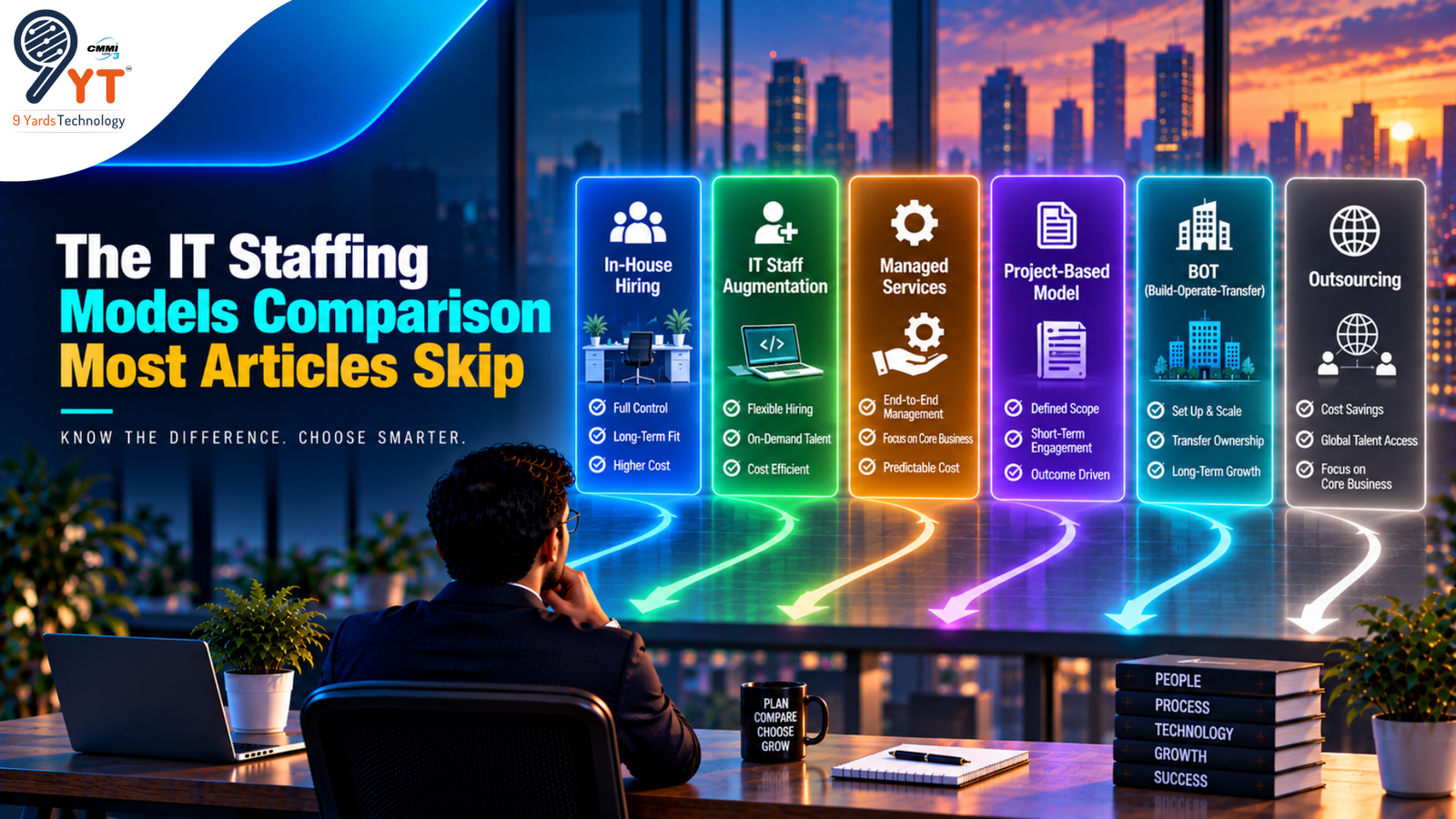
Every IT staffing models comparison article lists the same criteria: cost, control, speed, flexibility. None of them ask the one question that actually separates the right model from the wrong one: what happens if the plan changes in month 10?
With traditional outsourcing, the answer is simple. You exit the contract, negotiate a wind-down, and find a new vendor. The vendor owns the team. You own the output. Nothing to absorb.
With BOT, month 10 is where it gets complicated. The Deloitte 2024 Global Outsourcing Survey found that 70% of organisations had brought previously outsourced work back in-house during the previous five years, citing the need for better control and strategic capability ownership. BOT is specifically designed to enable that move. But it only delivers on that promise if the vendor built the team for transfer from Day 1, not retrofitted the idea onto an existing delivery engagement.
The specific signal to look for: does the vendor contractually commit to a transfer mechanism, including what happens to engineers who decline to transfer? This is the most common handover failure mode, and most BOT articles do not mention it.
With staff augmentation, month 10 looks exactly like month 2. The engagement continues, scales, or winds down based on what the business needs. There is no infrastructure to absorb, no payroll entity to establish, and no retention risk tied to a change in employer.
The right model is determined before you start, not chosen by default.
How the Transfer Phase Actually Works (and Where It Fails)
The Transfer phase is where BOT promises diverge from BOT outcomes. Three failure modes appear consistently.
First, engineer attrition at handover. When engineers learn their employer is changing, 20-30% typically re-evaluate their options. The newer the team and the less established the client’s India brand, the higher that attrition risk. A vendor who built the team on their own employer brand, with their own benefits and culture, may have inadvertently made retention harder for the client post-transfer.
Second, infrastructure complexity. BOT engagements that included physical office setup, device management, and local compliance create a real operational burden at transfer. The client is not just absorbing engineers. They are absorbing lease agreements, HR obligations, and IT asset inventories.
Third, timeline creep. The operate phase often extends beyond the contracted 12 months because the client is not operationally ready to become an India employer. That extension typically incurs ongoing vendor management fees, which erode the cost case for BOT versus staying in a staff augmentation model.
The vendors who execute BOT well build for transfer from day one: aligning engineers to the client’s culture and systems during the operate phase, documenting infrastructure for clean handover, and contractually including a named transfer mechanism with a specific timeline. 9Yards Technology’s BOT model includes an optional transfer of the team to the client’s own rolls after 12 months, stated explicitly in the engagement structure, not left as a conversation for later.
Dedicated Team Model vs Staff Augmentation: The Finance Angle
The dedicated team model, whether delivered via BOT or staff augmentation, carries different accounting treatment than standard outsourcing. This is a real CFO-level consideration in 2026 buying decisions.
Traditional outsourcing is clean OpEx: a contracted service fee on the P&L. Staff augmentation is also OpEx, typically treated as a contractor cost or professional services line. BOT sits in a different category. The infrastructure setup costs and the eventual transfer of assets onto the client’s balance sheet can carry quasi-CapEx characteristics, depending on jurisdiction and accounting treatment.
For Series B and early growth-stage companies, this matters. A board optimising for OpEx flexibility will view a BOT commitment with a 12-month minimum operate phase differently than a month-to-month staff augmentation engagement.
For later-stage enterprises already committed to building an India engineering hub, the CapEx framing of BOT is a feature, not a bug. Owning a 50-person India team with established infrastructure is a balance-sheet asset, not just a cost line.
The Deloitte 2024 Global Outsourcing Survey found that insourcing and Global In-house Centres are regaining momentum, with many organisations adopting BOT variants specifically to streamline the path to internal ownership. The accounting motive is real. But it only works if the operate phase is genuinely building toward something transferable.
BOT vs Outsourcing: A Direct Comparison
| Evaluation Criterion | Traditional Outsourcing | BOT Model | IT Staff Augmentation (9YT) |
|---|---|---|---|
| Time to first engineer | 4-8 weeks | 6-12 weeks (setup required) | 48-72 hours (profiles); 2-3 weeks (deployment) |
| Who manages the team | Vendor | Vendor (transitioning to client) | Client directs; 9YT manages HR/compliance |
| End-state ownership | Vendor retains team | Client absorbs team after 12+ months | Vendor remains employer of record |
| Dedicated team model fit | Low (output-focused) | High (team built for client) | High (engineers embedded in client team) |
| Exit flexibility | Contract wind-down | Transfer or extend operate phase | Scale up/down; 7-day replacement SLA |
| IP and process ownership | Shared or vendor-held | Client-owned from Day 1 (if structured correctly) | Client-owned; 100% NDA adherence |
| Upfront cost | Lower | 30-40% higher (infrastructure and setup) | Low; no infrastructure overhead |
| Best fit | Defined project scope; no team ownership intended | Building a permanent India engineering hub | Scaling fast; team integration; flexible tenure |
The 9YT Proof Point
What an Executed BOT Engagement Looks Like Talkdesk needed an India engineering hub. They needed it in months, not years. 9Yards Technology built, operated, and established Talkdesk’s India engineering centre in 3 months, deploying 45+ pre-vetted engineers across Engineering, QA, Security, ERP, and Business Analysis. Hiring ran 80% faster than their previous process. Talent costs dropped 50% through offshore delivery. The engagement is active and still expanding. That is not a theoretical BOT outcome. It is a documented one.
The SHL engagement is the parallel data point for a different question: what if you need engineers deployed at scale, fast, without waiting for a full BOT setup cycle? 9Yards Technology deployed 60+ engineers across Product Engineering, QA, Performance Engineering, and Business Analysis within 2 months, achieving 70% faster resource deployment and 20% reduction in talent acquisition costs. The partnership has run for 5+ years. The BOT model’s optional 12-month transfer was available. SHL chose to keep the engagement running under 9YT’s operational management, because the flexibility matched the business better than full absorption would have.
Both outcomes are valid. The point is that the model was chosen to match the exit strategy, not the other way around.
How to Choose Before You Sign
Three questions determine the right model. Answer them honestly before any commercial discussion.
Question 1: Do you intend to employ these engineers directly within 18 months? If yes, BOT is worth the setup investment. If you are genuinely uncertain, staff augmentation preserves optionality. If the answer is definitively no, traditional outsourcing may fit a defined-scope need, but it will not build team continuity.
Question 2: Do you have the India legal entity, HR infrastructure, and employer brand to absorb a team transfer? If no, a BOT engagement will likely extend its operate phase beyond 12 months, which costs more than staying in a staff augmentation model. The NASSCOM India Tech Talent Report has consistently noted that companies underestimate the compliance complexity of becoming a direct employer in India for the first time.
Question 3: What is your replacement plan if an engineer does not work out? Traditional outsourcing rarely comes with a published replacement SLA. Most BOT vendors do not either. 9Yards Technology’s 7-day replacement SLA applies across all engagement models, including BOT and staff augmentation, because the guarantee rests on the pre-vetted bench, not on the engagement type.
A 7-day replacement SLA is the most honest thing a staffing company can offer, because it is a public bet on the vendor’s own vetting process. If a BOT or outsourcing vendor cannot state a specific replacement timeline, that absence tells you something concrete about the depth of their bench.
Speed without quality is the staffing industry’s biggest unspoken lie. A vendor who fills a BOT engagement fast with engineers who attrit at handover has not delivered BOT. They have delivered a 12-month delay with a premium price tag.
The right BOT partner publishes a transfer mechanism, names the timeline, and guarantees replacement within the operate phase. The right staff augmentation partner deploys pre-vetted engineers in 48-72 hours and maintains a 95% client retention rate that independently verifies their vetting quality. According to Gartner’s research on IT sourcing strategies, organisations that define sourcing model exit criteria before contract signing reduce engagement extension costs by a material margin. The exit strategy is not an afterthought. It is the brief.
BOT vs outsourcing is not a features comparison. It is a question about what you want to own, and when. Answer that first. Every other decision follows from it.
Need pre-vetted engineers in 48-72 hours? Talk to a 9YT specialist with no obligation and no generic shortlist.
Frequently Asked Questions
What is the main difference between BOT vs outsourcing for IT teams?
BOT (Build-Operate-Transfer) is designed for companies that plan to own their offshore engineering team within 12-18 months. The vendor builds and operates the team, then transfers full ownership to the client. Traditional outsourcing delivers output or a managed function with no transfer of team ownership. IT staff augmentation sits between both: pre-vetted engineers integrate into your team without the infrastructure commitment of a BOT setup or the output-only nature of outsourcing. The right choice depends on your intended exit strategy, not the feature list.
How does an IT staffing models comparison help you choose between BOT and outsourcing?
A genuine IT staffing models comparison goes beyond cost and control to ask: what happens if the plan changes at month 10? BOT locks in a transfer timeline that requires the client to be ready to become a direct India employer. Outsourcing requires no absorption but leaves no team ownership. IT staff augmentation keeps the engagement flexible, with a 7-day replacement SLA and no fixed handover date. Mapping your operational readiness to the model’s requirements, before signing, is the comparison most companies skip.
What is the dedicated team model and how does it differ from BOT?
The dedicated team model refers to a team built and allocated exclusively to one client, but it does not automatically include a transfer of ownership. BOT includes a formal, contractual transfer phase after the operate period. A dedicated team under staff augmentation means the vendor remains the employer of record indefinitely, and the client directs all work. 9Yards Technology’s dedicated engagement model deploys pre-vetted engineers full-time for a single client, with profiles delivered in 48-72 hours and deployment completed within 2-3 weeks, no infrastructure setup required.
Can a company use both BOT and staff augmentation at the same time?
Yes. Many enterprise clients use BOT to build a core India engineering hub while supplementing with IT staff augmentation for roles that require fast deployment or where tenure is uncertain. 9Yards Technology has run both models for enterprise clients, including a 5-year staff augmentation engagement for SHL spanning 60+ engineers and a BOT-based hub build for Talkdesk completed in 3 months. The two models are complementary, not mutually exclusive, when mapped to the right business need.