

 Post by
IT staff augmentation banking India carries a compliance burden most generic staffing agencies never factor in. A Business Standard report shows the RBI imposed 353 penalties totalling ₹54.78 crore in FY 2024–25 alone for contraventions linked to cybersecurity frameworks and KYC directions, and its 2024 Master Direction on IT Governance makes your CISO personally accountable for the risk posture of every outsourced IT function, including augmented engineering teams. When you’re hiring AML KYC compliance engineers through a staffing partner, that partner’s internal governance process becomes part of your compliance exposure. Most BFSI technology leaders already know the engineer screening problem. Fewer have worked through what it means that their staffing vendor’s own processes are effectively unaudited.
The answer is not to avoid staff augmentation. It is to choose a partner whose delivery process is documented and auditable to the same standard the regulator expects of you.
BFSI Developer Hiring India: Why the Standard Vetting Process Fails Here
Generic IT staff augmentation vetting screens for technical skills. BFSI developer hiring India requires a second layer: regulatory domain awareness. An engineer who can build a payment processing service is not automatically qualified to build one inside a regulated entity’s architecture.
The skills that matter specifically in BFSI augmentation:
- Security Engineering: Engineers who understand Zero Trust architecture, identity-first access controls, and RBI’s PKI and certificate lifecycle management requirements, not just engineers who list “security” on a CV.
- AML/KYC Engineering: Developers who have built transaction monitoring pipelines or customer due-diligence workflows inside regulated data environments, where audit trails are not optional.
- QA Automation for compliance-critical systems: Test coverage that documents regulatory scenarios, not just functional ones.
Most staffing agencies will send you a CV that matches keywords. A pre-vetted bench built for BFSI means the technical assessment has already included a compliance-domain checkpoint before the profile reaches your desk. 9Yards Technology delivers profiles in 48–72 hours. That speed doesn’t come from skipping steps; it comes from maintaining a pre-vetted bench where the domain check has already been done.
How the 9Yards Technology Talent Deployment Matrix Works for BFSI Clients
You’ve been burned before. A staffing partner sent three CVs, two interviews went nowhere, and the one engineer who joined spent the first month asking your team to explain your compliance framework to them. That’s a staffing agency optimising for placement fees. Here is how a compliance-first deployment actually runs.
Step 1, Requirement Received. The role specification includes technical requirements and regulatory context: which frameworks the engineer will touch, what data classification applies, whether the role carries personal accountability under RBI guidelines.
Step 2, Talent Mapping. Internal matching against the pre-vetted bench, filtered by both technical seniority and BFSI domain exposure.
Step 3, Screening. Initial qualification confirms domain fit, not just skill match.
Step 4, Technical Assessment. Structured evaluation covering both engineering competency and a BFSI-specific scenario, calibrated to the client’s stack.
Step 5, Client Interview. You meet the shortlisted engineer. One round, not five.
Step 6, Deployment. The engineer joins your team. Full deployment within 2–3 weeks from requirement receipt.
Step 7, Performance Monitoring. Ongoing tracking. If the engineer doesn’t meet your bar within the first weeks, the 7-day replacement SLA activates; no renegotiation, no extra cost.
The 7-day replacement SLA is a public bet on our own vetting process. A vendor who won’t put a specific number on a replacement commitment is a vendor who isn’t confident in their screening.
Comparing Compliance-Ready BFSI Staffing Against Generic IT Staffing
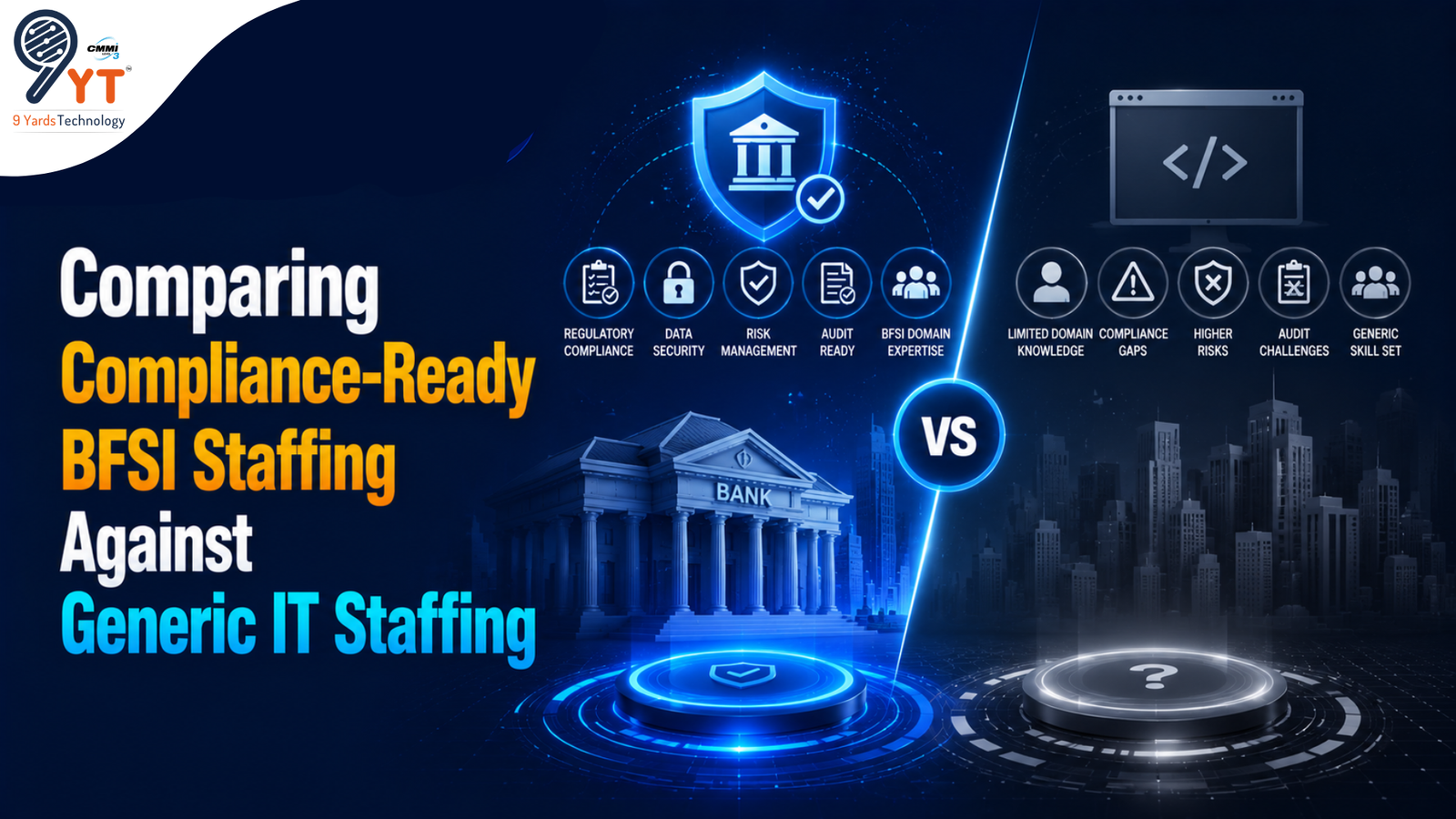
The table below maps the evaluation criteria BFSI procurement and legal teams use when qualifying a staffing vendor, and what separates a compliance-first partner from a generic agency.
| Evaluation Criterion | Generic IT Staffing Agency | 9Yards Technology (BFSI-Ready) |
|---|---|---|
| Process certification | ISO 9001 or none | Documented NDA and replacement protocols, audited per engagement |
| BFSI developer hiring India | Keyword CV matching | Pre-vetted bench with domain checkpoint |
| NDA and IP framework | Standard boilerplate | 100% NDA adherence, documented per engagement |
| Profile turnaround | 5–15 business days | 48–72 hours |
| Replacement guarantee | “We’ll find a replacement” | 7-day replacement SLA, written |
| Vendor audit readiness | Self-declared compliance | Documented process available for audit. NDA terms, replacement protocols, and engagement history reviewable on request |
| Client retention rate | Industry average ~70% | 95% (verified across 300+ deployments) |
| Engagement models for BFSI | T&M or FTE only | T&M, FTE, Managed Services, BOT |
The column that matters most to your legal team is the third one. Your regulator audits processes, not promises.
AML KYC Compliance Engineer Staffing: The Hardest Role in BFSI to Fill
Thirty engineers in to a product engineering team and two months later, your hiring pipeline is still stalled on one role. That role is almost always an AML/KYC compliance engineer. The combination of financial crime domain knowledge, transaction monitoring system experience, and engineering seniority is narrow. Local hiring in India’s major BFSI hubs, Mumbai, Bengaluru, Hyderabad, takes 90 days on average for this profile. Three months of open headcount in a compliance function is not an inconvenience. It is a reportable gap.
AML KYC compliance engineer staffing requires a vendor who maintains a bench in this category year-round, not one who begins sourcing when you raise the requirement. The RBI’s Master Direction on IT Governance requires banks to document staffing controls for functions that touch anti-money laundering systems, which means the engineer’s vetting history and the vendor’s NDA terms become part of your audit file.
9Yards Technology pre-vets engineers across Security Engineering, Data Engineering, QA Automation, and Business Analysis, the four functions that converge in most AML/KYC build-outs. Profiles arrive in 48–72 hours because the domain qualification has already been done before you ask.
Al Rajhi Bank and the Middle East BFSI Proof Point, and What It Means for India
9Yards Technology counts Al Rajhi Bank among its approved client roster. Al Rajhi operates under a compliance framework that mirrors many of the governance, audit trail, and data confidentiality requirements that the RBI mandates for Indian banks. Deploying engineering talent inside a regulated financial institution at that scale requires the same pre-vetting rigour, the same NDA architecture, and the same replacement accountability that BFSI clients in India need.
The lesson: compliance-ready engineering deployment is a repeatable process, not a one-time configuration. A vendor who has done it once for a major bank can do it for yours.
Why Retention Rate Is the Real Compliance Metric
Every staffing agency will tell you their engineers are experienced. Testimonials can be selected. A retention rate cannot be faked at scale.
9Yards Technology maintains a 95% client retention rate across 300+ engineer deployments. The industry average sits at approximately 70%. That 25-point gap is not a marketing figure; it is the downstream output of a vetting process rigorous enough that clients don’t need to replace engineers, and an account management model structured enough that clients don’t need to find a different vendor.
For BFSI clients specifically, engineer turnover inside a compliance-critical function creates a documentation gap. Every time an augmented engineer rolls off an AML or KYC system, a knowledge transfer has to be documented and audited. High turnover in a regulated environment isn’t just operationally painful; it generates audit findings. A 95% retention rate is the most honest compliance-adjacent metric a staffing vendor can offer.
Speed without quality is the staffing industry’s biggest unspoken lie. A vendor who fills your AML role in three days with an engineer who leaves in four months has not solved your problem; they have deferred it and added an audit trail gap.
Closing: The Staffing Decision Is Also a Compliance Decision
For BFSI engineering leaders, choosing an IT staff augmentation partner is not a procurement exercise separate from compliance. The RBI’s 2024 IT governance direction makes that separation impossible. Your vendor’s process documentation, NDA framework, and audit readiness are now part of your own compliance posture.
A partner with a 95% retention rate, a written 7-day replacement SLA, documented NDA adherence, and a pre-vetted bench in Security Engineering, AML/KYC, Data Engineering, and QA Automation is not a staffing convenience. It is a compliance control.
9Yards Technology has deployed 300+ engineers across enterprise clients with 100% NDA adherence on every engagement. Pre-vetted BFSI profiles are delivered in 48–72 hours. The governance documentation your legal team needs for the next RBI audit is already in place.
Need pre-vetted engineers in 48–72 hours? Talk to a 9Yards Technology specialist with no obligation and no generic shortlist.
Frequently Asked Questions
What does RBI compliance IT staffing require from a vendor in India?
The RBI’s 2024 Master Direction on IT Governance requires regulated entities to document vendor oversight, maintain audit trails, and hold outsourced IT partners accountable for data confidentiality and incident response. A staffing vendor serving BFSI clients must have documented, auditable processes, not just self-declared compliance. That means a specific, written NDA framework, documented replacement protocols, and process transparency that your legal team can review directly, rather than a vendor’s own assurance that their processes are sound. Partners must also provide enforceable NDA frameworks and documented replacement protocols for any engineer touching regulated systems.
How does BFSI developer hiring in India differ from standard IT staffing?
BFSI developer hiring in India adds a regulatory domain layer to standard technical vetting. Engineers must understand the compliance frameworks they work within, RBI IT governance, SEBI CSCRF, CERT-In breach notification, and data localisation obligations, not just the technology stack. Pre-vetting for BFSI must include a domain knowledge checkpoint alongside the technical assessment. Generic staffing agencies screen for keyword CV matches; a BFSI-ready partner screens for engineers who can operate inside a regulated environment from day one.
How quickly can AML KYC compliance engineers be deployed through staff augmentation in India?
AML KYC compliance engineer staffing through a vendor with a pre-vetted bench takes 48–72 hours to deliver shortlisted profiles and 2–3 weeks for full deployment. Local hiring for this profile averages 90 days in India’s major BFSI hubs. The difference is whether the vendor maintains an active, domain-qualified bench year-round or begins sourcing from scratch when a requirement is raised. A written 7-day replacement SLA ensures that if the first deployment doesn’t meet your compliance bar, a replacement is in place within a week.
What certifications should a BFSI IT staffing partner hold to satisfy audit requirements?
The most important thing a BFSI IT staffing vendor can offer isn’t a single certification. It’s auditable process documentation: a specific NDA framework per engagement, a written replacement SLA with a defined number of days, and a published, verifiable client retention rate. RBI’s IT governance framework requires documented, auditable vendor processes; ask any vendor to show you the documentation, not just describe it.