

 Post by
Quick Answer: To hire DevOps engineers in India, use a staff augmentation partner with a documented, auditable vetting process, not a resume marketplace. Expect pre-vetted profiles in 48-72 hours, full deployment in 2-3 weeks, and a written 7-day replacement SLA. India’s senior DevOps cost runs $42,000-$58,000 annually versus $170,000-$210,000 for a US-local SRE.
Hiring DevOps engineers in India saves a 10-person infrastructure team $112,000-$152,000 per engineer annually, but only if the person who arrives actually owns production infrastructure rather than reciting it on a CV. That is the question every competitor guide skips: not how to find India DevOps talent, but how to verify it before it hits your CI/CD pipeline. India sits 9.5 hours ahead of Eastern Time, which creates a real follow-the-sun incident response window instead of just a vague “24/7 coverage” pitch. Both problems have specific answers. This guide gives you them.
Your situation is probably one of these: a critical infrastructure role open 60-90 days, an on-call rotation burning out your US team, or a cloud migration that needs three senior SREs in the next month. None of those timelines work with a 90-day US local hiring cycle. That lag compounds every week.
Why Most Agencies Fail the DevOps Vetting Test
The staffing industry’s incentive is placement speed, not candidate quality. Most agencies are measured on how fast they fill a seat, not on whether the engineer still performs six months later. DevOps is where that gap hurts most.
The Indian DevOps talent market splits sharply. On one side: engineers who have run production EKS clusters at scale, written Terraform modules from scratch, and owned an incident response rotation. On the other: engineers who studied Kubernetes from a course and can demonstrate a Minikube cluster in an interview. Both pass a standard CV screen. Only one belongs on your infrastructure team.
Kubernetes demand estimates vary sharply by source and methodology, from single-digit percentages of broad infrastructure listings to figures above 80% for senior, production-focused roles specifically. What every source agrees on is the direction: Kubernetes has moved from differentiator to baseline for senior DevOps hiring in the last three years. Kubernetes has moved from differentiator to baseline for senior DevOps hiring in the last three years, and every source agrees the qualified-candidate supply hasn’t kept pace with demand. That supply gap is why unvetted resumes dominate the market.
The Certified Kubernetes Administrator certification is useful, but not sufficient alone. Production EKS and GKE scars matter more than a certificate. Any vetting process worth trusting goes deeper: multi-cloud IAM, GitOps workflows with ArgoCD or Flux, Infrastructure-as-Code at module depth, not just Terraform apply.
A 9Yards Technology pre-vetting screen for senior DevOps roles runs through all of these layers before a profile reaches a client. A structured, audited, repeatable vetting process means exactly this in practice. Not a claim, a documented sequence every profile goes through before it reaches you.
What DevOps Engineer Skills India 2026 Actually Require
Thirty-six months ago, Terraform was a differentiator. Now it is the baseline. The 2026 senior DevOps stack has moved, and a partner who cannot describe the shift is not screening against current market reality.
The non-negotiables for a senior hire in 2026:
Kubernetes at production depth. Not Helm chart deployment from a tutorial. Cluster networking, RBAC, pod security, and ideally custom controller experience. Engineers who can prove this consistently earn a 15-25% salary premium over peers at the same seniority.
Infrastructure-as-Code maturity. OpenTofu, the Linux Foundation fork of Terraform accepted into the CNCF at Sandbox level in 2025, is now the default for greenfield projects. Candidates familiar only with Terraform remain fully relevant. Insistence on either tool exclusively is a red flag for inflexibility.
Observability ownership. Not just “we use Datadog.” Full-stack observability design: structured logging, distributed tracing, SLO definition, and alert fatigue reduction. This separates DevOps engineers from DevOps operators.
Security integration. DevSecOps is no longer a specialisation. Snyk, Trivy, and container image scanning inside the CI pipeline are now standard expectations for any role serving compliance-sensitive industries.
For IT staff augmentation engagements specifically, pre-vetting against this exact stack is what makes a 48-72 hour profile turnaround meaningful rather than just fast. Anything less is pure throughput.
The DevOps Engineer Hourly Rate India: What the Numbers Actually Mean
9Yards Technology’s annual cost for a Senior DevOps/SRE Engineer from India runs $42,000-$58,000, compared to $170,000-$210,000 for an equivalent US-local hire. That is a $112,000-$152,000 annual saving per engineer.
For a 10-person infrastructure team, annualised savings typically run $1,050,000 to $1,450,000 depending on role mix. That number is verifiable, not a rounding estimate.
The annual cost difference, $42,000-$58,000 versus $170,000-$210,000, is real regardless of how you slice it into a billing period. But the hourly rate alone tells you nothing about whether the engineer can own your infrastructure.
Here is what the rate comparison actually looks like across hiring paths:
| Hiring Path | Annual Cost (Senior DevOps/SRE) | Time-to-Deploy | Replacement SLA |
|---|---|---|---|
| US Local Hire | $170,000-$210,000 | ~90 days | Months to rehire |
| Generic Offshore Agency (India) | $35,000-$50,000 | 4-6 weeks | Undefined |
| Freelance Marketplace (India) | $25,000-$40,000 | 1-2 weeks | None |
| 9Yards Technology (India) | $42,000-$58,000 | 2-3 weeks | 7 days, guaranteed |
The gap between a generic offshore agency and 9Yards Technology is not the cost. It is the written replacement guarantee and the audited process behind the profile.
How Timezone Overlap DevOps Offshore Actually Works
Every guide says India offers “follow-the-sun coverage.” Almost none describe what that means for an infrastructure team running real incident response.
India is 9.5 hours ahead of Eastern Time. The genuine real-time overlap is roughly 30-90 minutes at the seam around 8:30 AM ET. That window is not wide enough for a live incident bridge. It is wide enough for a structured handoff.
The model that works:
- US team owns: business hours plus early morning on-call (8 PM-2 AM ET)
- India team owns: their full business day plus early India-morning on-call (India 1:30 AM-9:00 AM IST)
- Handoff point: the timezone seam, with a written incident summary and action log
Both sides own a specific 8-hour accountability window. Neither side is “casually covering” the other’s hours. Talkdesk’s India engineering hub runs on exactly this structure. Their team of 45+ engineers, deployed across Engineering, QA, Security, ERP, and Business Analysis functions, operates with seamless collaboration across US and India teams because the structure is deliberate, not improvised.
Distributed on-call teams see the strongest reliability gains when accountability is geographically clear and handoffs are structured, not when every region duplicates the same coverage, according to distributed on-call practice guides built around exactly this operating model.
> 9Yards Technology Proof Point: Talkdesk needed a complete India engineering hub, not just individual hires. 9Yards Technology established that hub in 3 months, deploying 45+ pre-vetted engineers across Engineering, QA, Security, ERP, and Business Analysis. Hiring moved 80% faster than Talkdesk’s prior process. Talent costs dropped 50%. The team is still active and expanding.
Choosing Your Deployment Model: Staff Augmentation vs. EOR vs. Subsidiary
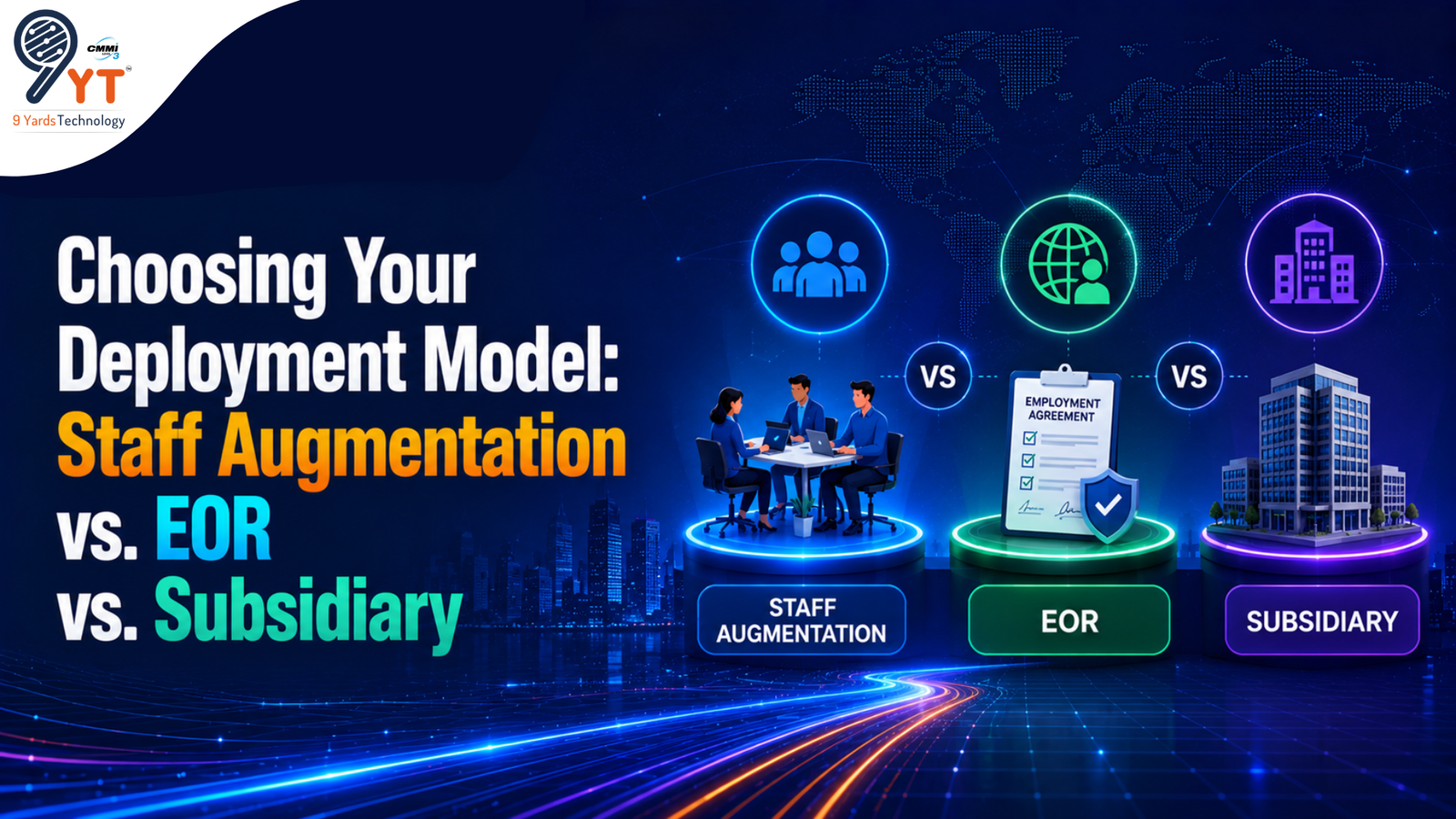
Most guides present the DevOps EOR vs subsidiary India decision as a compliance question. It is also an operational question.
Employer of Record (EOR): Fastest compliant path for a first India hire. The EOR is the legal employer. Your engineer integrates into your team but sits on a third-party payroll. Works well for 1-5 engineers. Loses efficiency at scale.
Subsidiary: Full legal entity in India. Right choice at 15-20+ engineers when you want full control of HR, compensation, and culture. Setup takes 3-6 months and requires ongoing compliance overhead.
IT staff augmentation: The engineer is deployed from a mix of the partner’s ready bench and rapidly sourced market talent — either way, the partner absorbs the sourcing cycle, not you. They integrate into your team, follow your processes, and join your standups. The partner handles employment compliance, replacement logistics, and performance monitoring. This is the model 9Yards Technology operates, and it is specifically why the 7-day replacement SLA is enforceable: the partner owns the bench.
For most Series B and later companies scaling infrastructure fast, staff augmentation under a partner with a published retention rate and a written replacement SLA delivers the speed of EOR with the governance of a subsidiary, without the entity setup cost. Most staffing vendors won’t put either commitment in writing; that’s what makes the two together a meaningful signal rather than a marketing line.
One mistake to avoid: hiring a full-time DevOps engineer as a contractor because it is faster. Indian tax authorities apply substance-over-form tests. If the engineer works fixed hours for your team, uses your tooling, and takes direction from your manager, the contractor classification is unlikely to hold.
How to Hire DevOps Engineers India: The 9Yards Technology Deployment Process
Here is the process that delivers profiles in 48-72 hours without compromising on the vetting depth described above.
Step 1: Requirement received. You submit a role specification: seniority, cloud platform, specific tools (Kubernetes version exposure, Terraform vs. OpenTofu, AWS vs. GCP vs. Azure), team size, and on-call expectations.
Step 2: Talent mapping. Internal matching against the pre-vetted bench. Not a cold search. Engineers on the bench have already cleared the technical screen.
Step 3: Technical assessment. Structured evaluation against the 2026 senior stack: production Kubernetes proof, IaC module design, observability setup, and security integration. Not a whiteboard exercise.
Step 4: Client interview. You meet the shortlisted engineer. You run your own technical bar. The 9Yards Technology screen does not replace yours; it removes the 80% of candidates who would have failed it.
Step 5: Deployment within 2-3 weeks. The engineer joins your team, your standups, your tools, and your incident rotation.
Step 6: Performance monitoring. Ongoing. If performance does not meet your bar within the first weeks, the 7-day replacement SLA is activated. No renegotiation. No additional cost.
Distributed infrastructure teams can match co-located delivery quality when tooling and process are in place. Pre-vetting plus a structured deployment model is exactly what ‘tooling and process’ means in a staffing context.
Speed without quality is the staffing industry’s biggest unspoken lie. A 24-hour profile turnaround that sends you an unvetted CV is not faster. It is slower, because the next three weeks are wasted on interviews that go nowhere.
The hiring decision you are making is not “India vs. local.” It is “which India partner has a process I can audit, a retention rate I can verify, and a replacement guarantee I can hold them to.” 9Yards Technology’s 95% client retention rate is not a marketing claim. A 5-year active partnership with SHL, who deployed 60+ engineers through a BOT model with 70% faster resource deployment and 20% lower talent acquisition costs, is the verification.
Need pre-vetted engineers in 48-72 hours? Talk to a 9Yards Technology specialist with no obligation and no generic shortlist.
Frequently Asked Questions
What is the DevOps engineer hourly rate in India compared to the US?
A senior DevOps/SRE engineer deployed through 9Yards Technology from India costs $42,000-$58,000 annually. A US-local senior SRE costs $170,000-$210,000 annually. The cost difference is significant, but the vetting process behind the profile determines whether that cost advantage is genuine or illusory.
What DevOps engineer skills should I look for in India in 2026?
Production Kubernetes is non-negotiable in 2026, demand estimates for it vary by methodology, but every source shows it as the single most consistently required skill for senior DevOps roles. Beyond Kubernetes, look for Infrastructure-as-Code at module depth (Terraform or OpenTofu), GitOps workflows with ArgoCD or Flux, full-stack observability design, and integrated security tooling (Snyk, Trivy). Engineers combining Kubernetes and multi-cloud expertise command 25-40% salary premiums over single-skill peers.
What is the difference between DevOps EOR vs subsidiary in India, and which should I use?
An Employer of Record (EOR) is the fastest compliant route for a first India hire: the EOR acts as the legal employer while the engineer integrates into your team. A subsidiary gives full HR and culture control but requires 3-6 months of setup and suits 15-20+ engineers. IT staff augmentation is a third path: the partner is the legal employer, handles compliance, and backs performance with a written replacement SLA and a published retention rate, delivering EOR speed with stronger governance.
How does timezone overlap work for offshore DevOps teams in India?
India is 9.5 hours ahead of Eastern Time, giving roughly 30-90 minutes of genuine real-time overlap at around 8:30 AM ET. Effective offshore DevOps uses a follow-the-sun model: the US team owns business hours plus early morning on-call; the India team owns their full business day plus early India-morning on-call. Both sides hold a specific 8-hour accountability window with a written incident handoff at the timezone seam. This structure is how Talkdesk’s 45+ engineer India hub runs successfully with US teams.