

 Post by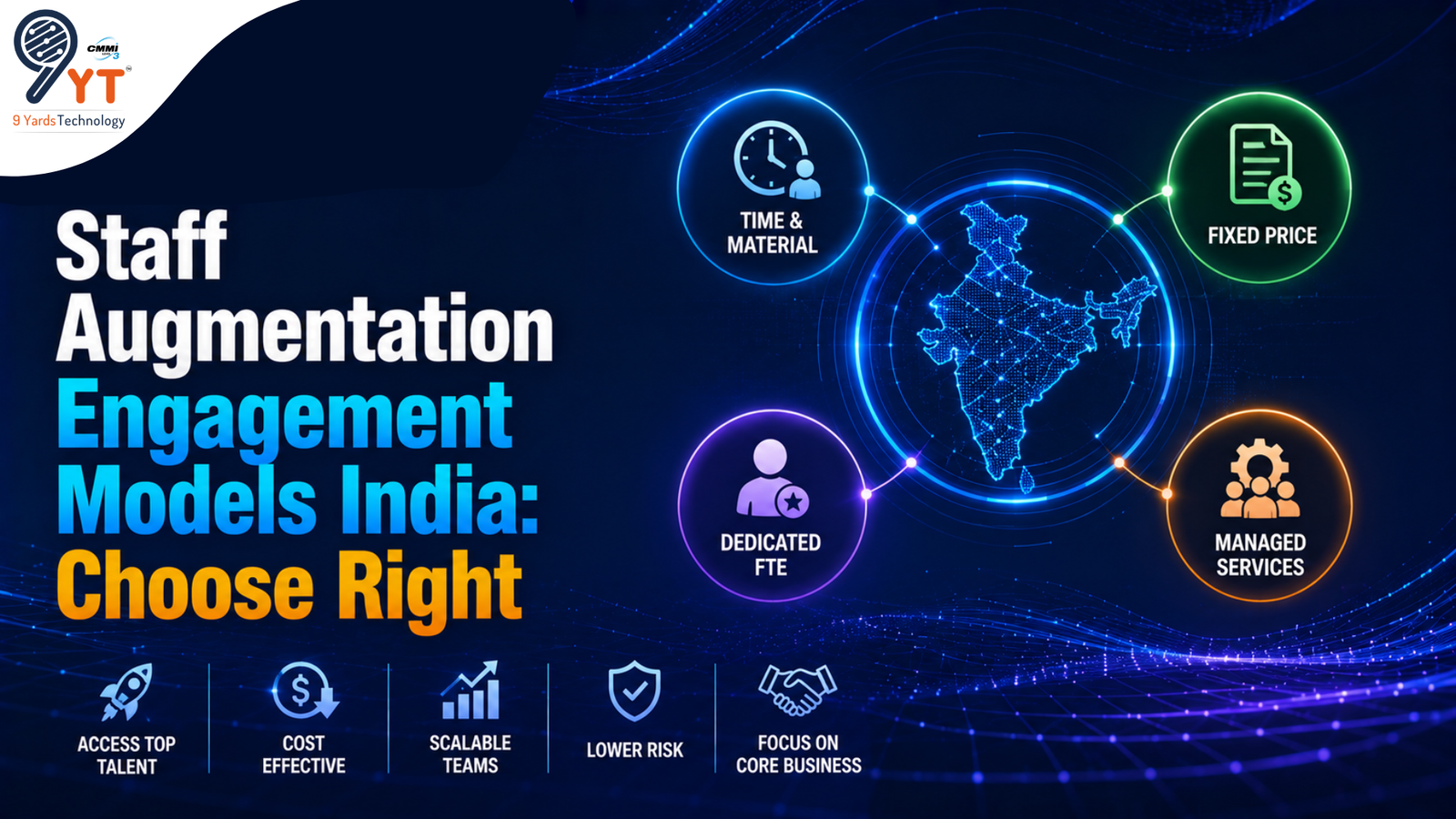
The wrong staff augmentation engagement model in an India contract does not announce itself at signing. It shows up six weeks in as a scope dispute, a surprise invoice, or an engineer who passed your interview but reports to nobody’s standards. At 9Yards Technology, we have deployed 300+ engineers across T&M, Fixed Price, FTE, and Managed Services engagements, and the single most common mistake we see is CTOs locking into a model based on rate negotiations rather than scope clarity. A hybrid engagement model T&M to fixed price transition, done at the right inflection point, routinely saves enterprise clients more than the rate difference ever would.
Your situation is probably one of these: you have open requisitions that have been unfilled for 60 to 180 days, your internal hiring cannot keep pace with your roadmap, and someone on your leadership team just asked whether you should outsource the whole function. Before that conversation goes any further, you need to know exactly what you are buying under each model.
What Each Engagement Model Actually Means
Four models cover almost every enterprise IT staff augmentation contract. Here is what each one delivers, in plain terms.
Time and Material (T&M): You pay for actual hours worked against agreed rates. Scope can evolve sprint to sprint. You carry the delivery risk because you own the backlog and the prioritisation. This is agile execution for teams whose requirements shift, and it is the right starting point when you do not yet know exactly what you need.
Fixed Price (FP): A defined scope, a defined timeline, a defined budget. The vendor carries the delivery risk because the fee does not move when the work overruns. This model rewards precision. If your requirements are locked and your acceptance criteria are written before the engagement starts, Fixed Price is predictable and clean. If they are not, it is expensive for both sides.
Full-Time Employees (FTE): Dedicated engineers who function exactly like internal hires. They attend your stand-ups, push to your repos, and report to your managers. The vendor handles employment, benefits, compliance, and HR. You get the output without the headcount overhead. This is the right model for long-term team extension where you want institutional knowledge to accumulate on your side.
Managed Services (MS): You outsource an entire function- QA, DevOps, or Business Analysis- under an SLA-driven contract with a guaranteed outcome. The vendor owns delivery quality, not just headcount. This is not staff augmentation in the traditional sense. It is the right model when you want accountability for results, not just people in seats.
One more model deserves mention here because it is the one most enterprise clients end up needing: Build-Operate-Transfer (BOT). 9Yards Technology used this model for both the SHL and Talkdesk engagements. It gives clients a path from augmented delivery to full internal ownership, with an optional transfer of the team onto the client’s own payroll after 12 months.
Time and Material vs Fixed Price: The Real Decision
The time and material vs fixed price question is not about which model is better. It is about who is carrying the risk, and whether that is the right party given your current scope clarity.
On a T&M contract, you carry delivery risk. That sounds bad until you remember that you also carry delivery control. You can reprioritise, cut features, pivot your roadmap mid-sprint, and the contract does not penalise you for it. For product engineering work, where requirements change every two to three weeks, this matters more than most buyers realise when they sign.
On a Fixed Price contract, the vendor carries delivery risk. That sounds good until the vendor prices that risk into the quote. Fixed Price contracts typically cost 15 to 25% more than equivalent T&M work, because the vendor is buying insurance against scope creep. If your requirements genuinely are locked, you pay a premium for certainty that was already yours. If they are not locked, you pay for certainty and then fight about change orders.
The practical answer: start on T&M when scope is still forming. Migrate to Fixed Price once a discovery phase has produced a written specification with agreed acceptance criteria. Deloitte’s Global Outsourcing Survey consistently identifies contract structure, not vendor selection, as the primary driver of outsourcing disputes; getting the model right before you sign is worth more than negotiating the rate after.
One trigger that makes the migration non-negotiable: if your engineers are spending more than 20% of sprint time on scope clarification conversations, you are paying T&M rates for Fixed Price work. That is the signal to re-contract.
The Capped T&M Model: A Third Option Most Buyers Miss
The comparison table below shows a model most competing articles never mention: capped T&M. It is a hybrid that gives you T&M flexibility up to a budget ceiling, after which the vendor must absorb overrun or renegotiate.
| Criterion | T&M | Fixed Price | Capped T&M | FTE | Managed Services |
|---|---|---|---|---|---|
| Scope flexibility | High | None | Moderate | High | Low |
| Budget predictability | Low | High | High | High | High |
| Delivery risk carrier | Client | Vendor | Shared | Client | Vendor |
| Right for evolving requirements | Yes | No | Yes | Yes | No |
| Right for defined deliverables | No | Yes | No | No | Yes |
| Minimum viable scope clarity | Low | High | Medium | Low | High |
| Vendor SLA enforceability | Low | High | Medium | Medium | High |
| 9Yards Technology model availability | Yes | Yes | Yes | Yes | Yes |
Capped T&M is under-used because most buyers do not ask for it. Ask for it. It is the right structure when your budget is fixed, but your requirements are not, which describes the majority of product engineering programmes running today.
FTE vs Staff Augmentation vs Managed Services: When Each Model Wins
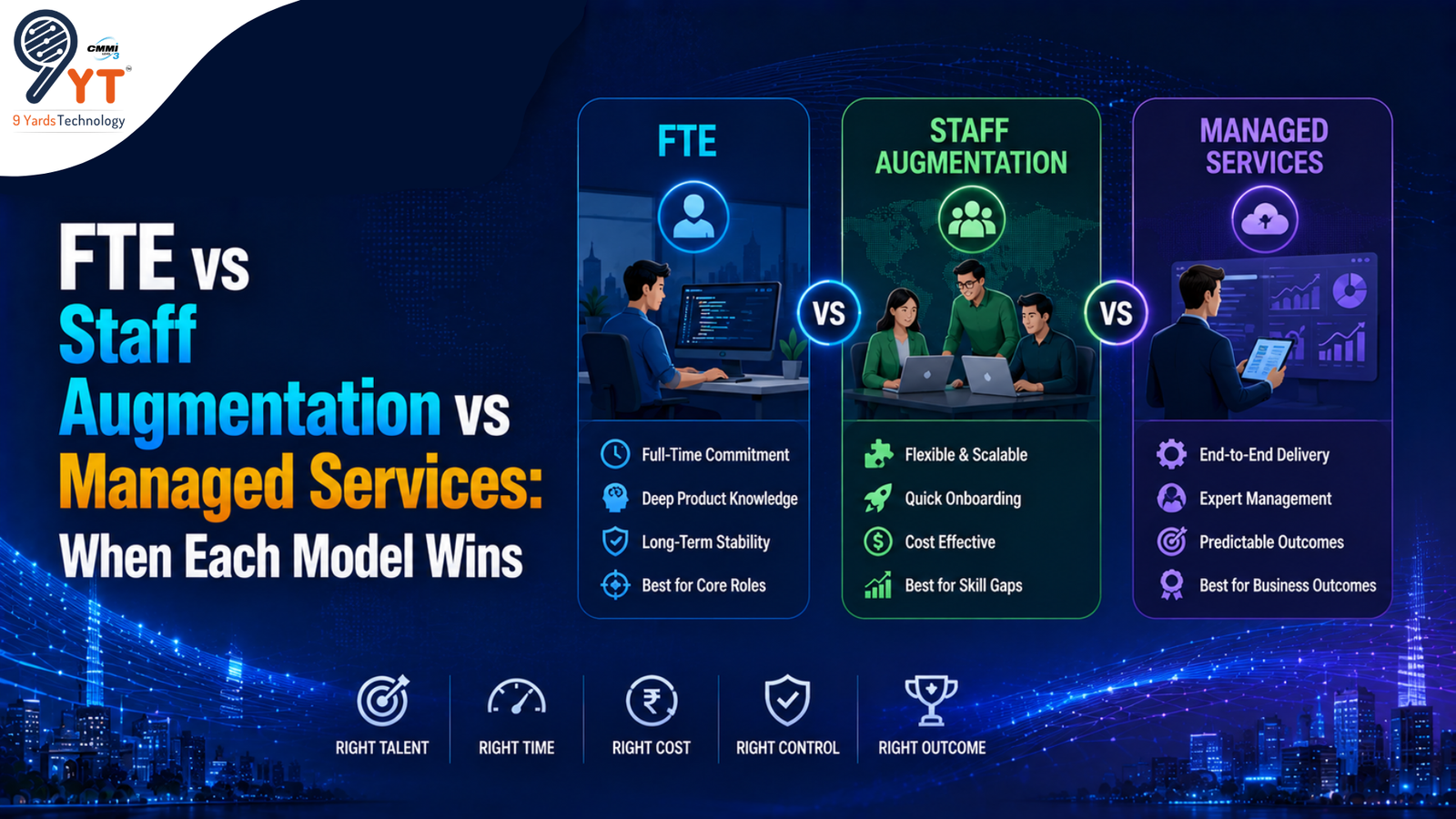
Three of the four models are often confused because they can look identical from the outside. An engineer shows up, joins your Slack, and starts committing code. The difference is in governance, accountability, and what happens when things go wrong.
FTE augmentation gives you the engineer. You provide the direction. If delivery is slow, that is your problem to solve, because you own the backlog. This is the right model when you have strong internal engineering leadership and just need more hands executing to your standard.
Managed Services gives you a function. The vendor provides the direction within that function. If QA coverage drops, the vendor answers for it under the SLA. This is the right model when you do not have the internal bandwidth to manage day-to-day delivery in that function.
Staff augmentation, the broader category that includes T&M and FTE, sits between the two. You stay in control of delivery. The vendor stays in control of the engineer’s employment, compliance, and HR. Industry research on offshore engagement models consistently finds that a mismatch between business expectations and the selected model, not talent quality, is the primary cause of cost overruns, delays, and delivery failures.
The practical test: if you have an internal engineering leader who can run a stand-up and manage a backlog, augmentation works. If you do not, Managed Services removes a management dependency you cannot currently fill.
9Yards Technology’s 95% client retention rate is the clearest evidence that model fit matters more than rate. Clients who stay for five-plus years are not staying because the rates are cheapest. They are staying because the governance model was set up correctly at the start.
Read More: Staff Augmentation Engagement Models India: Enterprise Evaluation Guide
How 9Yards Technology Structures a Real Engagement
The 9Yards Technology Talent Deployment Matrix is the process every engagement runs through, regardless of model:
- Requirement Received: Client submits the role specification.
- Talent Mapping: Internal matching against the pre-vetted bench.
- Screening: Initial qualification against the role requirements.
- Technical Assessment: Structured technical evaluation.
- Client Interview: Client meets the shortlisted candidates.
- Deployment: The engineer joins the client team.
- Performance Monitoring: Ongoing tracking to ensure delivery quality.
Profiles arrive in 48-72 hours. Full deployment completes within 2-3 weeks. The 7-day replacement SLA applies across all models: if an engineer does not meet your bar in the first weeks, we replace them within 7 days at no extra cost. That SLA is not a courtesy. It is a public bet on the vetting process.
NASSCOM’s Technology Sector in India: Strategic Review reports that India produces over 1.5 million engineering graduates annually, but quality vetting remains the primary differentiator between vendors.
9Yards Technology Proof Point
SHL needed 60+ engineers across Product Engineering, QA, Performance Engineering, and Business Analysis. Their internal hiring process was taking months per role. 9Yards Technology deployed all 60+ within 2 months using a BOT model, cutting talent acquisition costs by 20% and achieving 70% faster resource deployment. The partnership has been active for 5+ years, and the team continues supporting SHL’s ongoing product initiatives. That outcome did not happen because the rate was right. It happened because the engagement model matched the delivery structure.
The Migration Signal Most Buyers Miss
Every engagement model has a natural lifespan. T&M is a starting point, not a permanent state. Fixed Price is a phase tool, not a program structure. The most expensive mistake in staff augmentation is not picking the wrong model at the start. It is failing to migrate when the signal arrives.
Here are the four migration signals worth watching:
T&M to Fixed Price: Requirements have been stable for two consecutive sprints and acceptance criteria are written. This is the moment to re-contract on Fixed Price for the next defined deliverable, while keeping the base team on T&M for ongoing work.
T&M or FTE to BOT: You have been running augmented engineers for 6+ months, and the team has accumulated genuine institutional knowledge. The BOT path gives you the option to transfer the team onto your own payroll after 12 months, retaining that knowledge permanently.
FTE to Managed Services: Your internal engineering leadership has scaled to a point where managing augmented headcount in a non-core function (QA, DevOps) is consuming disproportionate management bandwidth. Managed Services removes that overhead under an SLA.
Managed Services back to FTE: The vendor’s SLA performance has been consistent for 12+ months, and you want to bring the function in-house. Most Managed Services contracts do not plan for this transition. Ask for exit terms upfront.
Hybrid engagement structures combining core FTE teams with Managed Services for non-core functions consistently produce the strongest cost-to-output ratio for scaling engineering organisations, particularly when offshore delivery anchors the cost structure. India-delivered staff augmentation sits at the centre of that structure for cost-optimized engineering capacity.
Talkdesk’s India engineering hub is the clearest proof of what that looks like at scale: 45+ engineers deployed across Engineering, QA, Security, ERP, and Business Analysis functions, with the entire hub established in 3 months. 80% faster hiring and 50% reduction in talent costs were the outcomes. The model was BOT, with flexible time-zone support built for the US-based team.
The engagement model you choose is a commercial and operational decision with a longer tail than most buyers realise. Get it right before you sign.
Need pre-vetted engineers in 48-72 hours? Talk to a 9Yards Technology specialist with no obligation and no generic shortlist.
Frequently Asked Questions
What is the difference between T&M and Fixed Price in staff augmentation?
In a time and materials vs fixed price comparison, T&M means you pay for actual hours worked and carry delivery control and risk. Fixed Price means a locked scope, locked budget, and the vendor carries delivery risk but prices that risk into the quote, typically 15-25% higher. T&M suits evolving requirements. Fixed Price suits clearly scoped, short-phase deliverables with written acceptance criteria agreed before the engagement starts.
How does FTE vs staff augmentation vs managed services differ for enterprise engineering teams?
FTE augmentation gives you an engineer who functions as an internal hire while the vendor handles HR and compliance. Standard staff augmentation (T&M) is similar but scope-driven per sprint. Managed Services goes further: the vendor owns an entire function under an SLA and is accountable for outcomes, not just headcount. FTE and T&M work best when you have strong internal engineering leadership. Managed Services works best when you do not have bandwidth to manage that function day to day.
What is a capped T&M contract model and when should I use it?
A capped T&M contract model sets a budget ceiling on a standard T&M engagement. You get the flexibility to evolve scope sprint to sprint, but the vendor must absorb cost overruns beyond the agreed cap or renegotiate. It is the right structure when your budget is fixed,d but your requirements are still forming. Most buyers never ask for it specifically, but reputable vendors including 9Yards Technology can structure engagements this way.
What triggers a hybrid engagement model migration from T&M to Fixed Price?
The clearest signal for a hybrid engagement model T&M to fixed price migration is two consecutive sprints of stable requirements with written acceptance criteria. At that point, re-contracting the next defined deliverable on Fixed Price gives you cost certainty without sacrificing the flexibility you needed earlier. Keep the base team on T&M for ongoing exploratory work and run Fixed Price only on the defined phase. Re-contracting mid-engagement is standard practice, not a renegotiation flag.