

 Post by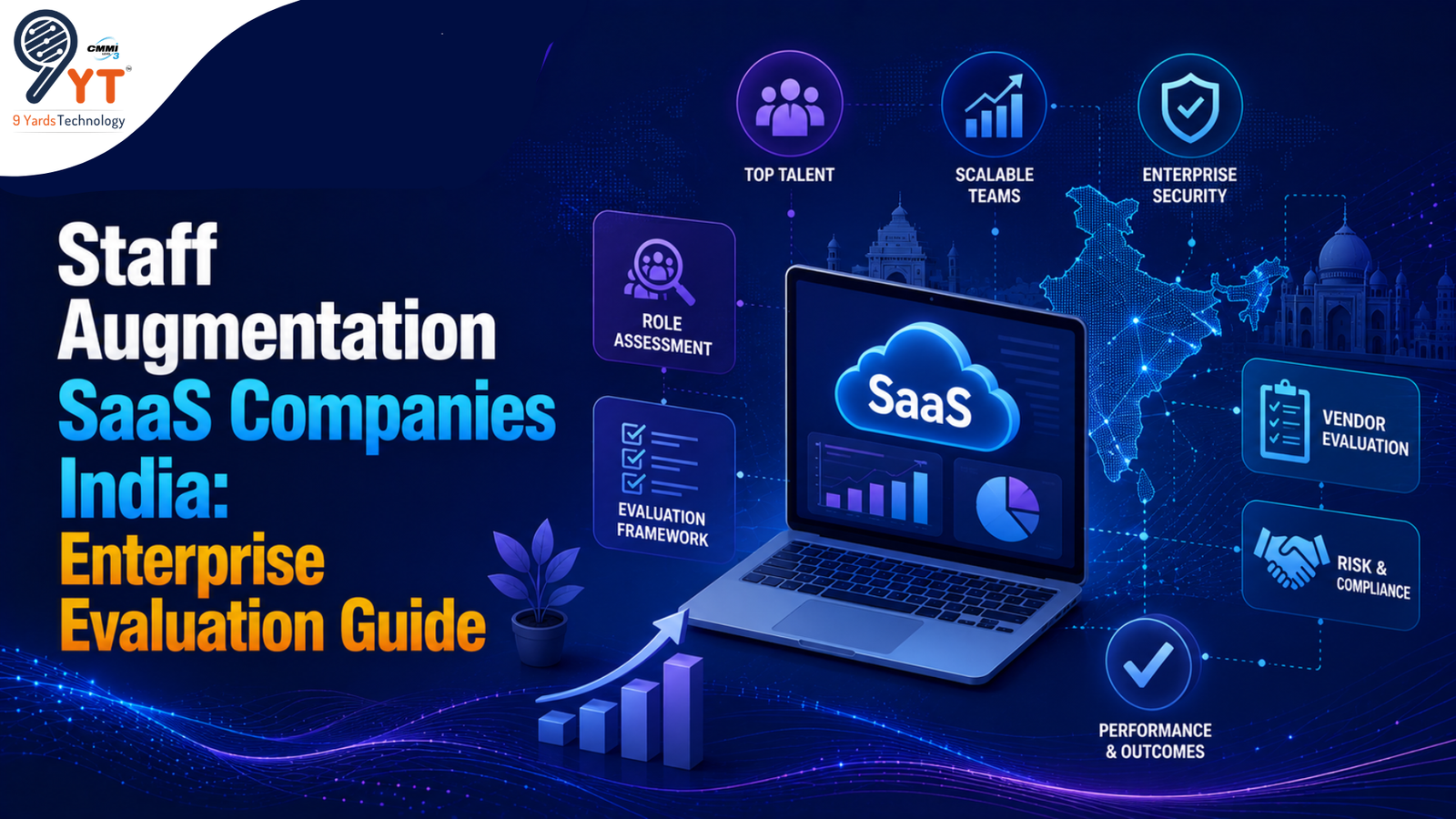
The best staff augmentation SaaS companies in India are not hard to find. The hard part is telling them apart. Every agency website lists “pre-vetted talent,” “fast turnaround,” and “seamless integration.” None of those phrases mean anything without a number attached. The SaaS engineering market in particular cannot afford to find that out slowly: a senior engineer unfilled for 90 days costs a product team roughly 69 days of lost sprint velocity against a competitor that is shipping.
Your actual problem is not shortage of options. It is the absence of an honest framework for evaluation. This guide gives you one.
What “Staff Augmentation” Actually Means for a SaaS Product Team
Most content conflates staff augmentation with outsourcing. They are not the same. Staff augmentation for IT staff augmentation embeds a pre-vetted engineer directly inside your existing team structure: your tools, your Jira board, your sprint ceremonies, your Slack channels. The engineer reports into your engineering hierarchy. You retain full IP ownership and delivery control.
Outsourcing hands a scope of work to an external team and asks for a deliverable. The two models answer different questions. Augmentation answers: “How do I add a senior React or AI/ML engineer to my existing pod in two weeks?” Outsourcing answers: “Who builds module X for us while we focus elsewhere?”
For SaaS companies specifically, augmentation wins on three counts. Speed: a well-run partner delivers shortlisted profiles in 48-72 hours. Control: the engineer becomes a genuine extension of the product team. Cost: a senior software engineer deployed from India typically costs $40,000-55,000 annually against $160,000-200,000 for a US local hire at the same seniority level. That delta funds two additional hires at the same budget.
The distinction matters because a body shop will sell you outsourcing and call it augmentation. Know the difference before your first vendor call.
Read More: How to Augment Your Software Engineering Team with India-Based Talent
The Criteria That Actually Separate Good Partners from Bad Ones
Every ranking list for staff augmentation SaaS companies in India recycles the same non-criteria: Clutch stars, years in business, technology stack coverage. Those data points tell you almost nothing about delivery quality.
Two criteria do:
A published retention rate with a specific number. The staffing industry average client retention sits at approximately 70%. A partner operating at 95% retention is not offering the same product. Testimonials can be cherry-picked. A retention rate cannot.
A replacement SLA with a specific day count in writing. “Flexible support” is not a guarantee. A 7-day replacement SLA is a public bet a vendor places on its own vetting process. If they will not write it into a contract with a specific number of days, they do not believe their own vetting is good enough.
Any vendor who passes these two tests has already eliminated the majority of the market.
How the Deployment Process Should Actually Work
You deserve to know exactly what happens between submitting a role specification and having an engineer in your standup. Here is what a mature, enterprise-grade deployment process looks like, step by step.
- Requirement received: You submit the role specification, seniority level, and team context.
- Talent mapping: The partner matches against a pre-vetted bench, not a fresh cold search.
- Screening: Initial qualification against the role requirements and your team’s working style.
- Technical assessment: Structured technical evaluation, not a quick phone screen.
- Client interview: You meet the shortlisted candidate. You decide.
- Deployment: The engineer joins your team.
- Performance monitoring: Ongoing tracking ensures delivery quality does not drift after the first 30 days.
Profiles should reach you in 48-72 hours at step 2. Full deployment, from requirement receipt to engineer in your standup, should complete within 2-3 weeks. If a partner cannot articulate a process this specific, their “fast turnaround” claim is marketing, not operations.
The monitoring step is where most agencies disappear. An enterprise-grade partner stays involved through the engagement and replaces within 7 days if an engineer does not meet your bar. No renegotiation. No extra cost.
SaaS-Specific Engineering Roles and Where India Delivers Best
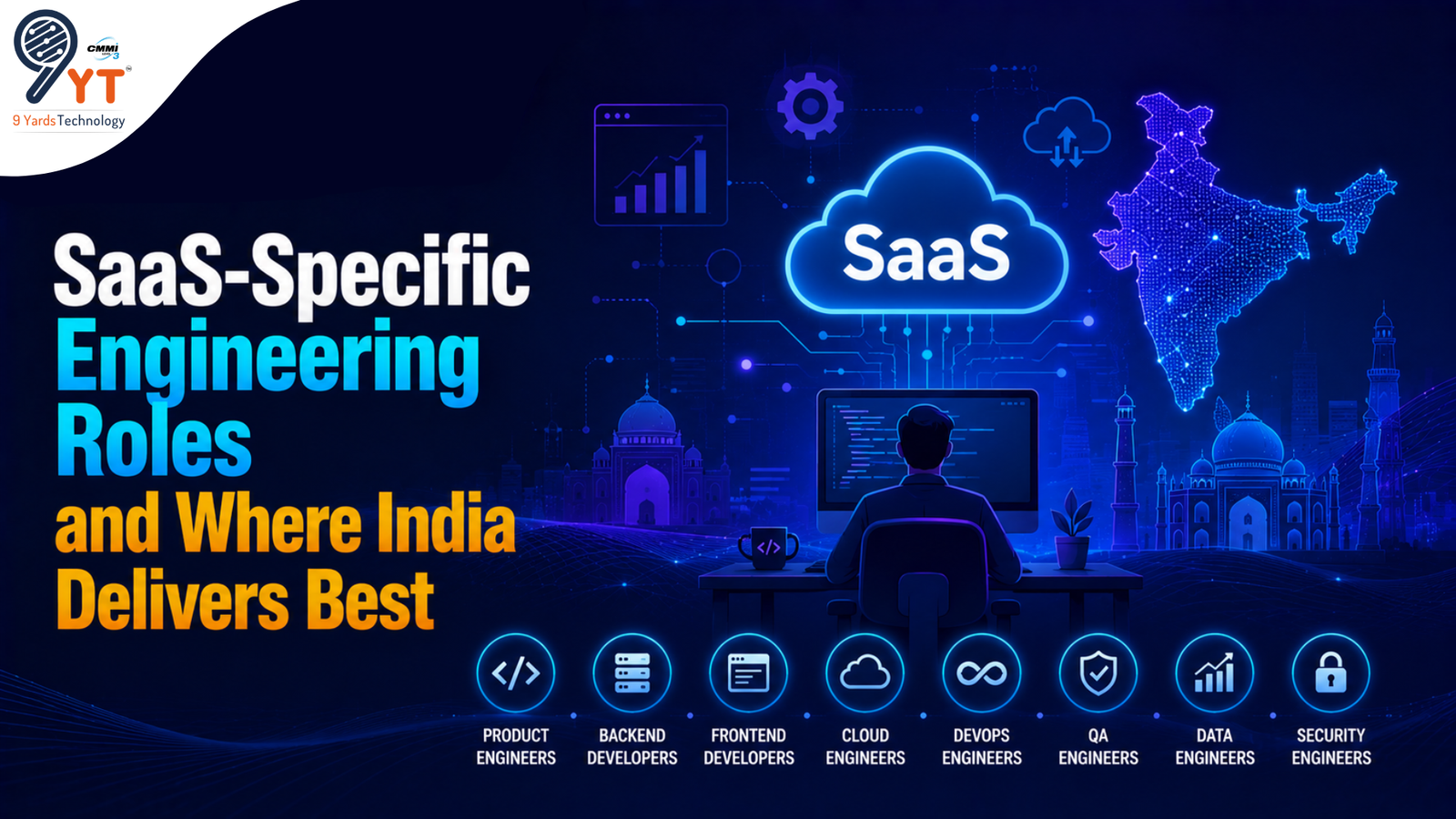
Not every role category carries the same cost-quality argument for India-based augmentation. India’s software engineering workforce exceeds five million active professionals (NASSCOM’s Technology Sector in India: Strategic Review), with deep concentrations across backend, cloud, and data engineering. For SaaS product teams, the case is strongest in four categories.
Product Engineering: Full-stack and backend engineers who can own features from design to production. This is the category 9Yards Technology deployed 60+ engineers in for SHL across Product Engineering, QA, Performance Engineering, and Business Analysis, all within two months.
QA Automation: Test automation engineers who reduce manual QA overhead and slot directly into existing CI/CD pipelines. Often the first hire a Series B SaaS team augments because the leverage per engineer is highest.
AI/ML Engineering: The highest-demand, hardest-to-fill category for most SaaS clients right now. Local hiring timelines for a senior AI/ML engineer in the US can run 90-120 days. A pre-vetted India profile arrives in 48-72 hours.
Cloud and DevOps: AWS, Azure, and GCP infrastructure engineers who can own CI/CD and infrastructure-as-code from day one, not after a 4-week ramp.
The NASSCOM’s Technology Sector in India: Strategic Review documents India’s engineering talent pool as one of the largest globally in all four of these categories. The quality gap between vendors is real; the pool itself is not the constraint.
Comparing Engagement Models: Which One Fits Your Stage
Staff augmentation is not a single product. The right model depends on what your team is trying to solve and how long you need the solution to hold.
| Engagement Model | Best Fit | Commitment | Control Level |
|---|---|---|---|
| Time and Material (T&M) | Evolving scope, sprint-by-sprint flexibility | No minimum term | Highest: scope shifts as you direct |
| Full-Time Equivalent (FTE) | Long-term team extension, internal-hire feel | Ongoing | High: engineer functions as internal hire |
| Managed Services | Full function outsourced with SLA accountability | SLA-defined | Medium: outcome-focused, not headcount-focused |
| Build-Operate-Transfer (BOT) | Building an India engineering hub for ownership | 12-36 months | Full ownership at transfer |
| Fixed Price | Well-scoped, known deliverable with a deadline | Project duration | Scope-locked |
For most SaaS companies at Series A or B, T&M or FTE augmentation is the right entry point. The BOT model becomes relevant when a company wants to establish a permanent India engineering presence rather than an ongoing augmentation relationship. Talkdesk used the BOT model to build a full India engineering hub in 3 months with 9Yards Technology, establishing the kind of team that is now a core delivery centre rather than a supplemental resource.
The finance framing matters too. T&M and FTE augmentation sit as operating expenditure. A BOT transition moves toward a quasi-capital structure once the team transfers into internal ownership. That is a real CFO-level consideration in 2026 budget planning.
The Evaluation Criteria Your Shortlist Should Be Built Around
Before you send a vendor a role specification, run every candidate partner through this table. These are not suggestions.
| Evaluation Criterion | What to Look For | Red Flag |
|---|---|---|
| Delivery Governance | Published retention rate above 90% with named client references | “High retention” or “strong processes” with no specific number |
| Retention rate | Published specific percentage, 90%+ | “High retention” with no number |
| Replacement guarantee | Written SLA with a specific day count | “Flexible support if issues arise” |
| Profile turnaround | 48-72 hours from role specification | “Fast” or “within a few days” |
| Client references | Named enterprise clients with verifiable outcomes | Generic testimonials without measurable results |
| IP and NDA | 100% NDA adherence, explicit IP assignment | Vague “we protect your IP” without documentation |
| Engagement flexibility | T&M, FTE, BOT, Managed Services on the same contract | Single-model-only providers |
A vendor who cannot answer every row in that table with a specific, verifiable claim is not ready for an enterprise SaaS engagement.
9Yards Technology Proof Point: Talkdesk, a global SaaS company, needed a scalable India engineering capability with aggressive hiring timelines and seamless collaboration with US-based teams. 9Yards Technology established Talkdesk’s India engineering hub in 3 months, deployed 45+ pre-vetted engineers across Engineering, QA, Security, ERP, and Business Analysis, delivered 80% faster hiring, and reduced talent costs by 50% through offshore delivery. The engagement is active and expanding.
The argument this guide makes is simple. Every list of staff augmentation SaaS companies in India produces the same 10-15 names without telling you how to choose between them. The choice is not about name recognition or Clutch rating. It is about three things: a retention rate that is specific enough to be held accountable, a replacement guarantee written into the contract in days, and named client references with verifiable outcomes. Those three criteria do not eliminate the best vendors. They reveal them.
Need pre-vetted engineers in 48-72 hours? Talk to a 9Yards Technology specialist with no obligation and no generic shortlist.
Frequently Asked Questions
What should SaaS companies look for in a staff augmentation partner in India?
Three criteria matter most for SaaS companies evaluating staff augmentation partners in India. First, a published client retention rate with a specific number — the industry average is around 70%, so a partner at 95% is a different product. Second, a written replacement SLA with a specific day count, ideally 7 days or fewer. Third, named enterprise clients with verifiable, measurable outcomes you can reference-check directly. Any vendor who cannot answer all three with a verifiable number is not ready for an enterprise SaaS engagement.
How fast can a staff augmentation company in India deploy engineers to a SaaS team?
A mature, enterprise-grade staff augmentation company in India should deliver shortlisted, pre-vetted profiles within 48-72 hours of receiving a role specification. Full deployment, from requirement receipt through technical assessment, client interview, and onboarding, should complete within 2-3 weeks. Partners quoting longer timelines are typically running a cold search rather than working from a pre-vetted bench. The difference between those two models is the difference between 2 weeks and 90 days.
What is the cost difference between hiring a senior engineer locally versus using staff augmentation SaaS companies in India?
For a senior software engineer, US local hiring costs $160,000-200,000 annually. A pre-vetted engineer deployed from India through a structured, enterprise-grade staff augmentation partner typically costs $40,000-55,000 annually, a saving of $105,000-160,000 per role per year. For a 10-person senior engineering team, that delta typically ranges from $1,050,000 to $1,600,000 in annual savings depending on role mix, which at most Series B SaaS companies is enough to fund a second product line.
What is the difference between staff augmentation and outsourcing for SaaS product companies?
Staff augmentation embeds a pre-vetted engineer directly inside your existing team: your tools, your sprint ceremonies, your reporting structure, your IP. The engineer is a genuine extension of your engineering organisation. Outsourcing hands a scope of work to an external team operating more independently, with a deliverable as the output. For SaaS product companies, augmentation is the right model when you need to extend a specific team pod quickly while retaining full delivery control and institutional knowledge inside the company.