

 Post by
IT staff augmentation banking India is not a generic staffing problem. BFSI teams carry a compliance burden that most staffing vendors have never had to think through: RBI data localization mandates, SEBI audit trail requirements, AML/KYC pipeline architecture, and the security clearance norms that sit above all of it. When a VP Engineering at a bank hires the wrong engineer through a body-shop, they create regulatory exposure, not just a delayed sprint.
This article makes one straightforward claim: the BFSI sector requires a staffing partner who screens for compliance familiarity before evaluating technical skill. Most competing articles treat banking as just another industry vertical. It is not. The compliance layer changes the evaluation criteria entirely. A vendor who cannot demonstrate AML KYC compliance engineer staffing experience is not a safe choice, regardless of profile speed.
Why RBI Compliance IT Staffing Requires a Different Screening Standard
RBI compliance IT staffing is a specialisation, not a checkbox. Since the Reserve Bank of India’s data localization circular took effect, any engineer working on payment systems, core banking data pipelines, or customer data infrastructure must understand data movement constraints. Engineers who build payment processing microservices or design data lake architectures for a scheduled commercial bank must know that certain payment system data categories cannot be mirrored to foreign servers. This is not a soft requirement.
Most Indian IT staffing agencies screen for Java, Python, or AWS certifications and stop there. They do not ask whether a candidate has worked within an RBI-regulated environment, has experience with banking security baselines, or understands SEBI audit log requirements. The gap becomes apparent six weeks into deployment when a technically capable engineer makes a data-handling decision that the bank’s compliance team must reverse.
At 9Yards Technology, the pre-vetting process for BFSI roles adds a compliance familiarity layer to the standard technical assessment. A candidate’s prior work environment, the regulatory context of previous engagements, and awareness of data residency constraints are evaluated before any profile reaches a client. This step costs time and explains the 95% client retention rate in an industry where most staffing agencies report 70% retention.
The 7-day replacement SLA is a public bet on screening quality.
What BFSI Developer Hiring India Actually Looks Like at Scale
BFSI developer hiring in India faces no talent supply constraint. India produces more than 1.5 million engineering graduates per year, according to NASSCOM’s published talent data. The real constraint is structured vetting at scale.
A bank scaling from 40 to 120 engineers over 18 months does not need a vendor who finds one good engineer. They need a vendor who delivers 80 pre-vetted engineers across Security Engineering, Data Engineering, QA Automation, and Business Analysis without quality degradation as volume increases. The SHL engagement demonstrates this: 60+ engineers deployed across Product Engineering, QA, Performance Engineering, and Business Analysis in two months delivered 70% faster deployment, a 60% improvement in hiring efficiency, and a 20% reduction in talent acquisition costs versus SHL’s prior approach. The partnership has remained active for 5+ years.
For BFSI clients, two functions remain hardest to fill through conventional hiring: Security Engineers with regulated environment experience, and Data Engineers who understand AML/KYC transaction monitoring pipeline architecture. Both command premium salaries globally and locally. Through structured India staffing, both are available at a fraction of that cost.
A Senior Security Engineer costs $170,000 to $210,000 annually in the US. The same seniority through 9Yards Technology’s India delivery model costs $42,000 to $58,000. That represents $112,000 to $152,000 in annual savings per engineer, computed directly from verified market benchmarks.
How AML KYC Compliance Engineer Staffing Works in Practice
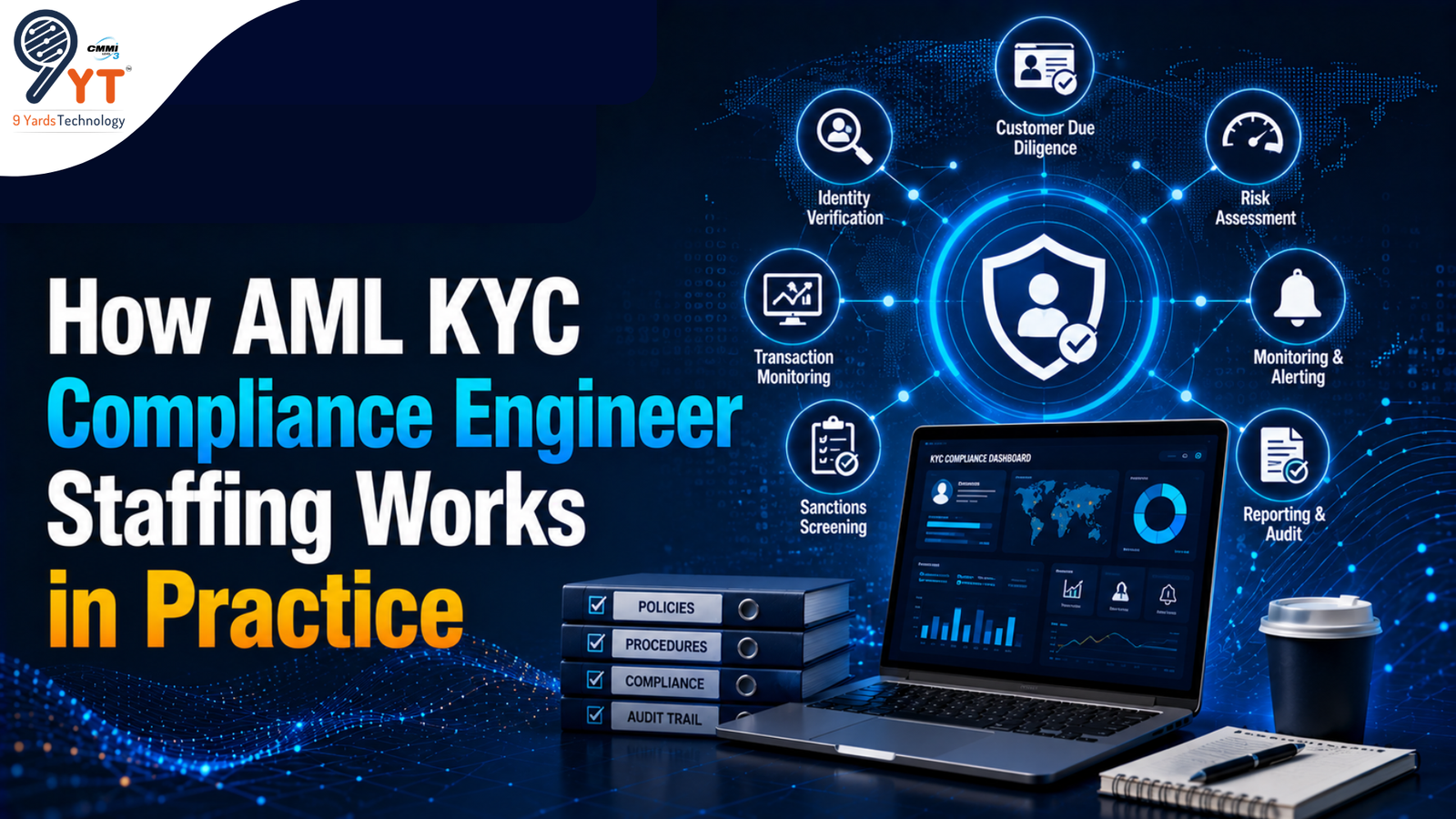
AML and KYC system builds demand more than standard software development. Engineers must understand transaction monitoring logic, screening rule configuration, false-positive tuning, and data integration patterns connecting KYC platforms to core banking systems. They must also understand why these systems are audited and what auditors examine in technical documentation.
The procedural reality runs like this: a BFSI client submits a role specification listing the technical stack (typically Java or Python, a rules engine like Actimize or Oracle FCCM, AWS or Azure data layer). Most staffing vendors stop there and send any candidate matching the stack.
A structured pre-vetting process goes further. Has this engineer configured AML detection rules in production? Have they participated in regulatory audit review of systems they built? Do they understand the difference between Tier 1 and Tier 2 investigation workflows and how that maps to system architecture?
Those questions filter out large percentages of technically qualified candidates. The ones who pass are more expensive to source and do not create compliance exposures six weeks into a project.
| Evaluation Criterion | What to Look For | Red Flag |
|---|---|---|
| Regulatory environment experience | Prior work in RBI, SEBI, or equivalent regulated context | Only non-regulated product or startup experience |
| Data residency awareness | Can explain RBI data localization requirements unprompted | Unfamiliar with the RBI circular or treats it as a backend concern |
| AML/KYC system exposure | Named platform experience (Actimize, FCCM, NICE Actimize) | Generic “fraud detection” framing with no platform specifics |
| Audit trail documentation | Has produced technical documentation reviewed by compliance teams | Treats documentation as a post-project activity |
| Security clearance readiness | Background check completed, references from regulated employers available | Unexplained employment gaps at regulated institutions |
| Replacement SLA from vendor | Written, specific-day-count guarantee in the contract | “We will do our best to find a replacement” with no timeline |
Data Localization Compliance Fintech India: The Architecture Constraint Staffing Vendors Ignore
Data localization compliance fintech India represents one of the most underappreciated hiring constraints in BFSI right now. The RBI’s data localization directive requires payment system data to be stored only in India. For fintech companies building cross-border payment rails, wallet infrastructure, or UPI-integrated products, this creates a specific architectural constraint: the data layer must keep certain data resident in India even when the application layer runs on a global cloud.
Most staffing articles mention compliance as a background consideration. This one states it as a hard dependency: a Data Engineer or Cloud Architect who does not understand data localization compliance fintech India requirements will design the wrong architecture. The cost of retrofitting after a regulator inquiry is orders of magnitude higher than hiring the first time correctly.
According to Deloitte’s 2024 Asia Pacific Financial Services Regulatory Outlook, data and technology are the most prevalent theme in Asia-Pacific financial services regulation, with regulators increasing focus on cybersecurity and operational resilience. Engineers who understand both the technical build and the regulatory rationale are the scarce resource.
This is why the Build-Operate-Transfer model suits BFSI engineering teams building long-term India capability. Rather than hiring project-by-project contractors, a BOT engagement builds a dedicated, stable team, operates it with governance accountability, and transfers full ownership after 12 months. Institutional compliance knowledge stays with the team rather than departing when a contractor engagement ends.
The Proof Point BFSI Buyers Ask For
Generic claims about compliance readiness are easy to make. Documented outcomes are harder to fake.
9Yards Technology deployed 45+ engineers for Talkdesk, establishing their India engineering hub in 3 months across Engineering, QA, Security, ERP, and Business Analysis. The engagement delivered 80% faster hiring versus Talkdesk’s prior process and a 50% reduction in talent costs through offshore delivery. The team remains active.
For BFSI clients, the Security Engineering component is the most relevant. Security-focused talent is among the hardest to place quickly because of additional screening requirements. The Talkdesk deployment shows that 9Yards Technology’s pre-vetting process holds at scale across compliance-sensitive functions, not just standard product engineering roles.
Al Rajhi Bank and Arab National Bank are among 9Yards Technology’s approved reference clients for BFSI sector delivery in the Middle East. That track record is available for procurement teams to verify.
How to Evaluate a BFSI IT Staffing Partner Before Signing
Security and compliance tooling has become an active skill-building area for engineers across the market; a vendor who does not screen for it will send profiles where compliance knowledge is shallow and self-reported rather than demonstrated in prior production environments. More engineers develop compliance familiarity organically. A staffing vendor who does not screen for it will send profiles where compliance knowledge is shallow and self-reported rather than demonstrated in prior production environments.
Three questions separate credible BFSI staffing partners from generic ones. First: do you have a documented screening step for regulatory environment experience, separate from technical assessment? Second: what is your written replacement SLA as a specific number of days? Third: can you name a BFSI client willing to speak on the record about a deployment at scale?
A vendor unable to answer all three with specifics is optimising for placement fees, not client compliance exposure. The staffing industry’s default incentive is speed to placement. BFSI teams need a partner whose incentive is retention and quality, which is why a 95% client retention rate matters more in this sector than in most.
A 7-day replacement SLA only works if the vendor maintains a pre-vetted bench deep enough to fulfill it. Building that bench takes years and requires turning down candidates who pass technical screens but fail compliance familiarity checks, even when this means slower fills.
Most body-shops will not make that tradeoff.
Need pre-vetted engineers in 48-72 hours? Talk to a 9Yards Technology specialist with no obligation and no generic shortlist. When evaluating IT staff augmentation for a BFSI engineering team, bring compliance requirements to the first conversation.
Frequently Asked Questions
What does RBI compliance IT staffing require that standard IT staffing does not?
RBI compliance IT staffing requires screening candidates for data localization awareness, prior experience in regulated environments, and familiarity with payment system data handling rules under the RBI data localization circular. Standard IT staffing typically screens only for technical stack match. For BFSI teams, a candidate who passes a Java or Python screen but has never worked in a regulated environment can create compliance exposures that are expensive to unwind after deployment.
How does data localization compliance in fintech India affect engineer hiring decisions?
Data localization compliance in fintech India means engineers building payment infrastructure, wallet systems, or UPI-integrated products must understand that certain payment data cannot be stored or mirrored outside India. This affects Data Engineers, Cloud Architects, and Backend Engineers who design the data layer. A staffing partner who does not screen for this awareness will send technically qualified candidates who design non-compliant architectures, creating remediation costs far higher than a careful hire.
What is the typical cost saving for BFSI developer hiring in India versus US local hiring?
For senior-level BFSI roles, the annual saving through India-based staff augmentation is significant. A Senior Security Engineer costs $170,000-$210,000 annually in the US. The equivalent seniority through 9Yards Technology’s India delivery model costs $42,000-$58,000, an annual saving of $112,000-$152,000 per engineer. For a 10-person senior team, total annual savings typically range from $1,050,000 to $1,600,000 depending on role mix.
How do AML KYC compliance engineer staffing requirements differ from standard software engineering hiring?
AML KYC compliance engineer staffing requires platform-specific experience (Actimize, Oracle FCCM, NICE Actimize), familiarity with transaction monitoring rule configuration, and prior involvement in regulatory audit reviews. Standard software engineering hiring screens for language and framework proficiency. A vendor who does not add a compliance familiarity layer to their AML/KYC screen will place technically capable engineers who have never operated in a regulated audit context, which is a different risk profile entirely.