

 Post by
AML KYC compliance engineer staffing has become the fastest-growing and hardest-to-fill category inside India’s BFSI sector. Recent data shows that 61% of fintech firms plan workforce expansion in 2026, with the heaviest hiring concentrated in compliance and AI-led product roles, yet most staffing agencies treat a KYC automation engineer the same way they treat a generic Java developer. Open compliance roles stay unfilled for 90 days on average while regulatory deadlines pass. That mismatch has a cost.
If you run engineering at a bank, NBFC, or fintech in India, your problem is not simply a talent shortage. It is a talent shortage inside a regulated environment where your staffing vendor is itself a governance obligation. That distinction changes everything about how you should evaluate a partner.
Why Your Staffing Vendor Is an RBI Compliance Variable
Most CTOs think about RBI compliance as a product or infrastructure problem. The RBI’s Master Directions on IT Governance, updated in April 2024, reframe it as a vendor management problem too. The RBI mandates that regulated entities maintain strong cybersecurity controls, governance frameworks, third-party risk management, and evidence-based compliance processes, and outsourced IT vendors sit squarely inside that third-party risk scope.
The RBI requires that regulated entities remain ultimately responsible for data security, service quality, and compliance, even when outsourcing IT. If an engineer deployed by your staffing partner causes a data incident, your board answers to the regulator, not the agency. Every staffing vendor you onboard needs to clear the same due diligence bar as a software vendor. This sentence has direct procurement implications.
The practical checklist your procurement team should apply to any staffing partner:
- Written NDA with specific data-handling obligations, not a boilerplate clause
- Documented background verification process for every engineer before deployment
- A named replacement SLA with a specific day count, not a vague “we’ll sort it out”
- Demonstrable governance process: SLA reporting, account management, incident escalation path
Most agencies cannot produce all four. 9Yards Technology puts all four in writing before a single profile is shared.
Read More: IT Staff Augmentation Banking India: What BFSI Teams Get in 2026
RBI Compliance IT Staffing: The Role Categories That Actually Matter
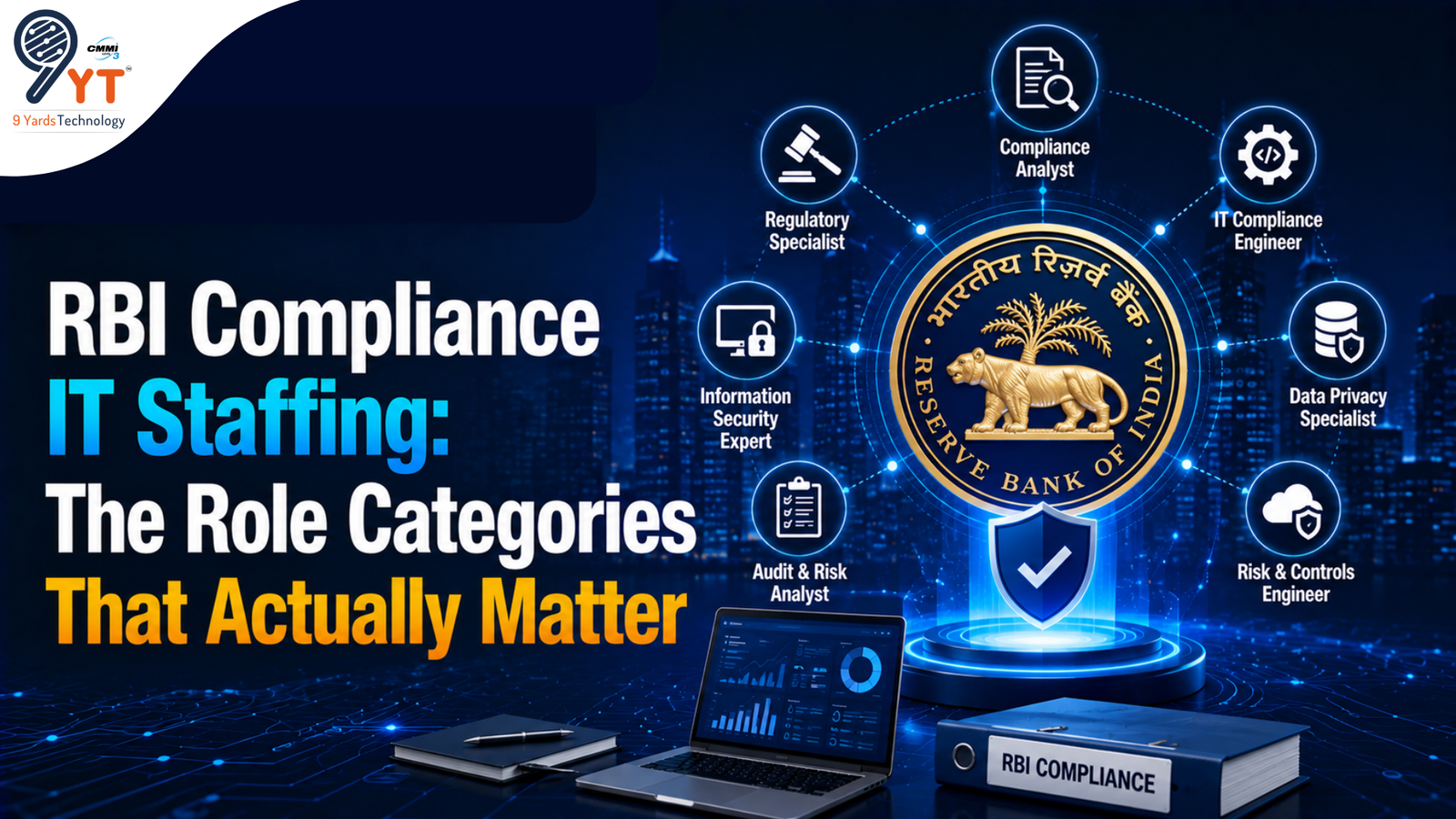
BFSI developer hiring India has a specificity problem. Fintech and BFSI hiring spans several distinct talent pools, each with its own vocabulary, credentialing, and candidate behaviour, and domain-blind sourcing fails most often in roles at the intersection of regulation and technology. A generic staffing agency that sources Java developers will send you Java developers. Whether those developers understand UPI rails, NPCI transaction structures, or AML transaction monitoring logic is a different question.
The engineering roles that BFSI CTOs consistently struggle to fill through standard staffing channels:
Security Engineering: Engineers who understand both application security and the RBI Cyber Security Framework’s specific access-control and DLP mandates. Generalist security engineers exist; engineers who can translate RBI incident-reporting timelines into actual engineering workflows are rare.
AML/KYC Systems Engineers: Building or extending transaction monitoring pipelines requires domain knowledge most software engineers do not carry. AML and KYC specialists familiar with transaction monitoring systems and suspicious activity reporting are among the roles where domain-blind sourcing fails most often.
Data Engineering for Localisation Compliance: Payment data localisation requires engineering, not just legal advice. Someone has to architect the India-resident storage layer, audit the data flows, and certify compliance to the RBI.
DevOps/SRE for Regulated Environments: CI/CD pipelines in a banking environment must satisfy audit logging, change management, and access-control requirements that standard DevOps practice does not address by default.
These are not niche roles. They determine whether your 2026 product roadmap ships on time or stalls on a compliance review.
Data Localisation Compliance Fintech India: What Engineers Actually Build
The RBI’s data localisation mandate is engineering work, not just legal work. The RBI directive requires that all data relating to payment systems operated in India is stored only within India, a requirement that applies across banks, payment gateways, aggregators, digital wallets, and fintech infrastructure providers. Every entity in that list needs engineers who can implement, audit, and certify a compliant storage architecture.
The RBI’s payment data localisation mandate continues to override the DPDP Act’s permissive cross-border provisions, requiring all payment-system data to be stored exclusively on servers in India. Layer the Digital Personal Data Protection Act 2023 on top, and you have two overlapping compliance regimes that require ongoing engineering maintenance, not a one-time implementation.
The engineering tasks that fall directly from data localisation compliance:
- Mapping every data flow across the payment stack to confirm India residency
- Architecting or migrating storage layers to India-domiciled infrastructure
- Building audit logging that satisfies the System Audit Report requirements for CERT-In empanelled auditors
- Maintaining that architecture as the product evolves, UPI transaction volumes grow, and new RBI circulars arrive
This is continuous engineering work. It belongs inside your permanent or augmented engineering team, not a one-time consultant engagement.
Read More: IT Staff Augmentation Companies India 2026: Evaluate Quality Beyond the CV
How to Evaluate a BFSI Staffing Partner: The Criteria That Separate Good from Generic
The staffing industry optimises for placement fees. That incentive is misaligned with your compliance obligations. Retention rate, a written replacement guarantee, and NDA enforceability are the three evaluation criteria that matter most for IT staff augmentation banking India. Most agencies offer none of these as specific, documented commitments.
| Evaluation Criterion | What to Demand | Red Flag |
|---|---|---|
| BFSI domain vetting | Structured technical assessment covering domain-specific knowledge, not just language proficiency | CV shortlist with no technical screen specific to BFSI context |
| NDA and data handling | Written NDA covering data handling obligations for each deployed engineer | Boilerplate NDA with no engineer-level specificity |
| Replacement SLA | Named number of days in writing (e.g., 7 days) | “We’ll handle it” with no contractual commitment |
| Time to first profile | Specific commitment in hours (e.g., 48–72 hours) | “We’ll get back to you shortly” |
| Retention evidence | Published client retention rate with a verifiable basis | Testimonials only, no aggregate retention data |
| Vendor governance | Documented account management, SLA reporting cadence | Single point of contact, no escalation path |
| BFSI developer hiring India track record | Named enterprise clients in regulated sectors | Case studies that describe any industry without specifics |
9Yards Technology’s 95% client retention rate is the number that matters most here. Testimonials can be cherry-picked; a retention rate across 300+ deployed engineers cannot.
The 9Yards Technology Deployment Process for Banking Clients
Speed and compliance are not opposites. The reason most staffing engagements in banking take 60–90 days from requirement to deployed engineer is an absence of a pre-vetted bench and a defined process, not regulatory caution.
9Yards Technology’s Talent Deployment Matrix for banking engagements runs in seven stages:
- Requirement received: Role specification with BFSI domain context, not just a job description
- Talent mapping: Match against a pre-vetted bench that includes security, data, and compliance-fluent engineers
- Screening: Initial qualification against both technical and domain requirements
- Technical assessment: Structured evaluation that tests BFSI-specific knowledge where the role demands it
- Client interview: Your engineering team interviews the shortlisted candidate
- Deployment: Engineer joins your team within 2–3 weeks of requirement receipt
- Performance monitoring: Ongoing tracking, with the 7-day replacement SLA active from day one
Profiles arrive in 48–72 hours. Full deployment happens in 2–3 weeks. If an engineer does not meet your bar within the first weeks, the 7-day replacement SLA applies with no renegotiation and no extra cost.
For banking CTOs who have been burned by agencies that sent unqualified CVs for three weeks and then went quiet, this process is not a promise. It is a contractual commitment.
9Yards Technology Proof Point
TestCrew, a globally operating QA authority serving tier-1 banks and government ministries with zero tolerance for compliance gaps, needed to scale a specialised engineering team in India without establishing a local entity. 9Yards Technology deployed 50+ engineers across Security Engineering, DevOps, Performance Engineering, and AI/ML infrastructure in 85% less time than traditional hiring, a 45% reduction in talent acquisition and operational costs, with full compliance maintained for banking and government ministry clients across international markets. The partnership is active after 5+ years, with zero local India infrastructure required from TestCrew at any point.
This is what IT staff augmentation looks like when it is built for compliance-sensitive environments.
The Cost Reality for BFSI Engineering Roles in India
BFSI contributes approximately 42% of India’s total IT-BPM industry revenue, and its highest-value functions, KYC/AML compliance, underwriting support, financial crime operations, and regulatory reporting, are the least automatable and therefore the most competitively hired. That demand drives salary inflation. Banking executives in India are expected to see around 9% salary increases in 2026, with NBFCs projecting approximately 10% salary growth. Local hiring costs compound annually while the talent pool does not grow at the same pace.
For North America-headquartered fintechs or global banks building India engineering capability, the cost comparison runs sharper. A Senior Security Engineer in the US costs $170,000–$210,000 annually. A pre-vetted Senior Security Engineer deployed through 9Yards Technology from India costs $42,000–$58,000 per year. The annual saving on a single role reaches $112,000–$168,000. Across a 10-person compliance and security engineering team, that differential reaches $1,050,000–$1,600,000 per year, at equivalent seniority, with a documented replacement guarantee the local hire cannot offer.
For Indian banks and NBFCs scaling internal engineering teams, pre-vetted talent in 48–72 hours versus an industry-reported 90-day average time-to-hire recovers roughly 69 days of lost engineering productivity per role. Across a compliance engineering build-out of five to ten engineers, that is a meaningful roadmap impact.
Need pre-vetted engineers in 48–72 hours? Talk to a 9Yards Technology specialist with no obligation and no generic shortlist.
Frequently Asked Questions
What does RBI compliance IT staffing actually require from a staffing vendor?
RBI’s Master Directions on IT Governance place outsourced IT vendors inside a bank’s third-party risk management obligations. This means your staffing partner must support written NDA adherence for each deployed engineer, documented background verification, an auditable governance process, and a contractual replacement SLA. The bank remains accountable to the regulator for any data or compliance incident involving an augmented engineer, so the staffing vendor’s own governance posture is a direct compliance variable, not a secondary concern.
How does data localization compliance fintech India affect engineering team structure?
RBI’s data localisation mandate requires all payment-system data to be stored exclusively on India-domiciled servers. This is continuous engineering work, not a one-time migration. Fintech and payment companies need dedicated engineers to architect and maintain compliant storage layers, map data flows, build audit logging for CERT-In System Audit Reports, and update architecture as products evolve. That requirement points toward long-term augmented engineering capacity inside the team, not a short-term consultant engagement.
Which BFSI developer hiring India roles are hardest to fill through standard staffing?
The hardest roles to fill sit at the intersection of technology and regulation: AML/KYC systems engineers who understand transaction monitoring and suspicious activity reporting, security engineers fluent in the RBI Cyber Security Framework’s specific access-control and DLP requirements, data engineers who can architect RBI-compliant storage layers, and DevOps/SRE engineers experienced in audit-logging and change management for regulated environments. Generic staffing agencies screen for programming language proficiency; they rarely screen for BFSI domain context, which is the actual differentiator for these roles.
How fast can AML KYC compliance engineer staffing actually move with a pre-vetted model?
With a pre-vetted bench and a defined Talent Deployment Matrix, the first shortlisted profiles for AML/KYC and security engineering roles arrive in 48–72 hours, with full deployment within 2–3 weeks. The industry-reported average time-to-hire for equivalent roles through traditional channels is approximately 90 days. The gap, roughly 69 days per hire, represents real engineering capacity and compliance readiness lost to a slow sourcing process. A 7-day replacement SLA means underperformance does not extend that gap further.