

 Post by
Introduction: Why the Operating Model, Not the Talent, Makes or Breaks the Engagement
Managing an offshore augmented team in India separates engineering leaders who compound hiring problems from those who solve them permanently. The engineers themselves are rarely the issue. What matters is your operating model.
Flexible staffing arrangements like IT staff augmentation have moved from a niche tactic to a mainstream workforce strategy, with a large majority of organizations now actively using or considering them.
9Yards Technology has deployed 300+ engineers across enterprise clients including SHL and Talkdesk. The pattern holds consistently: teams that lock in offshore team performance KPIs and governance structures before day one outperforms those retrofitting governance after a missed sprint by a wide margin.
The teams that struggle aren’t the ones that had a bad kickoff, they’re the ones whose governance rhythm collapsed after month two. Most competing guides treat offshore management as a one-time setup problem: pick your tools, agree on time zones, do a cultural briefing. That framing misses the point entirely.
You are not managing an outsourced project. You are managing engineers embedded inside your sprint cadence, your code review process, and your delivery culture. The integration model must run with the same discipline at month nine as it did at week one. The moment it doesn’t, quality drifts silently, and by the time it shows up in a sprint retrospective, you have lost two months of output.
Read More: How to Integrate Offshore Engineers: A Deployment-First Framework
What Managing an Offshore Augmented Team Actually Means
Staff augmentation and outsourcing are structurally different models, conflating them is the single fastest way to set up a governance failure. With outsourcing, you hand a specification to a vendor and review a deliverable. With IT staff augmentation, the engineers sit inside your team, attend your standups, own tickets, and report into your tech leads. The vendor’s job is vetting, deployment, and replacement, not day-to-day delivery management. The distinction matters because it shapes accountability from day one: a widely cited Harvard Business Review analysis on offshoring found that engagements go wrong most often not from a talent gap, but from unclear process ownership between client and provider.
The IST/EST time zone gap is approximately 9.5 hours. That sounds like an obstacle; it is actually a structured asset. A 3-4 hour overlap window (approximately 7:30 AM-11:30 AM EST mapping to 5:00 PM-9:00 PM IST) is enough for live standups, code reviews, and sprint ceremonies. Outside that window, async-first communication keeps both sides moving without blocking each other.
Pre-vetted engineers who join with production-grade context, not graduates being ramped from zero, reach meaningful delivery contribution inside 2-3 weeks. The onboarding challenge most guides describe at length is largely a vetting problem: solve vetting before deployment, and onboarding becomes a process of context transfer, not capability building.
McKinsey research on distributed team performance confirms that employees included in detailed, consistent communication are nearly five times more likely to report increased productivity, and this is a sustained-cadence finding, not just a week-one benefit.
What “Offshore Team Integration” Actually Means in Practice
Most guides treat integration as a communication problem. It isn’t. Communication is the symptom. Accountability structure is the root cause.
When an engineer sits down the hall, accountability is ambient: informal check-ins, visible progress, hallway conversations. Three time zones away, none of that exists. Every accountability mechanism must be explicit, written, and agreed on before work starts.
The onshore-offshore team integration model that scales has three layers:
- A clear reporting line: the offshore engineer reports to a named technical owner on the client side, not to a generic team.
- A defined handoff protocol: specifying what gets written down, when, and in which tool.
- A shared definition of done: that includes documentation, not just a merged PR.
Teams that skip layer two accumulate documentation debt that compounds over quarters. By month six, the offshore engineer holds institutional knowledge no one else has. By month twelve, their departure creates a crisis no SLA can fully repair. Build the documentation habit during onboarding, not after the first incident.
Offshore Team Communication Best Practices That Hold at Month Nine
Every guide covers week-one communication setup. Almost none address why the communication model breaks down at month five. The answer is always the same: the structure that worked when everyone was paying close attention stops getting enforced when the team feels comfortable, and the onshore lead moves focus to a new initiative.
Three communication commitments that hold over time:
Daily async standup in writing. Not a video call. A written update: what shipped yesterday, what is in progress today, what is blocked. Written updates create a searchable record and force clarity in a way verbal standups do not.
One live sync per week minimum, two during active sprints. The live session is for decisions, not status. Status lives in the async update. The live session exists to unblock, realign, and catch the signal that only comes from a real conversation.
A documented escalation path with named owners. Who does the offshore tech lead contact when a production incident hits at 11 PM IST? That answer must exist in a shared document before the incident happens, not be improvised during it.
One rule that governs all three: if a communication norm stops being enforced, name it explicitly in the next sync and reset. Letting it slide silently trains the team that governance is optional.
Week-one communication sequencing:
Synchronous-heavy by design, daily 30-minute standups with video are required, not optional. The goal in the first four days is not status updates but accent calibration, communication-style mapping, and catching ambiguity in requirements before it costs sprint velocity.
From week two, shift to structured async: each offshore engineer writes a three-sentence end-of-day summary covering what was completed, what is blocked, and what is planned for tomorrow. This takes two minutes to write and ten seconds to read, it eliminates 80% of “I didn’t know they were blocked” conversations.
India Offshore Team Governance and Documentation
Governance is the word that makes engineers glaze over. It shouldn’t. At the team level, governance means three things: documented standards, a visible audit trail, and a formal review cadence. Before the first engineer writes code, answer three questions:
Who owns what? Define a RACI by function, not by person. People leave; functions don’t. A RACI across at least these six friction points covers 80% of governance gaps:
- Backlog prioritization: Onshore product owner owns. Offshore tech lead inputs capacity estimates before finalization.
- Technical architecture decisions: Shared. No architecture decision record (ADR) is merged without sign-off from both sides.
- Day-to-day task sequencing: Offshore team owns entirely. Onshore lead reviews at sprint review, not daily.
- Production incident response: Offshore on-call owns initial triage. Onshore lead is notified within 30 minutes for P1.
- Code review approval: Peer review from same side, final approval from senior on either side. No single-reviewer merges.
- Tooling and environment access: Onshore IT provisions. Offshore tech lead confirms access within 48 hours of engineer deployment.
Where does knowledge live? One canonical home for every artifact, architecture decision records in Confluence, runbooks in the same space, not scattered across personal drives. Define this before deployment.
What triggers escalation? Define explicitly: what does an offshore engineer do when blocked for more than two hours? Who do they contact? What response SLA does the onshore owner commit to?
Documentation SLA
The governance layer most guides skip is documentation ownership: who on the offshore team owns the living documentation for the systems they are building? The fix is a documentation SLA, every merged PR that introduces a new service, modifies an integration point, or changes an API contract requires an updated doc block or README section before the PR is approved. This is enforced at code review, not by a separate documentation sprint that never gets prioritized.
Governance Framework Table
| Governance Area | Minimum Standard | Red Flag |
|---|---|---|
| Documentation | PR-level requirement, README owned by offshore tech lead | Updated quarterly in batches, not per PR |
| Sprint Review | Bi-weekly demo to onshore stakeholder | Monthly or skipped when team is “on track” |
| KPI Review | Weekly velocity + defect rate review with account manager | Only reviewed when a deadline slips |
| Escalation | Named owner per incident type, <2-hour SLA for P1 | Undocumented or informal |
| Replacement Protocol | 7-day replacement SLA, written into engagement terms | Handled ad hoc, timeline undefined |
| NDA / IP Compliance | 100% adherence, formal sign-off per engineer | Blanket vendor NDA with no per-engineer coverage |
Offshore Team Performance KPIs: What to Track and When to Act
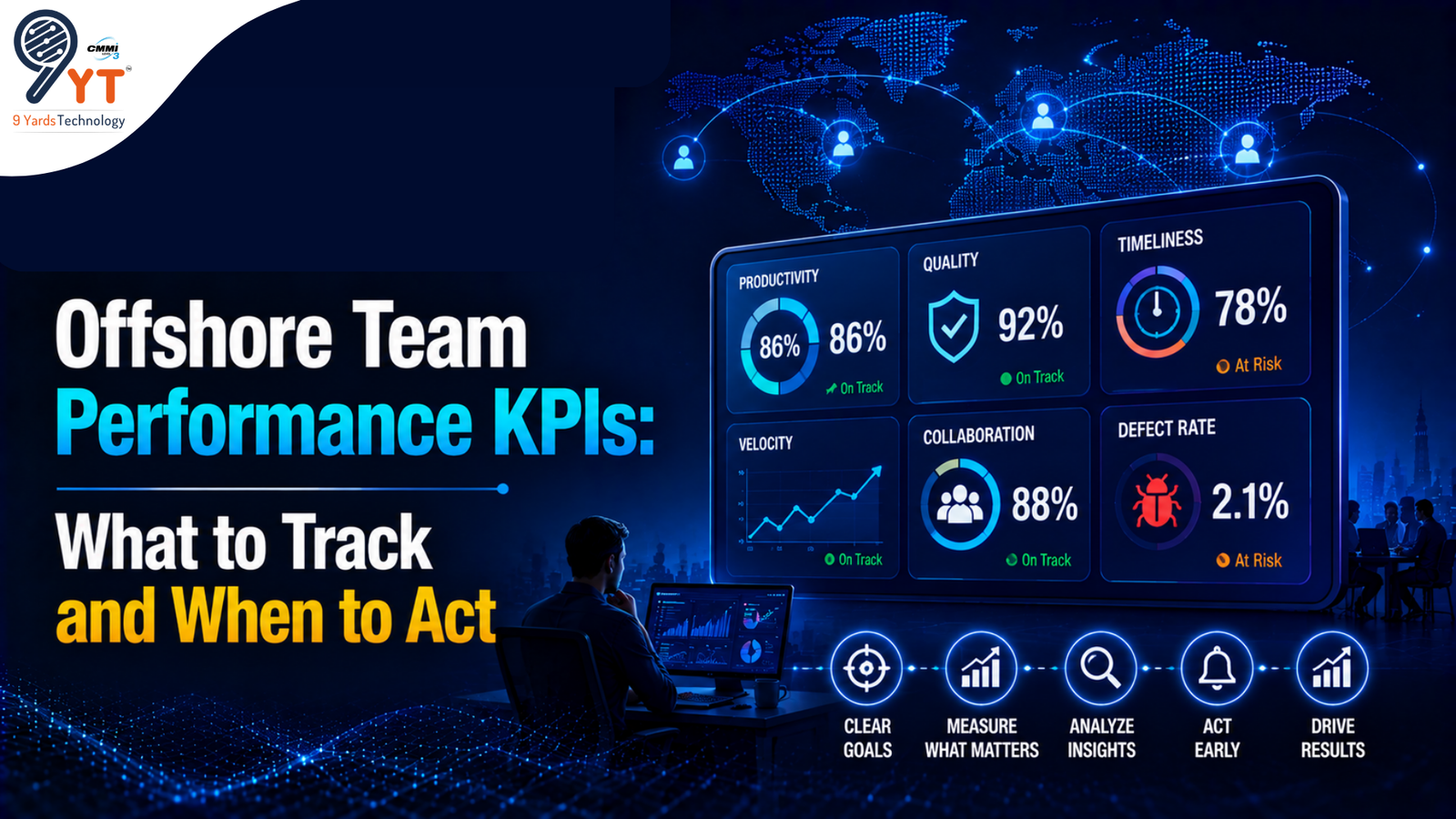
Most performance frameworks list the right metrics but almost none specify the trigger point, the number at which a KPI reading requires action, not just a note in a spreadsheet.
Five KPIs that carry signal for an augmented India team, with trigger points:
Sprint velocity variance. A single sprint at minus 20% is noise. Two consecutive sprints at minus 20% is a governance signal. Three is a retention risk.
Defect escape rate. Defects caught in QA are expected. Defects reaching production from an augmented QA-enabled team require a root cause review within 48 hours, not the next retrospective.
PR review turnaround. If the average time from PR open to first review exceeds 24 hours, the integration model has a bottleneck. This is almost always on the onshore side.
Documentation coverage. Percentage of merged PRs that include a doc update. Benchmark: 90% or above. Below 70% signals the documentation SLA is not being enforced at code review.
Engineer retention. Measured quarterly. A single departure in a 10-person team is within normal variance. Two departures in a quarter from the same team warrants a conversation with the account manager. Engineers consistently cite unclear ownership and poor documentation as leading reasons for disengagement.
Velocity typically stabilizes over 4-8 weeks from deployment. After that point, a sustained downward trend in any two of these five KPIs at the same time is a trigger for a formal review.
What Breaks the Model After 12 Months
The 12-18 month window is where augmented team quality most commonly drifts. The cause is predictable: the engagement started well, trust was built, and the governance cadences that created that trust were gradually deprioritized as the relationship felt stable.
Three specific failure patterns:
Governance theater. The bi-weekly KPI review still happens, but nobody acts on a reading outside the target range. Fix it: every KPI review must end with either “no action required” (stated explicitly) or a named action with an owner and a deadline.
Ownership creep. Over time, offshore engineers start taking on tasks never formally scoped into their role. Six months later, nobody knows exactly what the offshore team owns, making capacity planning impossible. Fix it: review the RACI every quarter, not just at kickoff.
Attrition without notice. The most damaging version is when a high-performing offshore engineer is considering leaving and nobody on the onshore side knows until they’ve already accepted another offer. Fix it: account manager-level check-ins with individual engineers every quarter, separate from the sprint process.
The difference between a 5-year partnership and a 9-month disappointment is rarely the quality of the initial engineers deployed. It is whether the governance model that made the first three months work was maintained with the same discipline for the next 21.
9Yards Technology Proof Points
Talkdesk needed an India engineering hub built from scratch. 9Yards Technology established the full operation in 3 months: 45+ engineers deployed across Engineering, QA, Security, ERP, and Business Analysis. Hiring speed improved 80%. Talent costs dropped 50% against US equivalents. The Talkdesk team continues to expand through active 9Yards Technology deployments across multiple functions. A multi-year relationship not built on a good kickoff call, but on sustained governance discipline.
SHL deployed 60+ engineers across Product Engineering, QA, Performance Engineering, and Business Analysis through a BOT model. Full deployment was achieved in 2 months, with 70% improvement in deployment speed, 60% improvement in hiring efficiency, and 20% reduction in talent acquisition costs. The partnership has remained active for 5+ years.
Frequently Asked Questions
What offshore team communication best practices prevent quality drift after month six?
The practices that prevent quality drift after month six are the same ones that worked in month one, enforced consistently: daily written async standups, one live weekly sync focused on decisions not status, a documented escalation path with named owners, and bi-weekly KPI reviews that require a named action or an explicit “no action” decision.
How does an onshore-offshore team integration model define ownership?
A functioning integration model requires a RACI across at least six friction points: backlog prioritization, architecture decisions, day-to-day task sequencing, production incident response, code review approval, and tooling access. Onshore owns product priority and final architecture sign-off. The offshore tech lead owns daily sequencing and initial incident triage. No architecture decision record is merged without sign-off from both sides.
What offshore team performance KPIs should a VP Engineering track?
Track five KPIs with defined trigger points: sprint velocity variance (two consecutive sprints at minus 20% requires investigation), defect escape rate to production (any occurrence triggers a 48-hour root cause review), PR review turnaround (above 24 hours signals an onshore bottleneck), documentation coverage per merged PR (below 70% means the doc SLA is not being enforced), and engineer retention (two departures in a quarter from one team warrants an account manager conversation).
How long does it take to fully integrate an offshore augmented India engineering team?
With pre-vetted engineers and a structured onboarding process, delivery contribution typically begins within 2-3 weeks of deployment. Full velocity stabilization, where sprint output is consistent and the integration model is running without active management intervention, takes 4-8 weeks from the first sprint. Time-to-velocity is primarily a context transfer problem, not a capability problem, when engineers are pre-vetted before deployment.
Need pre-vetted engineers deployed and integrated in 2–3 weeks? Talk to a 9Yards Technology specialist with no obligation and no generic shortlist.