

 Post by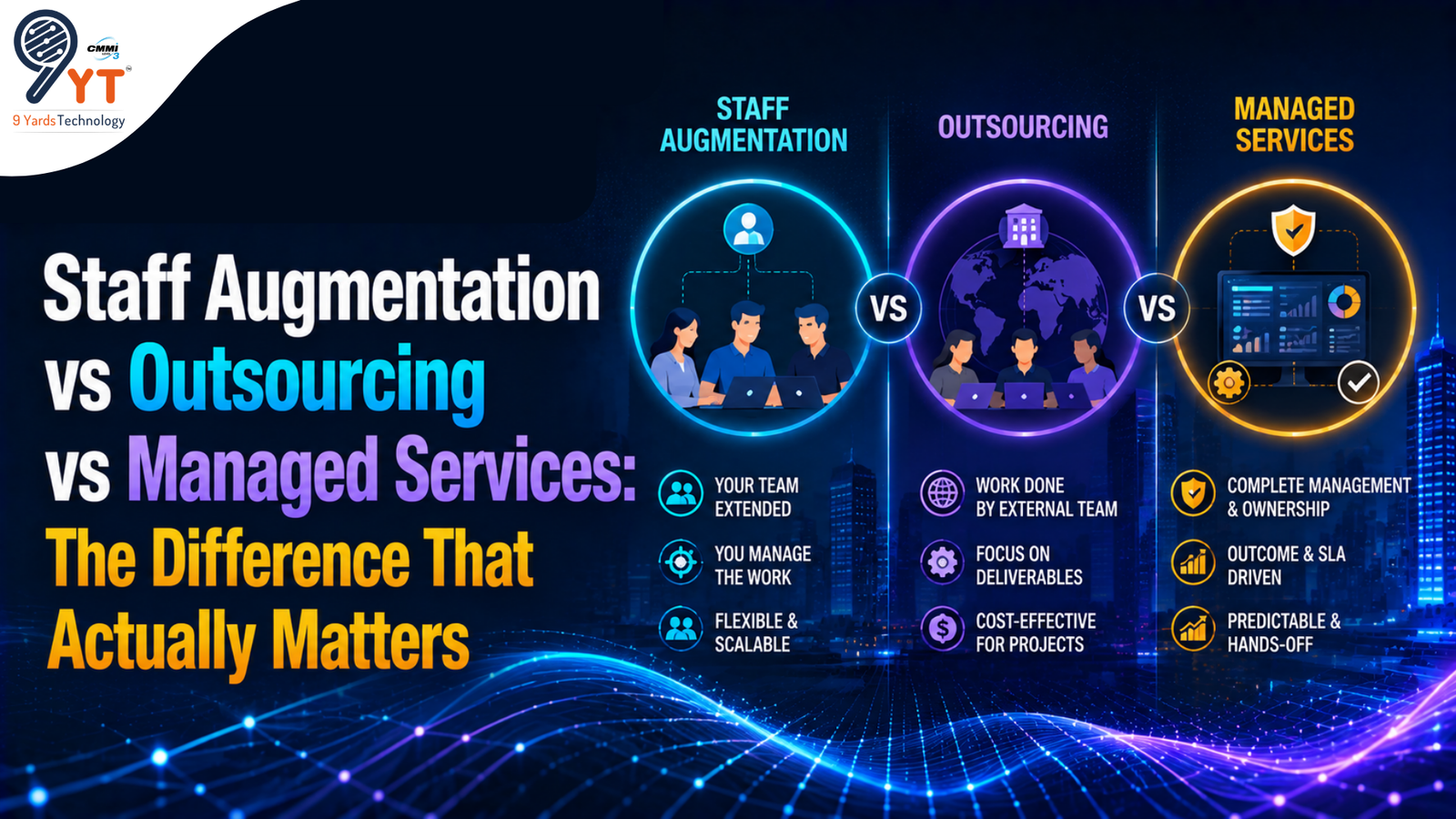
Here’s a problem I see constantly. Companies use “outsourcing,” “staff augmentation,” and “managed services” as if they’re three ways of saying the same thing. They’re not. Not even close.
The differences aren’t just semantic. They determine who controls your codebase, who owns your IP, who’s responsible when a deadline slips, and – critically – what happens to the institutional knowledge your team has built when the engagement ends. Getting this wrong doesn’t just waste money. It creates the kind of operational mess that takes months to untangle.
I’ve seen engineering teams augment their staff when they needed a managed service. I’ve seen CTOs outsource work that required daily sprint involvement. Both decisions are fixable. But both are preventable. This article gives you the framework to get it right the first time.
What Is Staff Augmentation, Really?
Let’s start with what staff augmentation actually is – not the marketing version.
You have a gap on your team. Maybe your lead DevOps engineer left. Maybe you’re scaling faster than you can hire. Maybe you need a specific skill for a specific sprint and you can’t wait 90 days to find someone locally. Staff augmentation is how you solve that problem without giving up control of your product.
A pre-vetted engineer joins your team. They’re in your Slack. They attend your standups. They pick up Jira tickets the same way any team member would. They report to your engineering lead. They follow your code standards. Your lead makes the architectural decisions. Not the vendor. Not some third-party project manager sitting three management layers away from the actual work.
That last part is what makes staff augmentation different from everything else. Control stays with you.
Read More: How IT Staff Augmentation Works: Step-by-Step
What it’s not – and this matters
A lot of vendors call their service “staff augmentation” when they’re actually running a managed service or a lightly disguised outsourcing arrangement. If the vendor is assigning tasks, managing sprints, or making daily delivery decisions on your behalf – that’s not staff augmentation. That’s managed services with a different label. Always ask who’s directing the engineer’s daily work. If the honest answer isn’t “your team,” the model doesn’t match the label.
How the employment side works
In a proper staff augmentation engagement, engineers are employed by the vendor entity – not by you. The vendor pays salaries, handles statutory contributions, and carries compliance liability. You sign a services agreement with the vendor, not an employment contract with each engineer individually. This keeps payroll complexity off your plate and – for companies hiring across borders – eliminates permanent establishment risk.
What Outsourcing Actually Means
Outsourcing is simpler than most people make it. You hand a vendor a defined piece of work. They build it. They own the team, the process, the internal decisions. You review the output at agreed milestones.
That’s it. The vendor manages the people. You manage the vendor relationship.
Outsourcing works beautifully for the right kind of work. A clearly specced data migration. A specific module with documented inputs and outputs. A performance testing engagement with a defined scope. In these situations, the accountability transfer to the vendor is an asset – you’re buying a result, not managing a team.
Where it falls apart is when companies try to outsource work that’s inherently collaborative. Product features that evolve sprint by sprint. Architecture work that requires constant context about business direction. Anything where the specification will change before delivery is complete. In those situations, outsourcing creates a coordination problem that compounds every week. The vendor builds to a spec that’s already stale. Change orders start. Costs creep. Timelines slip. And the product context that should live inside your team ends up sitting in a vendor’s project management tool instead.
The IP conversation nobody has early enough
Here’s something that bites companies regularly: IP ownership in outsourcing isn’t automatic. It depends entirely on what your contract says. “Work made for hire” language needs to be explicit. IP assignment clauses need to be watertight. Vague phrases like “to the best of the vendor’s knowledge” in IP sections create disputes. The Deloitte Global Outsourcing Survey consistently finds contract structure – not cost, not talent quality – is the leading driver of outsourcing disputes. Read the contract. Every clause.
What Managed Services Is (and Isn’t)
Managed services is what you buy when you want a function to run reliably without managing the people running it.
Think 24/7 security monitoring. You need someone watching for threats around the clock, responding to incidents, escalating appropriately. You don’t want to manage a rota of on-call engineers yourself. You want a provider who guarantees coverage, response times, and escalation – and you hold them to those outcomes via an SLA. Whether they use three engineers or seven engineers or automated tooling supplemented by human review isn’t your concern. The outcome is.
That’s the core of managed services. You’re buying an operational outcome, not managing people to produce it.
Common examples include managed QA (test automation ownership across an entire product), managed cloud operations (infrastructure monitoring, patching, scaling), and managed DevOps (CI/CD pipeline ownership). What these have in common is that they’re ongoing, operational, and measurable by outcome rather than by the daily work of any specific engineer.
The trade-off you’re making
Managed services exchanges control for operational certainty. You won’t decide how the provider staffs the function. You won’t choose their tools. You won’t set their internal process. You govern through the SLA and periodic reviews. For some engineering leaders, this is liberating – especially for functions that aren’t core to your competitive differentiation. For others, particularly those who need full technical authority over everything that touches the product, it’s a trade-off that doesn’t work.
Know which camp you’re in before you sign.
Managed services vs outsourcing – they’re not the same
People use these terms interchangeably. They shouldn’t. Outsourcing is typically project-based: a deliverable, a deadline, a contract end-date. Managed services is ongoing: a recurring function, a recurring SLA, an ongoing relationship. The difference matters for how you structure the contract, how you govern the engagement, and how painful it is to switch providers when something goes wrong.
The One Question That Settles the Choice
Before you look at cost, speed, or anything else – answer this:
Who do you want directing the engineers’ daily work?
If the answer is you – your engineering lead, your sprint ceremonies, your architecture decisions – you need staff augmentation. Full stop.
If you’re willing to transfer that direction to a vendor and govern by outputs – a deliverable, an SLA, a milestone – then outsourcing or managed services become options.
| Comparison Factor | Staff Augmentation | Outsourcing | Managed Services |
|---|---|---|---|
| Who directs daily work | Your team | Vendor | Vendor |
| Who owns IP | You (always) | You (if contracted right) | You (if contracted right) |
| Who sets sprint priorities | Your engineering lead | Vendor PM | Vendor (per SLA) |
| Delivery accountability | Your team | Vendor | Vendor |
| Engagement type | Flexible | Project-defined | Ongoing |
| Best for | Specific skill gaps | Defined deliverables | Ongoing operations |
Every other consideration flows from this table. Cost, flexibility, speed – all secondary to who’s actually directing the work.
Staff Augmentation vs Outsourcing: Where the Real Differences Bite
The information asymmetry problem in outsourcing
This is the one nobody talks about until it’s already a problem.
When you run an outsourced engagement, product context accumulates on the vendor’s side. Their project manager knows your requirements history. Their tech lead knows why certain architectural decisions were made. Their QA team knows which edge cases have already bitten you. The longer the engagement runs, the more of that knowledge lives with the vendor – and the harder it becomes to switch, bring work back in-house, or even run a proper handover.
Staff augmentation doesn’t have this problem. The engineers are on your team. The knowledge stays in your team. When the engagement ends, your team retains everything.
Speed to actual contribution
A pre-vetted staff augmentation engineer who joins week one can be in your standup on day one, into your codebase by day three, contributing to sprint tickets within the first week. That assumes your onboarding process is built for it – and if it isn’t, it should be.
An outsourced team starts with discovery. Then scoping. Then a kickoff. Then the first sprint of the vendor’s development cycle. You’re typically looking at two to four weeks before any code is written to your requirements. For clearly scoped, well-documented work, that’s fine. For sprint-by-sprint product work, it’s a structural disadvantage.
When outsourcing genuinely wins
I want to be fair here. Outsourcing isn’t the wrong model – it’s just the wrong model for the wrong type of work.
If you have a well-specified database migration, a documented API integration with clear inputs and outputs, or a performance testing engagement with a defined scope – outsourcing is probably your best option. The vendor takes the spec, builds to it, delivers a tested and documented output. You review at milestones. Clean accountability, predictable engagement.
Where it breaks down: scope that evolves, work that requires deep product context, anything where you need full daily visibility into decisions.
Staff Augmentation vs Managed Services: The Control Question
You keep the wheel, or you hand it over
Staff augmentation is additive. You get more capacity that you direct. The engineering function – the decisions, the standards, the priorities – remains yours.
Managed services is substitutive. You hand a function to a provider who runs it. You define outcomes. They decide how to achieve them.
For core product development, this distinction matters enormously. If your engineering lead needs to make daily decisions about architecture, code quality, and feature direction – managed services takes those decisions away from them. For operational functions that run predictably and can be governed by SLAs – the distinction becomes less important.
The rotation problem with managed services
In staff augmentation, the longer an engineer works with your team, the more valuable they become. They know your codebase. They know why things were built a certain way. They know what’s been tried and didn’t work. That accumulated context is real value that compounds over time.
In managed services, the provider staffs the function however they see fit. Staff rotates. The person who resolved your critical incident last month might not be available next month. For operational functions this is often fine – the process is documented, the tooling is consistent, the outcome is the SLA. For functions where institutional knowledge matters, it’s a real risk.
When managed services wins
Honestly? 24/7 security monitoring is where managed services makes the most sense and the argument is airtight. You need coverage around the clock. You need defined response times. You need escalation protocols. You need someone who picks up the 2 AM alert. You do not need to manage the person who picks it up.
That’s exactly what managed services is for.
Trying to staff augment your way into 24/7 monitoring means you’re managing security operations directly – scheduling, on-call, tooling, process. That’s the operational overhead you were trying to avoid in the first place.
Which Model Fits Your Situation: A Quick Reference
| Your Situation | Right Model | Why |
|---|---|---|
| Senior engineer unfilled, release delayed | Staff augmentation | You need someone in your standup, not a managed deliverable |
| Specific feature, clear spec, hard deadline | Outsourcing | Defined scope, clean accountability transfer |
| 24/7 infra monitoring you don’t want to manage | Managed services | Outcome-based SLA, provider manages operations |
| Scaling from 5 to 20 engineers for a growth push | Staff augmentation | Team extension with your leadership intact |
| Database migration to new architecture | Outsourcing | Defined scope, limited product context needed |
| QA automation ownership across a product | Managed services | Ongoing function, outcome-based coverage SLA |
| DevOps engineer needed for platform work this sprint | Staff augmentation | In your standup, your direction, your sprint |
| MVP build while your team focuses elsewhere | Outsourcing | Separate delivery track, clean scope |
| Compliance monitoring in a regulated environment | Managed services | Operational certainty, specialist SLA coverage |
Read More: Staff Augmentation Engagement Models India: Choose Right
Why India Changes the Staff Augmentation Math
For companies in the US, UK, UAE, and Australia, hiring from India through a structured staff augmentation model changes the economics in ways outsourcing and managed services simply can’t match for core engineering work.
Local hiring for a senior engineer in the US averages about 90 days from posting to day one on the job. A pre-vetted India profile through 9Yards Technology arrives in 48-72 hours. That’s 69 days of engineering velocity recovered per hire. At a product-critical moment, that gap is the difference between shipping and slipping.
The cost picture is equally stark. According to the US Bureau of Labor Statistics Occupational Outlook Handbook, the median annual wage for software developers was $133,080 in May 2024, with senior and specialist roles commanding $160,000 to $200,000 or more at the upper end of the market. The same calibre of pre-vetted engineer from 9Yards Technology’s India delivery runs $40,000 to $55,000 – a saving of $105,000 to $160,000 per engineer per year, before your account for benefits, payroll taxes, and onboarding overhead.
NASSCOM’s Technology Sector in India: Strategic Review documents approximately 1.5 million engineering graduates entering the Indian market annually. The talent pool isn’t just deep in common roles – it covers DevOps, cloud, data engineering, QA automation, security, AI/ML, and SAP at senior levels. Bench talent exists across every major stack.
Outsourcing from India has the same cost geography advantage but transfers control. Managed services from India has the same advantage but operates under SLA governance. Staff augmentation from India is the only model that captures the full cost benefit while you keep your hands on the wheel.
Read More: Offshore Staff Augmentation for US Companies: The Compliance-First Guide
What the Numbers Actually Look Like
Staff augmentation from India is priced on an annual or monthly per-engineer basis. Here’s the verified cost comparison for senior roles:
| Role | US Annual | India Annual | Annual Saving |
|---|---|---|---|
| Senior Software Engineer | $160,000–$200,000 | $40,000–$55,000 | $105,000–$160,000 |
| Senior DevOps / SRE | $170,000–$210,000 | $42,000–$58,000 | $112,000–$168,000 |
| Senior Data Engineer | $165,000–$205,000 | $38,000–$52,000 | $113,000–$167,000 |
| Senior AI / ML Engineer | $180,000–$220,000 | $45,000–$60,000 | $120,000–$175,000 |
| Senior QA Automation | $120,000–$150,000 | $28,000–$40,000 | $80,000–$122,000 |
| Senior Cloud Architect | $175,000–$215,000 | $48,000–$65,000 | $110,000–$167,000 |
| Senior SAP Consultant | $155,000–$195,000 | $40,000–$55,000 | $100,000–$155,000 |
A 10-person senior engineering team saves $1,050,000 to $1,600,000 annually depending on role mix. The savings percentage runs 68-76% across all roles – computed from the table, not pulled from a marketing claim.
Read More: Staff Augmentation vs Outsourcing: The Decision That Actually Protects Your Roadmap
One more thing on cost structure worth knowing: staff augmentation sits as operating expenditure. It scales with headcount. No severance, no long-term benefit obligations, no multi-month notice period when priorities shift.
How to Evaluate a Staff Augmentation Partner Before You Sign
Model choice matters. Partner choice matters just as much. Here’s what separates a structured staff augmentation partner from a body shop dressed up in better language:
A specific, published retention rate. The industry average sits around 70%. A partner at 95% retention across 300+ deployments is not the same product. Generic testimonials don’t tell you much. A specific rate across a documented number of deployments is much harder to fake.
A written replacement SLA with a day count. “We’ll make it right” is not an SLA. A 7-day written replacement guarantee is auditable. If a partner won’t commit to a specific number of days in writing, they’re telling you something about their confidence in their own vetting.
Bench depth, not just sourcing capability. Ask this directly: can you deliver profiles within 48-72 hours from a pre-vetted bench, or do you post to job boards after I send the requirement? One of these is a staffing firm with a real bench. The other is a recruitment agency with margin attached.
Named references with verifiable outcomes. Specific clients, specific engineer counts, specific timelines and results. Not “a leading fintech company” or “a major enterprise client.” Named. Verifiable. Checkable.
Compliant employment structure. Engineers should be on the vendor’s payroll under local labour law – not engaged as independent contractors. This protects you from employment liability and, in cross-border engagements, from permanent establishment exposure.
Read More: Staff Augmentation Contract India: What to Verify Before Signing
What 9Yards Technology’s Track Record Looks Like
SHL – Product Engineering Scaled in 2 Months
SHL needed 60+ engineers across Product Engineering, QA, Performance Engineering, and Business Analysis. Their internal process was running 90 days per senior hire. 9Yards Technology deployed all 60+ in two months through a Build-Operate-Transfer model: 70% faster resource deployment, 60% improvement in hiring efficiency, 20% reduction in talent acquisition costs. The partnership is now 5+ years old and still active.
60+ Engineers | 2 Months | 70% Faster | 60% Efficiency Gain | 20% Cost Reduction | 5+ Year Partnership
Talkdesk – Full India Engineering Hub in 3 Months
Talkdesk needed a complete India engineering hub, not a few contractors. Fast, at SaaS speed, with engineers who’d work seamlessly alongside US-based product teams from day one. 9Yards Technology deployed 45+ engineers across Engineering, QA, Security, ERP, and Business Analysis in three months. Hiring was 80% faster than Talkdesk’s prior process. Talent costs dropped 50%. The hub is still running and expanding.
45+ Engineers | 3 Months | 80% Faster Hiring | 50% Cost Drop | Still Active
TestCrew – Zero-Footprint GCC Hub, Zero Local Infrastructure
TestCrew is the GCC region’s leading QA authority – their clients include tier-1 banks and government ministries in Saudi Arabia. They needed specialized engineering talent in India without the complexity of setting up a local entity. 9Yards Technology deployed 50+ engineers across Manual and Automation Testing, DevOps, Performance Engineering, Security Engineering, and AI/ML infrastructure. Deployment was 85% faster than traditional hiring. Costs came in 45% lower. The client needed zero local India infrastructure setup. That engagement has run for 5+ years.
50+ Engineers | 85% Faster | 45% Cost Savings | 5+ Years | Zero Local Infra
We’ll put pre-vetted profiles in your inbox within 72 hours of your requirement. If we can’t – we haven’t done our job. No obligation. No generic shortlist.
Frequently Asked Questions
What is the difference between staff augmentation and outsourcing?
Staff augmentation puts pre-vetted engineers inside your team, working under your direction. You set the priorities, run the standups, review the code, and own the IP automatically – because you’re directing the work. Outsourcing transfers a defined piece of work to a vendor who manages their own team and reports back on outcomes. The fundamental difference is control: in staff augmentation you have it, in outsourcing you’ve transferred it.
What is the difference between staff augmentation and managed services?
Staff augmentation adds engineers that you direct. The function stays yours. Managed services replaces your management of a function entirely – a provider runs security monitoring or QA or cloud operations under a service-level agreement, and you govern through outcomes rather than through direct management. The right choice depends on whether you need engineers you can direct, or operational certainty over a function you don’t want to manage internally.
When should I choose staff augmentation over outsourcing?
Choose staff augmentation whenever the work requires daily direction, deep product context, or real-time architectural decisions. If your engineering lead needs to be in standups with the engineer, reviewing code, and setting sprint-by-sprint priorities – that’s a staff augmentation situation. It’s also the right model when IP protection matters most: the control structure makes ownership unambiguous in a way that outsourcing contracts often don’t.
How fast can 9Yards Technology deploy pre-vetted engineers?
Shortlisted profiles from the pre-vetted bench arrive within 48-72 hours of receiving your requirement. Full deployment – including interviews, onboarding, and sprint integration – completes within 2-3 weeks for bench talent, or 14 days for market-sourced specialists. Compare that to the approximately 90-day average for traditional local hiring of a senior engineering role. And if a deployed engineer doesn’t meet expectations within the first weeks? A replacement is deployed within 7 days at no additional cost, from the bench – not from a new sourcing cycle.