

 Post by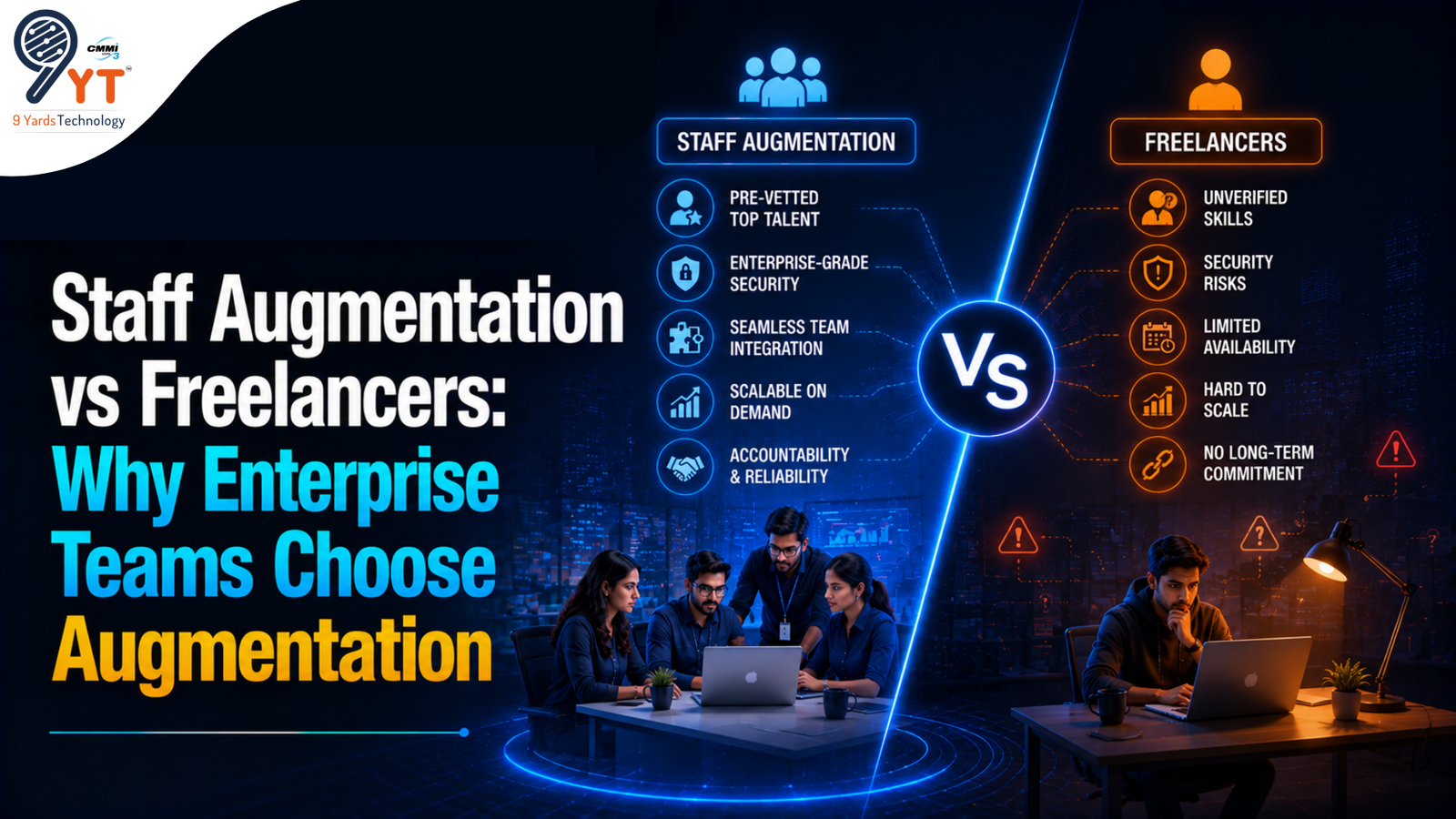
The staff augmentation vs freelancers debate looks like a cost question on the surface. It is not. When Talkdesk needed to build an India engineering hub, they did not post on a freelance marketplace. They deployed 45+ pre-vetted engineers through IT staff augmentation in 3 months, cutting hiring time by 80%. The reason is straightforward: enterprise teams are not buying headcount. They are buying accountability, a documented vetting process, and a guarantee they can hold a partner to. Freelancers offer none of those three things.
If you have open engineering requisitions that have sat unfilled for 60 days or more, and your current approach involves freelance marketplaces, this article will give you a framework to evaluate the real trade-off.
Staff Augmentation Definition in IT: What It Actually Means
The term gets used loosely, so a precise definition matters here. Staff augmentation in IT is a model where a vendor deploys pre-vetted engineers directly into your existing team structure. The engineers work inside your sprint cycles, your communication channels, and your delivery processes. You retain full control over technical direction and product decisions. The vendor retains the employment relationship, the compliance obligations, and the replacement accountability.
This is meaningfully different from outsourcing, where you hand off a function or a deliverable. It is also different from a freelance engagement, where you hire an individual directly with no intermediary carrying any obligation after the contract is signed.
The IT staff augmentation model sits at a specific point on the spectrum: maximum client control, with the risk of talent quality and continuity sitting with the vendor rather than with you. That risk transfer is the product. When 9Yards Technology quotes a 7-day replacement SLA, that is not a courtesy; it is a public bet on our own vetting process. A vendor who cannot offer a specific, written replacement timeline has no skin in the quality game.
The IT staff augmentation market reflects this shift in how enterprises think about talent. The global market was valued at USD 299.3 billion in 2024 and is projected to reach USD 857.2 billion by 2032 at a 13.2% CAGR, which signals that the industry is not a trend. It is how enterprise engineering gets built at scale.
Read More: Staff Augmentation vs In-House Hiring: Real Cost Comparison
The Real Cost of Freelancers: What the Hourly Rate Hides

Freelancers look cheaper per hour. That framing is the staffing industry’s most effective misdirection.
Consider what the hourly rate does not include. First, vetting costs: when you hire directly from a marketplace, your engineering manager conducts the technical screening. That is four to eight hours of senior engineering time per candidate, multiplied by however many candidates you review before finding one who passes. Second, coordination overhead: a freelancer working across three clients simultaneously is not attending your sprint planning with the same attention as someone deployed exclusively to your team. Third, misclassification and IP exposure: a contractor who has been working full-time on your codebase for 18+ months creates a worker misclassification risk that sits entirely with you. If a classification dispute escalates to an IP ownership claim over the code produced, you are facing legal costs and delayed release timelines that dwarf any hourly savings.
The comparison enterprises actually need to make is not between the hourly rate and the augmentation fee. It is the total cost of a failed hire plus re-hire time vs. the cost of a partner who guarantees a replacement in 7 days.
Freelancers optimise for their own portfolio. Staff augmentation optimises for your delivery. The incentive structures are not comparable.
Read More: Offshore Staff Augmentation Cost Savings: The Real Math
How Workforce Scalability Differs Between the Two Models
Scaling with freelancers and scaling with staff augmentation produce completely different operational outcomes. Understanding this difference is where most enterprise engineering leaders finally make the call.
With freelancers, every scale event is a from-scratch sourcing problem. You post, you screen, you interview, you onboard, and you repeat the cycle for each new role. The Stack Overflow 2024 Developer Survey shows just how competitive and diffuse the developer market is globally, which means marketplace quality is inconsistent and sourcing time compounds as you add more roles.
With pre-vetted staff augmentation, workforce scalability works differently. Profiles for new roles arrive in 48-72 hours because the vetting has already happened. Deployment completes within 2-3 weeks because the onboarding model is structured and repeatable. 9Yards Technology deployed 60+ engineers for SHL across Product Engineering, QA, Performance Engineering, and Business Analysis, all live within 2 months, delivering 70% faster resource deployment, a 60% improvement in hiring efficiency, and a 20% reduction in talent acquisition costs. The partnership is now 5+ years active. SHL did not run 60 separate freelance searches. They engaged one augmentation partner with a documented delivery process.
Scalability is not just a speed argument. It is an institutional knowledge argument. A pre-vetted engineer deployed through a structured model integrates into your team’s context. A freelancer working across multiple clients carries none of that context and leaves with none of it either.
95% of 9Yards Technology’s clients are still active. That number cannot be faked.
The Vetting Gap: What Pre-Vetted Actually Means
Every staffing company claims to vet candidates. Almost none of them define what that means.
“Pre-vetted” at 9Yards Technology means an engineer has cleared a multi-stage process before a single profile reaches a client: initial qualification against role requirements, a structured technical assessment, and a final client interview. The client sees only candidates who have already passed stages one and two. That is why profiles arrive in 48-72 hours rather than requiring days of back-and-forth.
The Talent Deployment Matrix at 9Yards Technology runs in this sequence: requirement received, talent mapping against the pre-vetted bench, internal screening, technical assessment, client interview, deployment, and then ongoing performance monitoring after the engineer joins. Monitoring after deployment is the step most agencies skip. It is also the step that explains the 95% retention rate.
By contrast, freelance marketplaces push self-reported skill ratings and portfolio links. The screening burden falls entirely on the client’s engineering team. For a senior DevOps engineer or a Senior AI/ML engineer, that screening demands real technical depth from your internal team. Every hour spent screening a candidate who does not pass is a direct cost of the freelance model that never appears in the hourly rate comparison.
Head-to-Head: Staff Augmentation vs Freelancers for Enterprise Teams
The table below maps the criteria that enterprise procurement and engineering leadership actually use when evaluating talent models. Use this to run the evaluation for your current situation.
| Evaluation Criterion | Freelancer Model | 9Yards Technology Staff Augmentation |
|---|---|---|
| Workforce scalability | Each hire is a new sourcing cycle | Pre-vetted bench; profiles in 48-72 hours |
| Vetting accountability | The client bears all screening efforts | Multi-stage vetting before the client sees any profile |
| Replacement guarantee | None; you start over | 7-day replacement SLA, no extra cost |
| IP and compliance risk | Misclassification risk sits with the client | 100% NDA adherence; vendor holds employment relationship |
| Team integration | Independent; spans multiple clients | Deployed exclusively to the client, in your sprint cycles |
| Time to productivity | Variable; depends on the individual | 50% faster onboarding through structured deployment |
| Retention visibility | No vendor metric available | 95% client retention rate, independently measurable |
| Engagement model flexibility | Fixed per-project or hourly | T&M, FTE, Fixed Price, Managed Services, BOT |
9YT Proof Point
Talkdesk needed to build an Indian engineering capability fast, with specialists across Engineering, QA, Security, ERP, and Business Analysis who could collaborate seamlessly with a US-based team. 9Yards Technology built the entire India engineering hub in 3 months, deployed 45+ pre-vetted engineers, and reduced hiring time by 80% while cutting talent costs by 50%. The partnership is still active and expanding. No freelance marketplace produces a documented outcome at that delivery speed and scale.
When Freelancers Are the Right Call
This article is not arguing that freelancers are always the wrong choice. A clear-eyed framework requires honesty about where each model fits.
Freelancers work well for a specific, isolated task with a defined deliverable and no integration requirement: a one-off security audit, a design sprint for a new product concept, a short-term data analysis. The engagement is self-contained, the output is easily evaluated, and the relationship ends cleanly when the deliverable is done.
The model breaks down when the work requires integration into your existing codebase and team processes, consistent availability across a sprint cycle, access to your production systems or sensitive data, or the ability to replace the person quickly if they underperform. All four of those conditions are standard for enterprise software engineering roles. That is why enterprise teams choose staff augmentation over freelancers for engineering at scale.
A useful test: if losing this person mid-sprint would materially delay your roadmap, you need a partner with a replacement SLA. A freelancer marketplace does not offer one. Talk to a 9YT specialist if you are trying to work out which model fits your current stage and team structure.
The Deloitte Global 2024 Human Capital Trends report identifies workforce agility as a key organisational priority, with companies actively restructuring how they source and deploy talent. Staff augmentation is the operational expression of that shift for engineering teams: fast access, enforced quality, and a documented off-ramp if the deployment does not work.
Need pre-vetted engineers in 48-72 hours? Talk to a 9YT specialist with no obligation and no generic shortlist.
Frequently Asked Questions
What is the main difference between staff augmentation and hiring freelancers?
The core difference is accountability. With freelancers, the client carries all the risk: vetting, onboarding, compliance, and replacement if the hire underperforms. With IT staff augmentation, the vendor handles pre-vetting, maintains the employment relationship, and is contractually obligated to replace an underperforming engineer within a defined window. At 9Yards Technology, that window is 7 days. Freelancers carry no equivalent replacement obligation.
Is staff augmentation more expensive than freelancers?
The hourly rate for a freelancer is typically lower. Total cost is a different question. Staff augmentation eliminates client-side screening time, reduces misclassification and IP risk, and includes a replacement SLA if the deployment does not work out. When you factor in the cost of a failed freelance hire plus the time to re-source and re-onboard, augmentation from a pre-vetted provider is frequently the lower-cost option over a 6-to-12-month engagement period.
How does staff augmentation support workforce scalability for enterprise teams?
Workforce scalability through staff augmentation works because the vetting has already been done before the client posts a requirement. At 9Yards Technology, profiles arrive in 48-72 hours, and full deployment completes in 2-3 weeks. For comparison, the industry-reported average for traditional hiring runs approximately 90 days per role. When SHL needed to scale by 60 engineers, augmentation delivered all 60 in 2 months. Freelance marketplaces require a separate sourcing cycle for each new role.
What is the staff augmentation definition in IT, and how is it different from outsourcing?
In IT, staff augmentation means deploying pre-vetted external engineers directly into your existing team structure. You retain full control over technical direction, sprint planning, and product decisions. The vendor retains employment, compliance, and replacement accountability. Outsourcing is different: you hand off a deliverable or function to a vendor who operates it independently. Augmentation keeps you in control; outsourcing transfers control. Most enterprise teams want to keep ownership of their engineering processes, which is why augmentation dominates at scale.