

 Post by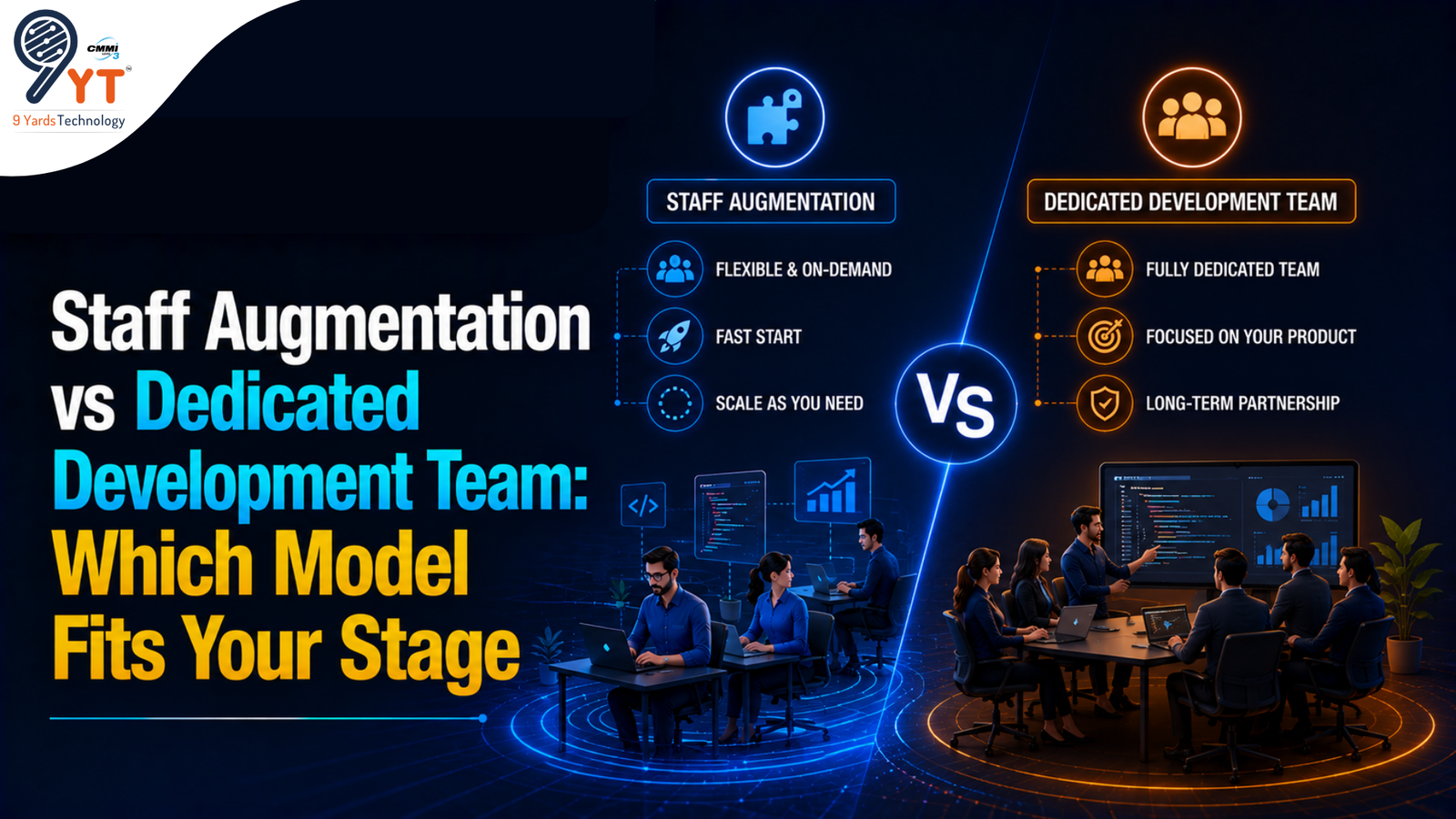
The IT Staff Augmentation vs dedicated development team decision is the one most engineering leaders get wrong, not because the models are confusing, but because every vendor frames the choice around project scope rather than company growth stage. SHL needed 60+ engineers across Product Engineering, QA, Performance Engineering, and Business Analysis. A generic agency would have pitched a dedicated outsourced team. 9Yards Technology deployed all 60+ in two months, achieving 70% faster resource deployment, a 60% improvement in hiring efficiency, and a 20% reduction in talent acquisition costs, and the partnership is now 5+ years active and still running.
If your engineering open roles have been unfilled for 60 days or more, the model question is secondary to the speed question. But choosing the wrong model costs you more than time.
What Technology Staff Augmentation Meaning Actually Is (and Is Not)
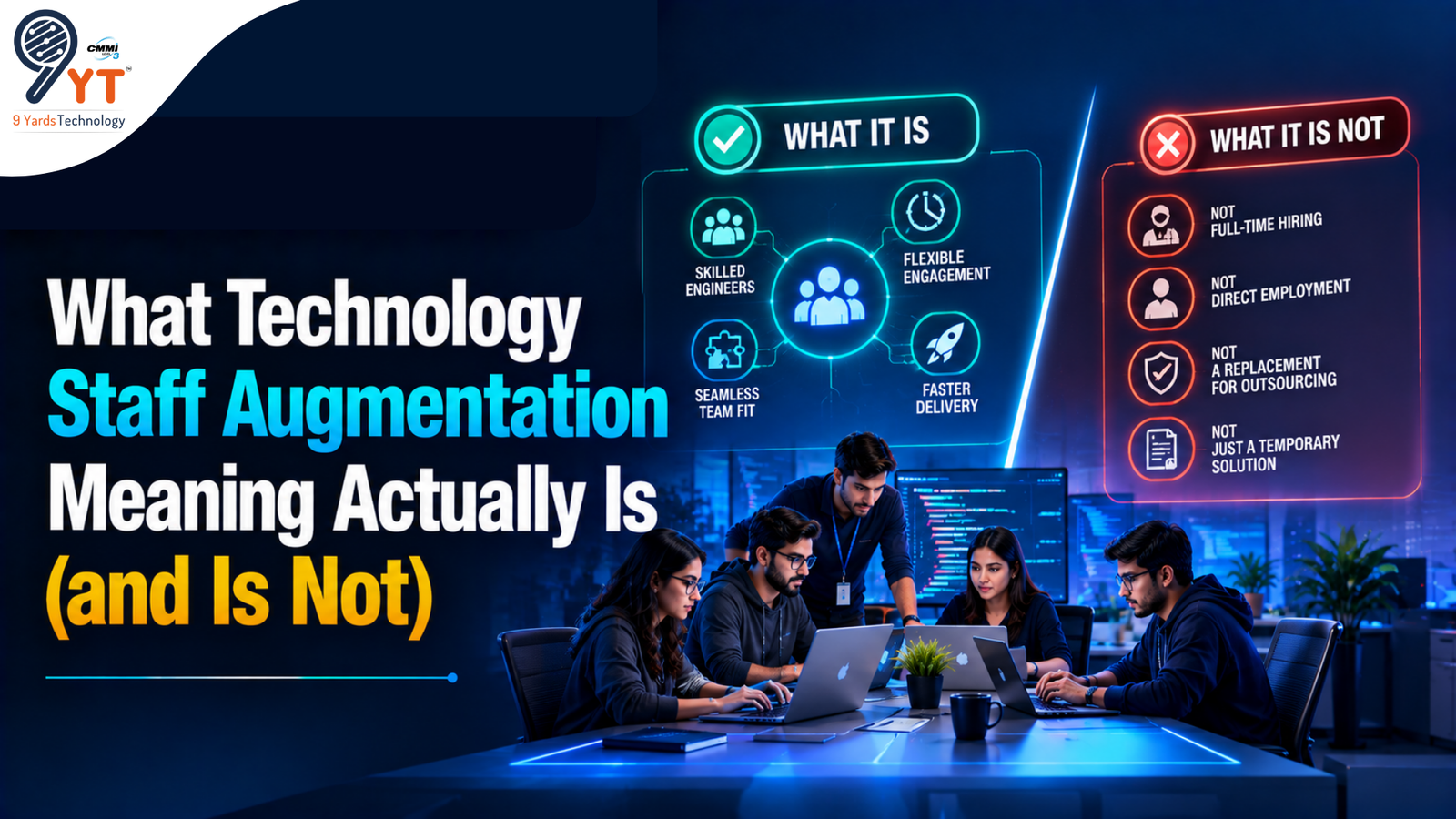
The meaning of technology staff augmentation gets muddied by vendors who apply the term to anything involving external engineers. The precise definition matters: staff augmentation places pre-vetted engineers directly inside your existing team, under your management, following your processes, attending your standups. Your engineering leads assign tasks, run code reviews, and own the roadmap. The vendor’s responsibility is vetting quality and replacing underperformers fast.
This is not outsourcing. Outsourcing hands off a function or deliverable to an external team operating under their own management. Staff augmentation extends your internal capacity without transferring management responsibility.
The practical implication: staff augmentation works when you have strong internal engineering leadership. If your VP of Engineering can manage 5 engineers, they can manage 5 augmented engineers from 9Yards Technology in exactly the same way. The only variable is where those engineers sit geographically. According to LinkedIn’s 2024 Global Talent Trends report, remote engineering roles now attract 3x more applicants than on-site equivalents, which means the talent pool for augmented roles is dramatically deeper than local hiring alone.
The wrong fit for augmentation: a company whose internal engineering team is itself understaffed at the leadership level. Augmenting a team with no senior internal engineers to direct the work creates coordination failure, not capacity.
Read More: Staff Augmentation Onboarding Process: How to Hit Week-1 Productivity
How Growth Stage Should Drive the Model Decision
Competing articles treat this as a project-scope question. It is a company-stage question. The two are related but not the same.
Pre-seed and Seed: Your internal team is 2-5 engineers. You need specific skills for a defined sprint. Staff augmentation is the correct answer. A dedicated external team at this stage creates a separate delivery unit with no internal engineering culture to absorb it.
Series A: You have engineering leadership but open requisitions going unfilled for 90 days or more. Staff augmentation fills those seats in 14-21 days. 9Yards Technology’s full deployment SLA is 2-3 weeks from requirement to a production-ready engineer.
Series B and beyond: You are building a permanent India engineering hub. This is the dedicated team territory, but the smarter path is BOT: Build-Operate-Transfer. 9Yards Technology builds and operates the team, then transfers full ownership to your rolls after 12 months. Talkdesk used this model. The result: 45+ engineers deployed, India hub established in 3 months, 80% faster hiring, 50% reduction in talent costs.
The finance angle matters here. Staff augmentation is OpEx. A permanent dedicated team is quasi-CapEx, requiring headcount approval, HR infrastructure, and entity setup in India if you want direct employment. BOT gives you the CapEx outcome on an OpEx timeline, with 9Yards Technology absorbing the setup complexity.
Read More: Staff Augmentation vs Outsourcing vs Managed Services: The Difference That Actually Matters
The Quality Drift Problem Nobody Talks About
Every article competing for this keyword compares staff augmentation and dedicated teams on setup speed, cost, and control. None of them address what happens 12-18 months into a staff augmentation engagement.
Quality drift is real. An augmented engineer who was top-quartile at month one may receive a competing offer at month fourteen. Generic staffing agencies replace them with whoever is available, not with a pre-vetted equivalent. Velocity dips. The internal team compensates. The cost of replacement is rarely tracked explicitly, so it never shows up in the original model comparison.
The fix is a written replacement SLA, not a verbal assurance. 9Yards Technology’s replacement SLA is 7 days. That is not a courtesy; it is a public bet on the vetting process behind every deployment. A 95% client retention rate across 300+ deployed engineers is the evidence behind that bet. Industry average retention for IT staffing is approximately 70%. The gap between 70% and 95% is the quality drift that goes untracked in most engagements.
When evaluating any vendor for a long-running staff augmentation engagement, ask one question: What is your documented replacement SLA in writing? If the answer is not a specific number of days, the engagement does not have one.
Evaluating External Technical Resources: What to Compare
Most evaluation frameworks in this space compare cost and speed. Both matter, but neither is sufficient. Here is the comparison that actually separates vendors:
| Criterion | Generic Staffing Agency | 9Yards Technology Staff Augmentation |
|---|---|---|
| Profile delivery | 1-3 weeks | 48-72 hours |
| Vetting depth | CV screen and one interview | Multi-stage: technical assessment, live coding, client interview |
| Replacement SLA | Verbal, no commitment | 7-day written SLA |
| External technical resources model | Contractor marketplace or bench | Pre-vetted bench, vendor-employed engineers |
| Onboarding speed | 4-8 weeks to full velocity | 50% faster onboarding vs. traditional hiring |
| Retention rate | ~70% industry average | 95% verified across 300+ deployments |
| BOT transition option | Rarely offered | Standard: client ownership after 12 months |
| Time-to-hire vs. local market | 90-day US market average | 14-21 days |
Top engineering candidates move fast; most are fielding competing offers within days of entering a process. The 48- 72-hour profile window is not only faster for clients; it captures candidate interest before competing offers close the door.
None of these criteria favours the model with more marketing spend. They favour the model with the more documented process and the more specific guarantees.
The BOT Model: The Third Option Competitors Never Mention
The staff augmentation vs dedicated development team framing is presented as binary by nearly every competing article. It is not binary. The Build-Operate-Transfer model is the third option, and for Series B+ companies establishing a permanent India engineering presence, it is often the right one.
BOT works in three phases. 9Yards Technology builds the team: hiring, vetting, onboarding, and integrating engineers into your delivery process. 9Yards Technology operates the team: managing HR compliance, payroll, performance monitoring, and replacement under the 7-day SLA. After 12 months, you take full ownership: the engineers transfer to your own roles, with no vendor dependency and no renegotiation.
The TestCrew engagement is the clearest illustration. TestCrew needed a specialized engineering team in India across Manual and Automation Testing, DevOps, Performance Engineering, Security Engineering, and AI/ML infrastructure, without setting up a local India entity. 9Yards Technology deployed 50+ engineers, 85% faster than traditional hiring, at 45% lower cost. The partnership has been active and uninterrupted for 5+ years. TestCrew retained complete engineering direction throughout; the operational complexity sat entirely with 9Yards Technology.
BOT is not a product to be sold. It is a response to a real procurement problem: the company wants a permanent engineering capability in India but cannot absorb the 6–12-month timeline and operational overhead of setting up its own entity from scratch.
9YT Proof Point: Talkdesk needed a high-performance India engineering hub, fast. 9Yards Technology established it in 3 months, deploying 45+ pre-vetted engineers across Engineering, QA, Security, ERP, and Business Analysis. Hiring speed improved by 80%. Talent costs dropped by 50%. The India team operates in full time-zone collaboration with Talkdesk’s US teams and continues to grow. This is what a BOT engagement looks like when the vetting process is built for enterprise delivery, not placement volume.
Read More: Dedicated Engineering Team India: Which Model Fits Your Growth Stage
How the 9Yards Technology Deployment Process Actually Works
Understanding the process removes the ambiguity from the model comparison. Whether a client chooses staff augmentation or a BOT-to-dedicated path, the delivery sequence is the same.
Requirement received: the client submits the role specification. Talent mapping runs against the pre-vetted bench within 24 hours. Screening filters against the role. A structured technical assessment follows: live coding, system design, or domain-specific evaluation, depending on the function. The client interviews shortlisted candidates. Deployment begins. Performance monitoring continues through the engagement, with a 7-day replacement trigger if any engineer does not meet the client’s bar.
Profiles are in the client’s inbox within 48-72 hours of requirement submission. Full deployment is complete within 2-3 weeks. The NASSCOM India IT Workforce Report consistently confirms India’s engineering talent pool as one of the deepest globally; the 9Yards Technology model converts that depth into a vetted, governed, enterprise-ready pipeline, not a raw marketplace.
The Talent Deployment Matrix is not a generic process description. It is a documented, audited workflow that the 7-day replacement SLA is built on top of. That SLA only works if the vetting upstream is rigorous enough to produce a replacement candidate within 7 days, which requires a standing pre-vetted bench, not a search started from zero when a replacement is needed.
Conclusion
The staff augmentation vs dedicated development team choice is not a feature comparison. It is a question of what your company needs at its current stage, what management capacity you have internally, and how long you need the engineering capability to last.
For most companies with open engineering requisitions sitting unfilled for 60 days or more, staff augmentation with a documented replacement SLA is the faster, lower-risk path. For companies building a permanent India hub, BOT is the answer that most vendors do not offer. The model that fails almost every client is the one chosen without asking: what happens when this engagement is 18 months old and an engineer leaves?
Need pre-vetted engineers in 48-72 hours? Talk to a 9Yards Technology specialist with no obligation and no generic shortlist.
Frequently Asked Questions
What is the main difference between staff augmentation and a dedicated development team?
Staff augmentation places individual pre-vetted engineers directly inside your existing team, under your management and processes. A dedicated development team is a self-managed external unit that operates more autonomously and takes end-to-end delivery ownership. The right choice depends on your company’s growth stage and internal engineering leadership capacity, not just the project scope or duration.
What does technology staff augmentation mean in practice?
Technology staff augmentation meaning covers any model where external technical specialists join your internal team under your direct management, following your tools, workflows, and sprint cadence. The external engineers attend your standups, report to your engineering leads, and are replaceable under a documented SLA. It is distinct from outsourcing, where delivery management transfers to the vendor’s team.
When should a company choose external technical resources through a BOT model instead of standard staff augmentation?
External technical resources through a Build-Operate-Transfer model are the right choice when a Series B+ company wants a permanent India engineering hub without the 6-12-month overhead of establishing a local entity. The vendor builds and operates the team, then transfers full ownership to the client after 12 months. Talkdesk used this model: India hub stood up in 3 months, 80% faster hiring, 50% cost reduction.
How fast can a staff augmentation company realistically deploy engineers?
A vetted staff augmentation partner should deliver candidate profiles within 48-72 hours and complete full deployment within 2-3 weeks. The US local market average time-to-hire is approximately 90 days, so a well-run augmentation process recovers roughly 69 days of lost engineering productivity per hire. If a vendor cannot commit to a specific profile turnaround time in writing, treat that as a red flag.