

 Post by
Most IT staff augmentation companies in India in 2026 will send you ten CVs within 24 hours. Which of those engineers will still be performing at month six? That’s the harder question. Staff augmentation replacement guarantee and compliance terms are rarely discussed upfront, yet they are the most reliable signal of whether a vendor actually believes in its own vetting process. If a company won’t put a specific number of days in writing, that tells you everything.
This article is for CTOs and VP Engineering who have already been burned once: a vendor promised quality, delivered mediocre CVs, and left you holding a vacant seat three months later. The evaluation framework below draws from 300+ engineer deployments across enterprise clients. Every criterion maps to a failure mode we have seen in real engagements.
Why the CV Is the Wrong Starting Point
The staffing industry optimises for placement speed, not candidate quality. That incentive structure produces polished CVs and underperforming engineers. A CV tells you what a candidate claims to have done. It tells you nothing about whether they can do it in your stack, at your pace, inside your processes.
According to NASSCOM’s 2024 talent report, India produces over 1.5 million engineering graduates annually. The supply is not the problem. Filtering that supply against a real bar is where most vendors cut corners.
The right starting point is not the CV. It is the vendor’s vetting architecture: how many stages, what each stage actually tests, and what percentage of candidates make it through. Any vendor who cannot answer those three questions with specific numbers is running a volume game, not a quality process.
A vendor passing 40% of applicants is not vetting. One passing 8% and backing the result with a written replacement SLA is making a public bet on its own process.
Read More: Staff Augmentation Onboarding Process: How to Hit Week-1 Productivity
The Staff Augmentation Vendor Evaluation Scorecard
When evaluating IT staff augmentation companies, reduce the conversation to five measurable criteria before a single CV changes hands.
| Evaluation Criterion | What to Look For | Red Flag |
|---|---|---|
| Technical vetting process for staff augmentation | Named stages, pass rate, assessment type | “We do a thorough interview” with no specifics |
| Replacement SLA | A specific number of days in writing | “We’ll handle it” or no written commitment |
| Client retention rate | A published percentage, ideally above 90% | Testimonials only, no rate cited |
| Compliance and NDA adherence | 100% NDA coverage, documented governance | Verbal assurances without documentation |
| Time-to-profile | A specific hour window, not “fast” | “We’ll get back to you soon” |
Each of these five criteria corresponds to a documented failure mode in vendor relationships. A vendor without a published retention rate has likely never measured it. A vendor without a written replacement SLA does not expect to use one.
The scorecard is deliberately short. Longer evaluation frameworks give vendors more surface area to sound good on metrics that don’t predict delivery quality.
How the Technical Vetting Process Should Actually Work
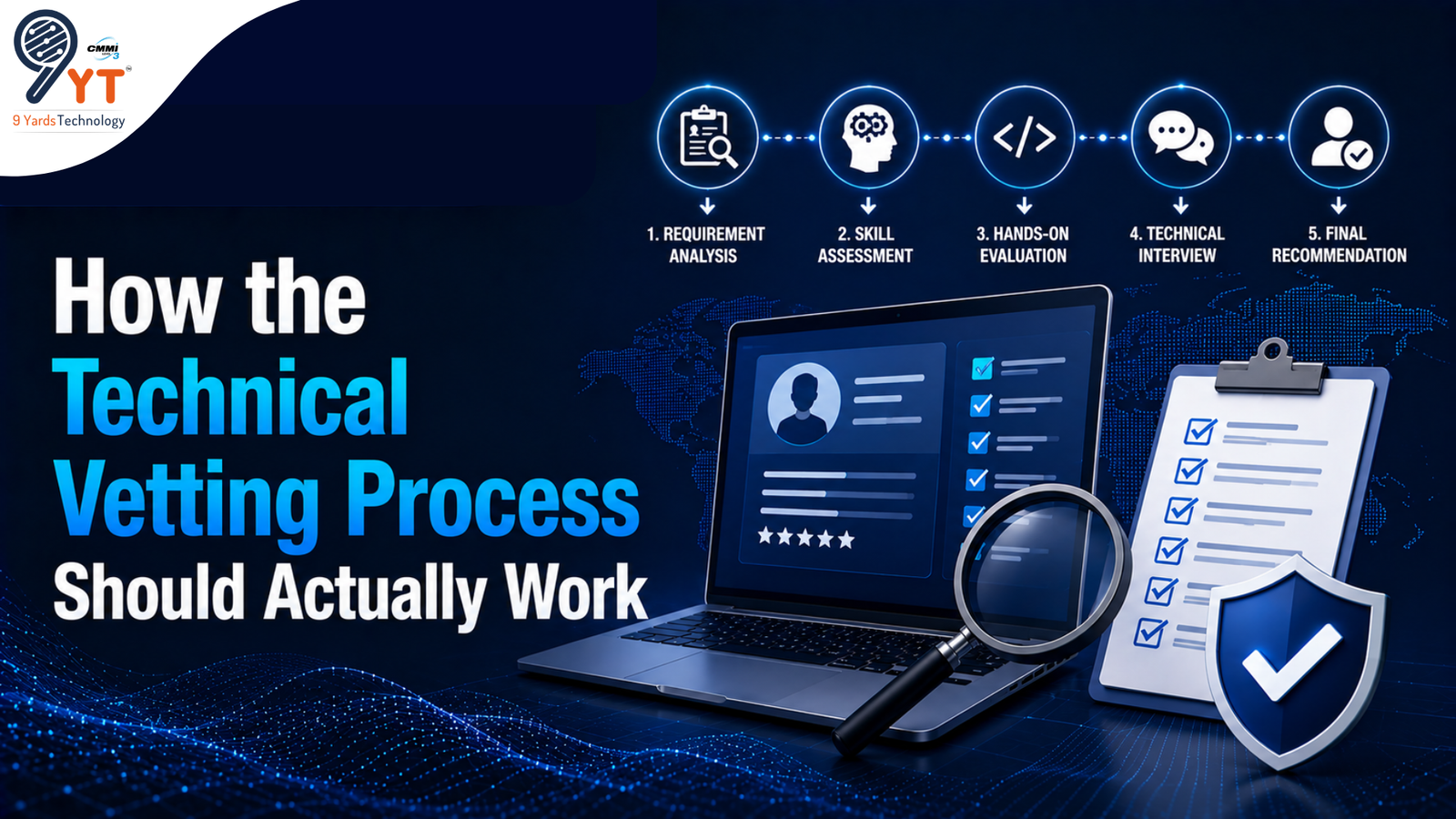
A credible technical vetting process in staff augmentation has at minimum four stages. Fewer stages means filtering on presentation, not engineering capability.
At 9Yards Technology, the Talent Deployment Matrix runs as follows: requirement received, talent mapping against a pre-vetted bench, structured screening, technical assessment, client interview, deployment, and ongoing performance monitoring. Each stage has an exit criterion. Engineers who pass the technical assessment still go through a client interview, and that interview is not a formality.
Some vendors treat the client interview as a courtesy step after they have already decided to deploy the engineer. Here, the client interview is a genuine gate. An engineer who doesn’t clear it doesn’t deploy.
Performance monitoring after deployment is the stage most vendors skip. It is also the stage that drives a 95% client retention rate. Retention gets built during the 90 days after hire, not at the point of hire.
Engineering teams consistently report that onboarding and ramp-up quality have a larger impact on long-term productivity than the hiring speed itself. A vendor whose process ends at deployment is optimising for the wrong metric.
Running a Pilot Engagement Before Committing to Scale
The single most reliable way to evaluate a vendor is to deploy one engineer before committing to ten. A genuine quality vendor will not resist this. A vendor who pushes back on a small pilot is telling you they need the volume commitment to justify the resourcing they have already promised you.
A well-structured pilot engagement runs for four to six weeks, with a defined technical scope, a clear performance benchmark, and a named counterpart on the vendor’s account team who is accountable for the outcome.
By week three, you know whether this engineer operates at the level the vendor claimed. By week six, you know whether the vendor’s account management is reactive or proactive.
The pilot also stress-tests the replacement SLA. Ask the vendor during the pilot: if this engineer is not meeting the benchmark at week four, what happens? Get the answer in writing before you start. That answer, more than any sales presentation, tells you what the vendor’s actual commitment looks like.
A 7-day replacement SLA is only meaningful if the vendor maintains a pre-vetted bench. You cannot replace an engineer in 7 days if you have to restart the sourcing process from zero. Ask to understand how the bench is maintained.
What Compliance and NDA Terms Actually Signal
For enterprise buyers, especially in BFSI, healthcare, and government, compliance is not a secondary consideration. An engineer who has access to your production systems, your customer data, or your product IP is a material risk if the vendor’s compliance infrastructure is thin.
100% NDA adherence is the floor, not a differentiator. Every serious vendor should be able to state this. The real differentiator is what sits behind it: structured onboarding that includes IP and confidentiality briefings for every deployed engineer, audit trails, and a documented offboarding process when an engagement ends.
In practice, the two compliance elements most commonly absent in mid-tier IT staffing vendor assessments are IP protection protocols and audit trail documentation, both verifiable before you sign, if you know to ask.
Ask for the vendor’s standard NDA terms before the sales conversation goes further. Ask specifically how confidentiality obligations are communicated to deployed engineers, not just signed at the company level. That second question separates vendors with genuine compliance infrastructure from vendors with a signed document in a drawer.
Business continuity is the companion question. If a deployed engineer leaves mid-engagement, what is the vendor’s documented process for knowledge transfer and replacement? A written answer to this question is a stronger signal than any certification claim.
9YT Proof Point: When Talkdesk needed to build an India engineering hub from scratch, the requirement was speed, quality, and seamless integration with US-based teams. 9Yards Technology deployed 45+ pre-vetted engineers across Engineering, QA, Security, ERP, and Business Analysis functions. The hub was operational in 3 months. Hiring was 80% faster than Talkdesk’s prior process. Talent costs dropped by 50%. The engagement is still active and expanding.
Building a Long-Term Partnership, Not a One-Time Transaction
The staffing industry frames engagements as placements. 9Yards Technology frames them as deployments. A placement is complete when the engineer starts. A deployment is a managed relationship with ongoing accountability.
The difference shows up in retention data. The industry average client retention rate for IT staffing is approximately 70%. 9Yards Technology’s is 95%. That 25-percentage-point gap does not come from better salespeople. It comes from account management that monitors delivery quality after deployment.
For companies evaluating IT staff augmentation as a scaling model, the engagement model also matters. The Build-Operate-Transfer model allows clients to start with an augmented team and transition it to their own rolls after 12 months. That is a concrete, procurement-friendly option that most staffing-first vendors do not offer.
SHL deployed 60+ engineers through this model in 2 months, 70% faster resource deployment, 60% improvement in hiring efficiency, and a 20% reduction in talent acquisition costs. The partnership is now 5+ years old.
That outcome comes from a documented process, a written replacement guarantee, and account management with a retention incentive, not a placement fee.
Need pre-vetted engineers in 48-72 hours? Talk to a 9Yards Technology specialist with no obligation and no generic shortlist.
Frequently Asked Questions
How do I evaluate the technical vetting process of IT staff augmentation companies in India?
Ask for the number of stages in the vetting process, the pass rate at each stage, and what the technical assessment specifically tests. A credible vendor will answer with specific numbers. Any answer that defaults to ‘we do a thorough screening’ without stage-level detail is a signal that the process is optimised for speed, not quality. Also ask whether performance monitoring continues after deployment, not just before it.
What should a staff augmentation replacement guarantee include to be meaningful?
A meaningful replacement guarantee names a specific number of days, not a vague commitment to ‘handle it.’ It should be in writing, not verbal. It should also clarify whether the replacement clock starts from the date you raise the concern or from the date the original engineer departs. 9Yards Technology’s replacement SLA is 7 days. A vendor who resists putting a day count in writing does not expect to meet that commitment.
How do I run a pilot engagement before scaling with an IT staff augmentation partner?
Deploy one engineer for a defined 4-6 week scope before committing to a larger team. Set a clear technical benchmark at the start, not after the pilot has begun. Require a named account contact who is accountable for the outcome, not just the deployment. Use week three as your first checkpoint. If the vendor resists a small pilot before a volume commitment, treat that resistance as a red flag, not a negotiating position.
What compliance and NDA terms should I verify before engaging an IT staff augmentation company in India?
Verify three things: whether the vendor maintains 100% NDA adherence across all deployed engineers (not just at the company level), how IP and confidentiality obligations are communicated directly to each engineer before deployment, and what the documented offboarding process looks like when an engagement ends. Ask for the standard NDA terms before the sales process advances. A vendor with genuine compliance infrastructure will share this without hesitation.