

 Post by
Most staff augmentation contract disputes in India do not start with a missing clause. They start with a number that was never written down. A VP of Engineering who signs a contract listing “timely delivery” and “best-effort replacement” has no recourse when a vendor takes three weeks to send a single profile or six weeks to replace an underperforming engineer. Soft language protects the vendor. Specific numbers protect you.
This distinction is what the staffing industry quietly hopes buyers miss. 9Yards Technology has deployed 300+ engineers under contracts that commit to exact figures, because vague promises are where the staffing industry hides. If a vendor will not write a number into a contract, you have your answer about their confidence in their own process.
What a Staff Augmentation Contract India Actually Covers
The standard structure for an IT staff augmentation engagement in India uses two documents. The master services agreement (MSA) governs the overall relationship: IP ownership, NDA terms, liability caps, dispute resolution, and billing mechanics. The Statement of Work (SOW) activates each individual deployment, naming the role, the engineer, the start date, and the rate.
Enterprise buyers prefer MSAs because they only need to negotiate the heavy legal terms once with each vendor, after which new projects can start immediately with just a short SOW. That is a real structural advantage. But it also means the commercial risk concentrates in the MSA. Accept weak SLA language in the MSA, and it governs every future deployment under that relationship.
The MSA is negotiated once and governs all future placements. Negotiate it carefully; the terms you accept there apply to every engineer the firm places with you.
The Indian Contract Act, 1872 governs enforceability. SLAs are enforceable under the Indian Contract Act if drafted clearly and with lawful consideration. Scope of services, performance metrics, penalties for breach, confidentiality, and dispute resolution are essential clauses. “Clearly” is what matters. A penalty clause that references “reasonable timeframes” will not survive a dispute. A penalty clause that references “7 calendar days” will.
Read More: Risks of IT Staff Augmentation: What Enterprise Buyers Must Audit Before Signing
The Three Numbers Every IT Staff Augmentation Agreement in India Must Name
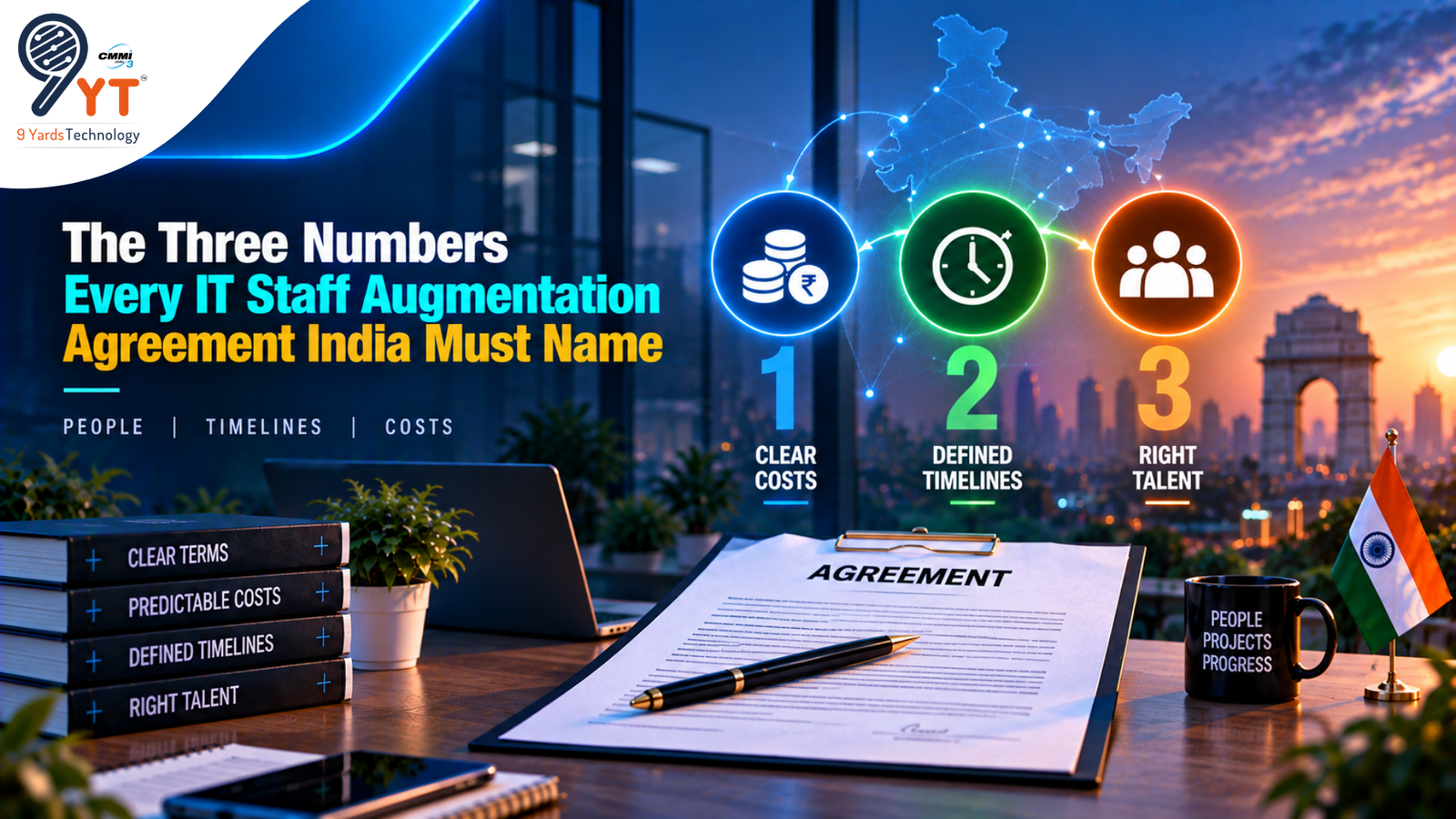
Contract review checklists from legal teams focus on IP assignment, non-solicitation enforceability, and indemnity caps. Those clauses matter. But for engineering leaders, three operational numbers determine whether the engagement runs or stalls.
Profile delivery window. How many hours after a requirement is submitted does the vendor commit to delivering candidate profiles? 48–72 hours is the standard a serious pre-vetted bench can sustain. Anything phrased as “within a reasonable period” or “subject to availability” is an admission that no bench exists and profiles will be sourced reactively.
Full deployment timeline. A profile in 48–72 hours means nothing if onboarding takes two months. The contract should name a total deployment target: engineer starts contributing to your team within 2–3 weeks of requirement submission. Screening, technical assessment, client interview, and onboarding all fit inside that window.
Replacement SLA. This is the number most vendors refuse to write down, which makes it the most important number to demand. A 7-day replacement SLA means an underperforming engineer is replaced within 7 calendar days at no additional cost. That clause is a public bet by the vendor on their own vetting process. It is one of the most common and costly contract mistakes engineering leaders make when they let replacement language slide until after the first performance issue surfaces.
Read More: BOT vs Outsourcing: Choose the Right Exit Strategy First
These three numbers should appear in the MSA as binding commitments, not in a sales deck as marketing claims.
What the Contract Cannot Fix: Quality Drift Over Time
The clauses above govern deployment speed. They do not govern what happens at month 14, when the engineers who were sharp at onboarding have grown comfortable, when turnover has quietly replaced two of your original five with less experienced alternatives, and when the vendor’s account manager has moved on.
Quality drift is the most underwritten risk in a staff augmentation contract in India, and standard templates almost never address it.
The contract-level defence against quality drift is a retention-rate clause: a vendor commitment to maintain named engineers on your account unless you initiate a change or the engineer resigns. Combined with a performance-monitoring commitment (written reporting cadence, named account manager, defined escalation path), this converts a one-time deployment transaction into a managed relationship.
Retention rates tell you whether a vendor can actually keep engineers engaged and performing. Industry average retention in IT staffing sits at approximately 70%. A vendor with a 95% retention rate is not making a marketing claim; they are describing a structural fact about their delivery model that shows up in every long-running engagement.
The contract should require the vendor to disclose their retention rate on request and to replace any departing engineer within the same 7-day SLA window that applies to performance-based replacements.
How the MSA and SOW Structure Protects IP in Cross-Border Engagements
For North America-headquartered companies deploying engineers from India, the IP section of the master services agreement carries extra weight. The engineers are employees of the Indian staffing entity, not of your company. Without an explicit IP assignment clause, code written on your project by a vendor-employed engineer may not automatically belong to you under Indian contract law.
Under a properly drafted staff augmentation agreement, all work product created by the contractor belongs to the client company. This is accomplished through a work-for-hire provision combined with an IP assignment clause that transfers any remaining rights to the client.
For compliance-sensitive clients, the NDA must bind the vendor entity and each individual engineer separately. A company-level NDA that does not extend to individual engineers creates a gap: the vendor is bound, but the engineer who actually handles your codebase is not.
9Yards Technology operates with 100% NDA adherence across all engagements as a non-negotiable governance standard. This applies at the entity level and at the individual engineer level, documented before each deployment begins.
One India-specific structural risk requires attention in cross-border MSAs: the Permanent Establishment (PE) risk. If your India-based employees are signing contracts, making business decisions, or acting as agents of your company in India, the Indian tax authority may determine that your company has a Permanent Establishment in India, making your global income taxable there. The MSA should explicitly state that deployed engineers are not authorised to represent the client company legally or commercially.
Read More: Staff Augmentation Onboarding Process: How to Hit Week-1 Productivity
Evaluating a Vendor’s Contract Against This Standard
The table below converts the criteria above into a review checklist. Use it before signing any staff augmentation contract in India.
| Evaluation Criterion | What to Demand | Red Flag |
|---|---|---|
| Profile delivery window | 48–72 hours, written in the MSA | “Timely delivery” or “subject to availability” |
| Full deployment timeline | 2–3 weeks from requirement submission | No timeline stated, or “depends on role complexity” |
| Replacement SLA | 7 calendar days, no additional cost | Replacement “on a best-effort basis” or undefined |
| Replacement trigger | Client-initiated, no performance threshold to clear | Vendor sole discretion on whether replacement is warranted |
| IP assignment | Work-for-hire plus explicit IP assignment to client | IP clause covers the vendor entity only, not individual engineers |
| NDA coverage | Vendor entity plus each individual engineer, pre-deployment | Company-level NDA only |
| Retention commitment | Named engineers, disclosure of vendor retention rate | No retention metric, high account-manager turnover |
| PE risk mitigation | Explicit clause limiting engineer authority to act as client agent | Engineers sign client contracts or represent client commercially |
| master services agreement structure | MSA plus SOW, with SOW order-of-precedence clause | Single contract covering all engagements, no SOW mechanism |
Hiring is expected to shift from volume to skill mix across India’s technology sector, according to NASSCOM’s Technology Sector Strategic Review 2026. That shift makes vetting rigour, and the contract terms that enforce it, more commercially critical than it was two years ago when volume was the primary metric.
The 9YT Proof Point
What Enforceable Contracts Actually Produce
Talkdesk came to 9Yards Technology needing a complete India engineering hub, built fast. Within 3 months, 45+ pre-vetted engineers were deployed across Engineering, QA, Security, ERP, and Business Analysis. Hiring speed improved by 80%. Talent costs fell by 50% compared to local North America hiring. The engagement is still active. Those outcomes were not the result of goodwill. They were the result of a contract that named specific timelines, a replacement SLA, and a structured onboarding process, and a delivery team that was measured against them.
SHL saw comparable results: 60+ engineers deployed in 2 months, 70% faster resource deployment, and a 20% reduction in talent acquisition costs. Five years later, the partnership is still active. Retention, not speed of placement, is what a five-year relationship proves.
Closing: A Contract Is Only as Strong as the Numbers in It
Every staff augmentation contract in India contains clauses. Very few contain numbers. The gap between those two things is where most engagements fail. Not at signing, but six weeks in, when an underperforming engineer is still on your team because the replacement clause said “best effort” and the vendor defines effort differently than you do.
Demand the three numbers. Get the replacement SLA in writing. Verify the vendor’s retention rate. And confirm that the MSA binds individual engineers to the NDA, not just the parent company.
The contract does not guarantee quality. A pre-vetted bench, a transparent process, and a vendor willing to bet their fee on a 7-day replacement commitment do.
Need pre-vetted engineers in 48–72 hours? Talk to a 9YT specialist with no obligation and no generic shortlist.
Frequently Asked Questions
What should an IT staff augmentation agreement in India include to be enforceable?
An IT staff augmentation agreement in India must include specific, measurable SLA commitments to be operationally enforceable. The critical numbers are: profile delivery within 48–72 hours, full deployment within 2–3 weeks, and a written replacement SLA of 7 days or fewer at no additional cost. Beyond those, the agreement needs an explicit IP assignment clause, an NDA binding individual engineers (not just the vendor entity), and a permanent establishment risk mitigation clause for cross-border engagements. Soft language such as ‘timely delivery’ is a legal formality, not a quality guarantee.
What is a master services agreement and why does it matter for staff augmentation in India?
A master services agreement (MSA) is the foundational contract governing the entire vendor relationship: IP ownership, NDA terms, liability, billing, and SLA commitments. In a staff augmentation engagement, individual engineer deployments are activated via Statements of Work (SOW) that sit under the MSA. Because the MSA governs all future deployments, the SLA language negotiated there applies to every engineer placed under that relationship. Accepting weak replacement or delivery language in the MSA means it governs every future hire, not just the first one.
How is a staff augmentation contract in India different from a managed services contract?
A staff augmentation contract places pre-vetted engineers directly under the client’s management. The client owns delivery direction, backlog prioritisation, and quality standards. SLAs in the contract should therefore measure provider-controlled obligations: screening speed, replacement turnaround, and compliance administration. A managed services contract shifts operational delivery accountability to the vendor, who owns outputs and outcomes. Applying a managed services SLA to a staff augmentation engagement, or vice versa, misaligns accountability and creates disputes when performance gaps appear.
What replacement SLA should I demand in an IT staff augmentation agreement in India?
Demand a written replacement SLA of 7 calendar days or fewer, at no additional cost, triggered by client request without a performance threshold to clear. This means if an engineer is not meeting your standards, the vendor replaces them within 7 days from the date you raise the request. A vendor willing to put that number in writing is signalling genuine confidence in their vetting process. One that insists on ‘best effort’ or ‘subject to bench availability’ is signalling the opposite. The replacement SLA is the single most important number in any staff augmentation contract in India.
