

 Post by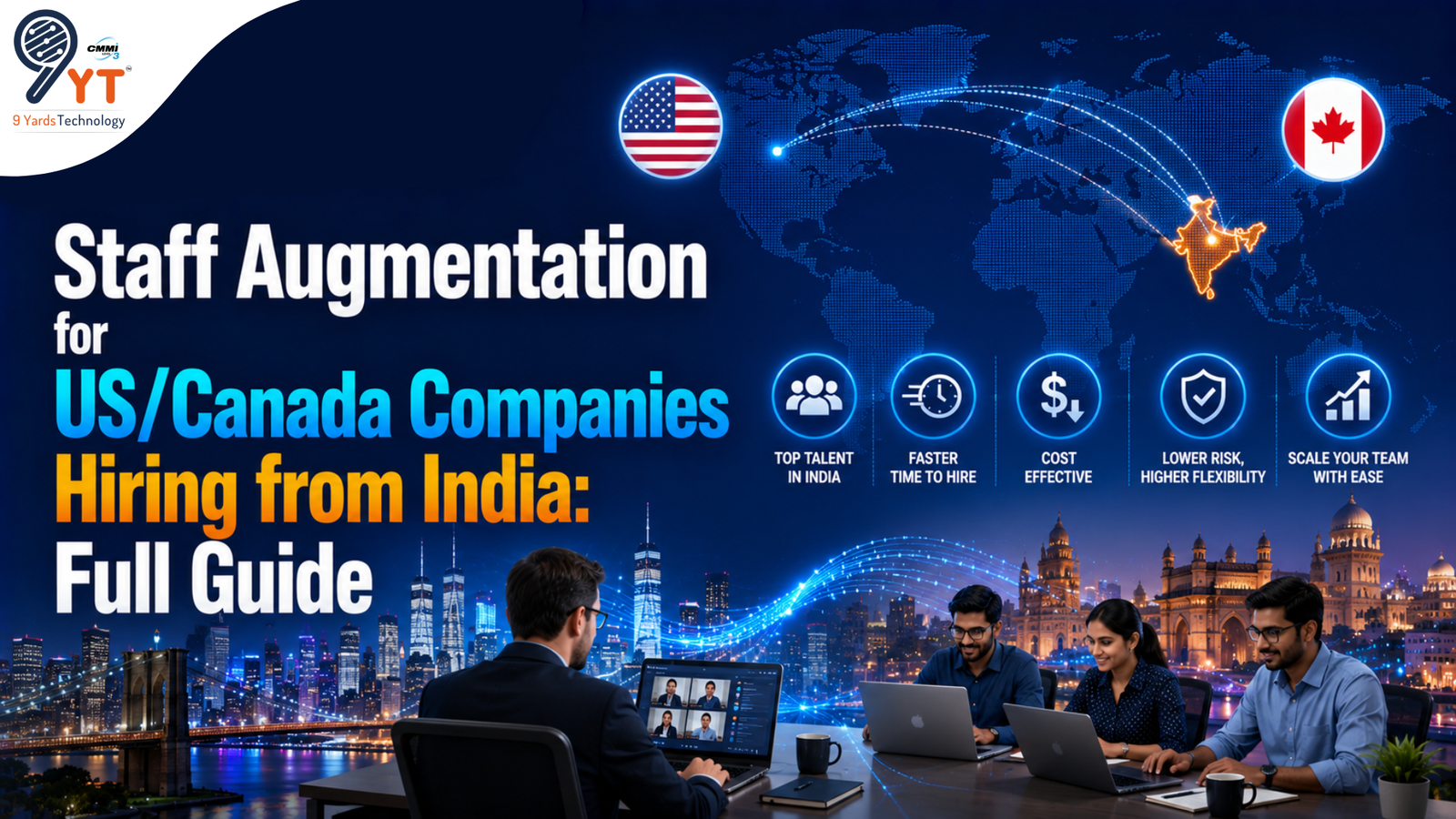
Offshore staff augmentation for US companies hiring from India is the fastest route to senior engineering talent at 68-76% lower annual cost than US equivalents. But only when the engagement is structured correctly to handle worker misclassification compliance in India. Get that structure wrong, and the cost savings disappear into retrospective tax assessments and statutory contribution back-claims. Get it right, and you are running a 60-engineer team within two months, as SHL did at 9Yards Technology. The real decision most US and Canadian engineering leaders face is not whether to hire from India, but which model carries the compliance risk on their behalf while giving them full control over daily engineering work.
What Offshore Staff Augmentation Actually Means for a US Engineering Team
Staff augmentation embeds pre-vetted engineers directly into your existing team. They join your sprint cadence, your Jira board, your Slack channels, and report to your engineering leads. The staffing partner handles employment compliance, payroll, and statutory contributions in India while you retain full control over priorities, code standards, and delivery expectations.
This differs fundamentally from outsourcing. In outsourcing, a vendor owns the work and reports on outcomes. In IT staff augmentation, you own the work, and the engineers operate as an extension of your internal team. This distinction matters for IP protection, code quality governance, and who decides what gets built next sprint.
It also differs from hiring contractors directly. Direct contractor arrangements push every compliance obligation onto you: TDS withholding, EPFO registration, and the substance-over-form misclassification test that Indian authorities apply regardless of what a contract says. A certified staff augmentation partner absorbs those obligations. That is the core value of the model, separate from speed or cost.
Read More: How to Integrate Offshore Engineers: A Deployment-First Framework
EOR vs Staff Augmentation vs Entity India: Choosing the Right Structure
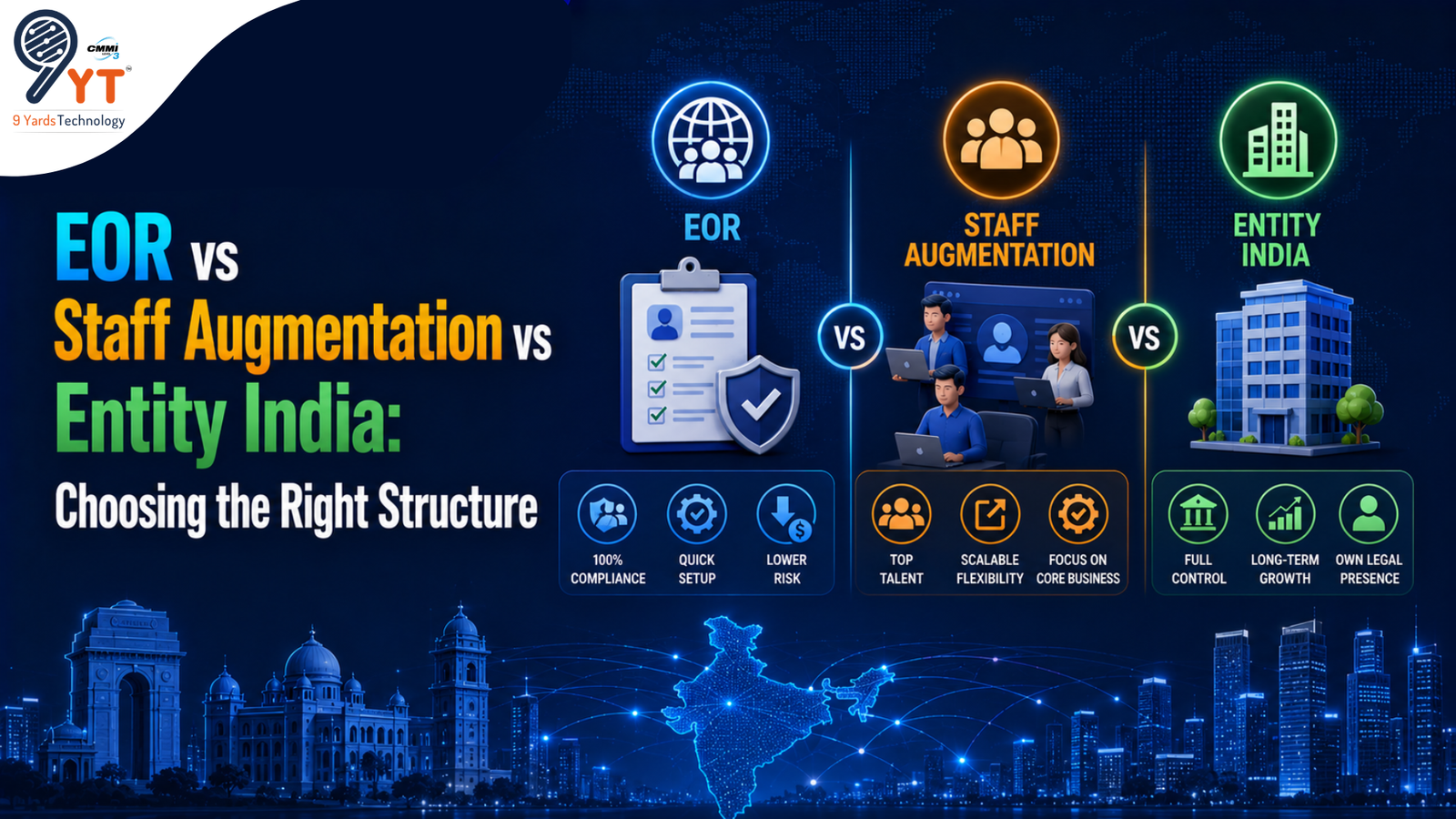
Three models dominate the market, each serving a different company stage and risk profile.
Employer of Record (EOR): An EOR legally employs the engineer in India on your behalf while you direct the work and the EOR issues the payslip and handles statutory compliance. EOR works well for 1-5 engineers where you have a specific role and internal bandwidth to manage day-to-day performance yourself. The limitation: most EOR platforms are multi-country payroll tools with thin India-specific technical vetting depth.
Staff augmentation through a certified India partner: The partner maintains a pre-vetted bench, runs structured technical assessments, handles employment compliance, and provides account-level governance including replacement SLAs. This model fits 5-60 engineers where you need vetting rigor, managed onboarding, and a published fallback if someone doesn’t perform. 9Yards Technology’s 7-day replacement SLA is a concrete example of the fallback structure most EOR providers cannot match.
Own India entity (subsidiary or branch): Appropriate when headcount exceeds 50-80 engineers, and the engagement is permanent. Setup takes 3-6 months minimum and introduces full statutory employer obligations. The Talkdesk engagement shows why most fast-scaling companies choose staff augmentation first: 9Yards Technology built Talkdesk’s entire India engineering hub, 45+ engineers across Engineering, QA, Security, ERP, and Business Analysis in 3 months, before Talkdesk had an India entity at all.
The Build-Operate-Transfer model bridges the gap. 9Yards Technology builds and operates the team, then transfers it to your own entity after 12 months, a procurement-friendly commitment that most competitors do not offer in writing.
| Hiring Structure | Best For | PE Risk Holder | Vetting Depth | Replacement SLA |
|---|---|---|---|---|
| Direct contractor | 1-2 roles, short term | Client carries it fully | None structured | None |
| EOR only | 1-5 roles, self-managed | EOR carries payroll risk | Varies, often thin | Rarely published |
| Staff augmentation (certified partner) | 5-60 engineers | Partner carries compliance | Pre-vetted bench | 7 days (9Yards Technology) |
| Own India entity | 80+ engineers, permanent | Client as employer | Fully internal | Internal HR |
| BOT model | Building a hub with future transfer | Partner initially, client post-transfer | Pre-vetted bench | 7 days during operate phase |
Permanent Establishment Risk India Hiring: What US Companies Get Wrong
Permanent Establishment risk is the most misunderstood compliance issue in offshore hiring. Many US companies assume that not having an office in India keeps them safe. It does not.
Indian tax authorities apply a conduct-over-form test. If you direct an Indian worker like an employee but pay them as a contractor, Indian tax authorities can argue your US parent has a fixed place of business in India. Once that flag goes up, your parent company’s India-attributable income becomes taxable in India, with retrospective tax assessments plus interest.
Worker misclassification follows the same logic: Indian authorities apply a substance-over-form test, and exclusivity, fixed hours, your laptop, daily standups, and review cycles all point to an employment relationship regardless of what the contract says.
Hiring through an Employer of Record does not automatically create a permanent establishment, nor does it automatically shield you from one. PE risk turns on conduct, mainly whether someone in India habitually concludes contracts on your behalf.
The practical mitigation is a clean structure: the engineer is employed by the Indian partner entity, contract authority stays with your US parent, and daily tasking flows through your engineering leads without crossing into contract negotiation or client-facing authority. A certified staff augmentation partner with 100% NDA adherence and documented governance builds this structure by default. You do not need to design it yourself.
For deeper legal grounding, the NASSCOM India workforce compliance resources cover statutory contribution obligations and cross-border hiring frameworks in detail.
How the Deployment Process Actually Works: 48 Hours to Productive Engineer
9Yards Technology’s Talent Deployment Matrix has seven stages with specific, not approximate, timelines.
Stage 1: Requirement received. You submit the role specification: seniority, stack, time zone preference, team context.
Stage 2: Talent mapping. Internal matching against the pre-vetted bench, not a job board post, but a match against engineers already assessed.
Stage 3: Screening. Initial qualification against your role requirements, completed within the same working day.
Stage 4: Technical assessment. Structured evaluation against your stack. This stage eliminates the unqualified CVs that waste three weeks at generic agencies.
Stage 5: Client interview. You meet shortlisted candidates, typically two to three profiles per role.
Stage 6: Deployment. The engineer joins your team within 2-3 weeks of the initial requirement.
Stage 7: Performance monitoring. Ongoing tracking against delivery quality, backing the 7-day replacement SLA with real operational substance.
US local recruitment averages approximately 90 days to hire. 9Yards Technology’s process runs 14-21 days. That recovers roughly 69 days of engineering velocity per hire. For a 10-engineer deployment, that compounds significantly. Speed without quality is staffing’s biggest unspoken lie. These seven stages exist specifically to prevent the two-week shortlist that arrives with three unqualified candidates.
India US Timezone Overlap Offshore Teams: The Practical Reality
Timezone is the concern that comes up most in the first conversation. It deserves a direct answer.
India Standard Time runs 9.5 hours ahead of US Eastern Standard Time and 12.5 hours ahead of Pacific Standard Time. That gap is real, but the question is whether it is a structural barrier or a scheduling problem.
US East Coast teams can secure 3 to 4 live overlap hours daily by scheduling India working hours from 1:00 PM to 10:00 PM IST, which equals 8:30 AM to 12:30 PM EST. West Coast teams typically get 2 to 3 overlap hours by extending India shifts slightly later.
For sprint-based engineering work, 3-4 hours of live overlap covers daily standups, sprint planning, and blocker resolution. The remaining hours run async with written handoffs. The Talkdesk engagement proves this works at scale: 45+ engineers across multiple functions collaborating with US-based teams, with the partnership still active and expanding.
The practical setup that works consistently: daily standup at 9:00-9:30 AM EST (landing at 7:00-7:30 PM IST), written decision logs for architectural choices made during US afternoon hours, and a documented escalation path for blockers that cannot wait 14 hours. In practice, sprint-based engineering work requires 2-3 live hours for standups and blocker resolution, with the remainder running async through written handoffs, a structure that works consistently when documentation practices are strong.
Canadian teams in Toronto land in a similar position to the US East Coast with EST-aligned working hours, producing the same 3-4 hour overlap window.
What Separates a Compliant Partner from a Risky One
Not every firm calling itself an offshore staff augmentation partner has the governance infrastructure to carry compliance risk cleanly. The evaluation criteria that matter are specific.
Replacement SLA with a day count. A partner confident in their vetting process publishes a specific number. A 7-day replacement SLA is a public bet on the quality of that bench. Vague phrases like “flexible support” or “we’ll work with you” are not equivalent.
Retention rate with a verifiable basis. 9Yards Technology’s 95% client retention rate compares against an industry average of approximately 70%. Retention is real proof of quality; testimonials can be cherry-picked; a 95% retention rate cannot.
100% NDA adherence as a documented governance commitment. For US companies with IP in active development, this is not a courtesy but a legal requirement. Ask for the specific terms, not a reassurance.
A pre-vetted bench, not a job board. Ask directly: can you deliver profiles in 48-72 hours, or do you post to Naukri and LinkedIn? The answer distinguishes a staffing firm with a bench from a recruitment agency with a fee.
The Deloitte Global Outsourcing Survey has consistently found that governance and compliance infrastructure, not price, is the top determinant of long-term satisfaction in offshore staffing relationships.
9Yards Technology Proof Point
Talkdesk needed a full India engineering hub, not just a few engineers. 9Yards Technology deployed 45+ engineers across Engineering, QA, Security, ERP, and Business Analysis in 3 months. Hiring moved 80% faster than Talkdesk’s prior process. Talent costs dropped 50% through offshore delivery. The hub runs today with active expansion. For a North America SaaS company evaluating whether offshore India engineers can genuinely integrate with a US product team, that is the answer.
Cost Math: What Offshore Staff Augmentation Actually Saves
The savings are large enough that presenting them without specifics is a disservice.
A Senior Software Engineer costs $160,000-200,000 annually in the US. 9Yards Technology’s India-delivered equivalent runs $40,000-55,000. Annual saving per engineer: $105,000-160,000. For a Senior AI/ML Engineer, that saving rises to $120,000-160,000 per year.
For a 10-person senior engineering team at a North American company, annual savings typically range from $1,050,000 to $1,600,000 depending on role mix. That is the verified figure from 9Yards Technology’s own cost table, not a rounding.
The SHL engagement put a number on cost reduction at the delivery level: a 20% reduction in talent acquisition costs for a 60-engineer deployment. That figure matters because it accounts for the full engagement cost, including partner fees and onboarding overhead, not just salary arbitrage.
For US-headquartered companies, offshore staff augmentation also converts engineering headcount from quasi-CapEx (a direct-hire employee with severance obligations) to OpEx (a deployment that can scale down in 30-90 days). That CFO-level consideration increasingly determines 2026 budget cycles.
For exact role-based pricing, the right next step is a direct conversation rather than a generic rate card. Talk to a 9Yards Technology specialist with your role requirements and get a specific cost comparison built around your actual team mix.
Need pre-vetted engineers in 48-72 hours? Talk to a 9Yards Technology specialist with no obligation and no generic shortlist.
Frequently Asked Questions
What is the difference between EOR vs staff augmentation vs entity India for US companies?
An EOR legally employs the engineer in India on your behalf but offers thin vetting depth. Staff augmentation through a certified partner like 9Yards Technology provides a pre-vetted bench, structured technical assessment, governance, and a 7-day replacement SLA, making it the right model for 5-60 engineers. A direct India entity makes sense at 80+ permanent engineers but takes 3-6 months to establish. The BOT model bridges the gap, allowing a staff augmentation partner to build and operate the team before transferring it to your entity.
How does Permanent Establishment risk in India hiring affect US companies using offshore staff augmentation?
Permanent Establishment risk is triggered when Indian tax authorities determine a US company has a fixed taxable presence in India, even without a formal office. Direct contractor arrangements where you direct work, issue laptops, and run daily standups all signal an employment relationship regardless of the contract. A certified staff augmentation partner absorbs employment compliance, keeping contract authority with your US parent entity and the engineer formally employed by the India partner, which is the structure that keeps PE risk low.
How does India-US timezone overlap work for offshore engineering teams?
India Standard Time runs 9.5 hours ahead of US Eastern and 12.5 hours ahead of Pacific time. US East Coast teams can secure 3-4 hours of live daily overlap by scheduling India engineers from 1:00 PM to 10:00 PM IST. West Coast teams get 2-3 hours with a slightly later shift. In practice, sprint-based engineering work requires 2-3 live hours for standups and blocker resolution, with the remainder running async through written handoffs. Talkdesk’s 45+ engineers collaborate with US teams daily under exactly this structure.
How do you avoid worker misclassification compliance issues when hiring engineers in India?
Indian authorities apply a substance-over-form test for worker misclassification compliance in India. Exclusivity, fixed hours, company-issued equipment, and daily management contact all point to an employment relationship regardless of contract language. The correct mitigation is ensuring engineers are formally employed by the India staffing partner, not engaged as individual contractors wired from US payroll. 9Yards Technology’s deployment model places all statutory obligations, including TDS, EPFO, and ESI, with the partner entity, not the US client.