

 Post by
Manufacturing IT staff augmentation from India is no longer a cost play. It is a speed and quality play that most enterprise engineering leaders still underestimate. A plant digitalization initiative with a six-month window cannot wait 90 days for a local hire to clear procurement. The typical US time-to-hire for a senior industrial software engineer sits at approximately 90 days, while 9Yards Technology delivers a shortlisted, pre-vetted profile within 48-72 hours.
The manufacturing sector faces specific pressure around this timeline. IoT deployments, predictive maintenance platforms, and SCADA modernization projects all require engineers who understand both the software layer and the industrial context beneath it. That combination is rare locally and expensive when found. India’s engineering talent pool runs deep across all these specialisms, but quality varies sharply between vendors. The problem is not finding an Indian engineer; it is finding a pre-vetted one with an enforceable quality guarantee.
Read More: Reliable IT Staffing Solutions For Rapid Team Scaling
What Manufacturing IT Staff Augmentation from India Actually Means
Staff augmentation embeds a vetted engineer directly inside your existing team. They work inside your sprint cycles, your tools, your reporting lines. This differs from outsourcing, where a vendor owns a deliverable and delivers it independently, and also from a freelance marketplace, where a platform surfaces candidates with no vetting accountability.
For manufacturing clients, the relevant engineering disciplines are Industrial Digitalization, IoT, Cloud and DevOps, Data Engineering, QA Automation, and ERP. Each maps to a real gap in what most manufacturing HR teams can source internally. A global manufacturer running a predictive maintenance rollout across 12 plants needs data pipeline engineers with OT/IT integration experience, a profile genuinely scarce in North America. NASSCOM data confirms India’s engineering talent output continues to grow year-over-year, particularly in cloud, data, and industrial automation disciplines.
The IT staff augmentation model works because these engineers join your team. They do not manage a separate deliverable. They own work inside your roadmap, supervised by your engineering leads, with the vendor accountable for quality through a replacement SLA.
That replacement SLA is the most honest thing a staffing company can offer: a public bet on the vendor’s own vetting process. 9Yards Technology backs every deployment with a 7-day replacement SLA. Most competitors do not publish a specific day count.
Why Manufacturing Companies Specifically Benefit From This Model
Three structural pressures make manufacturing an ideal fit for offshore IT staff augmentation.
First, project timelines are non-negotiable. A SCADA modernization tied to a plant shutdown window cannot slip three months because a local DevOps hire fell through. Pre-vetted engineers available in 48–72 hours give the project a fixed start date instead of a variable one.
Second, the cost gap is largest in manufacturing-adjacent technical roles. A senior DevOps or SRE engineer costs $170,000–$210,000 annually in the US, while the equivalent India-delivered rate through 9Yards Technology runs $42,000–$58,000. The annual saving per head is $112,000–$152,000. For a 10-person infrastructure team supporting plant operations, that exceeds $1 million in annual savings before accounting for benefits, equity, and recruiter fees.
Third, manufacturing enterprises typically have the governance infrastructure to handle offshore partnerships. NDAs, IP assignment, and compliance frameworks are already standard practice. The 100% NDA adherence 9Yards Technology operates under is not a differentiator for a manufacturing procurement team; it is a baseline expectation they already know how to verify.
McKinsey’s research on digital transformation in manufacturing, conducted in partnership with the World Economic Forum’s Global Lighthouse Network, identifies talent gaps as the primary reason manufacturing digitalization fails to scale
How the Deployment Process Works, Step by Step
The 9Yards Technology Talent Deployment Matrix works as follows. When a requirement arrives, the team maps it against a pre-vetted bench immediately. That bench is not a resume database but engineers who have already cleared a structured technical assessment against production-grade delivery standards, not just interview performance.
From there:
- Requirement received from the client engineering lead
- Talent mapping against pre-vetted bench
- Initial screening against the role specification
- Technical assessment at the relevant seniority level
- Client interview with shortlisted candidates
- Deployment into the client team
- Performance monitoring throughout the engagement
Profiles reach the client in 48-72 hours. Full deployment completes within 2-3 weeks. If an engineer does not meet the bar within the first weeks, the 7-day replacement SLA applies with no renegotiation and no additional cost, a sequence faster than most manufacturing enterprises can complete internal background checks.
Comparing Staff Augmentation Against Traditional Hiring for Manufacturing IT Roles
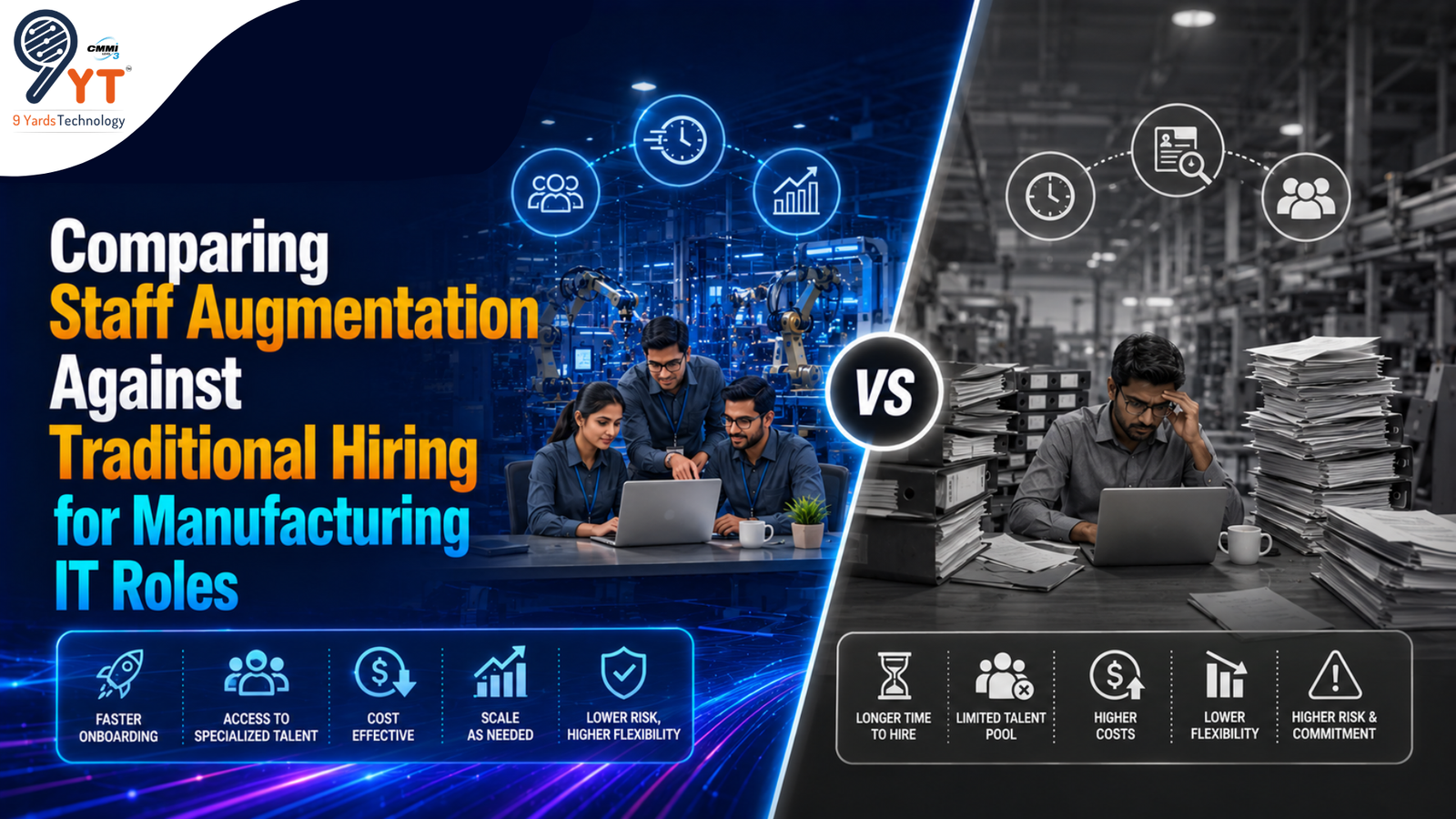
The table below uses verified data from Statistics.md and publicly available US hiring benchmarks, comparing the industry-reported average of approximately 90 days for traditional hiring against 9Yards Technology’s documented 14-21 day deployment window.
| Stage | Traditional Local Hiring | 9Yards Technology Staff Augmentation India | Time Saved |
|---|---|---|---|
| Job description to first profiles | 2-4 weeks | 48-72 hours | ~3 weeks |
| Screening and shortlisting | 2-3 weeks | Included in pre-vetting | ~2 weeks |
| Technical assessment rounds | 2-3 weeks | Completed pre-engagement | ~2 weeks |
| Offer, acceptance, notice period | 3-6 weeks | Not applicable | ~4 weeks |
| Total time to active contributor | 60-90 days | 14-21 days | 39-76 days |
| Annual cost (Senior DevOps, US) | $170,000-$210,000 | $42,000-$58,000 | $112,000-$152,000 |
| Replacement process if hire fails | Restart from scratch | 7-day SLA | Weeks recovered |
The 40–70 days recovered per hire translates directly to engineering velocity on the project side. For a manufacturing digitalization program running on a fixed capital budget, that velocity difference shows itself in roadmap milestones delivered, not abstract productivity gains.
What Separates Quality Vendors From the Rest in This Category
The manufacturing sector’s tolerance for delivery failure is low. A bad software hire on a consumer app costs a sprint. A bad hire on a SCADA project costs a plant window and a capital budget cycle.
Evaluating a manufacturing IT staff augmentation partner requires a different checklist than evaluating a generic staffing vendor.
Retention rate is the most defensible quality proxy. Testimonials can be curated, but a 95% client retention rate across 300+ deployments cannot be fabricated. 9Yards Technology’s 95% retention rate compares against an industry average of approximately 70%, a 25-point gap that compounds over a multi-year partnership.
The replacement SLA is the second filter. Ask any vendor for their written replacement SLA and watch the response. Most will describe a process. Fewer will name a specific number of days, and fewer still will put it in writing before the contract is signed.
Certification and NDA adherence are table stakes for manufacturing procurement, not differentiators. Verify them, but do not use them as your primary selection criterion.
Deloitte’s 2024 Global Outsourcing Survey of 500+ executives found that skilled talent access and agility have joined cost reduction as the top reasons organizations use extended workforce partners — with 70% of respondents reporting their governance of the extended workforce isn’t yet fully mature. Winning vendors in manufacturing are the ones who can show both a named retention number and a written replacement commitment.
9Yards Technology Proof Point: SHL needed 60+ engineers across Product Engineering, QA, Performance Engineering, and Business Analysis, and their internal hiring process was taking months per role. 9Yards Technology deployed all 60+ within two months using a BOT model, delivering 70% faster resource deployment and a 20% reduction in talent acquisition costs. The partnership is now five years old and still active.
The Build-Operate-Transfer Option for Longer Horizons
Some manufacturing enterprises are not just filling a gap but building a permanent India engineering capability to support ongoing plant digitalization, IoT operations, and ERP management across multiple sites. For those clients, the Build-Operate-Transfer model makes more sense than standard staff augmentation. 9Yards Technology builds the team, operates it under a managed delivery structure for an initial period, and transfers the team to the client’s own payroll after 12 months if the client wants full internal ownership.
This is how the Talkdesk India engineering hub was built: 45+ engineers deployed across Engineering, QA, Security, ERP, and Business Analysis functions, with the hub operational within three months and hiring running 80% faster than Talkdesk’s US process, at 50% of the equivalent talent cost. The BOT model removed the operational risk of building from scratch while preserving the option to internalize the team once it was proven.
For a manufacturing enterprise with a five-year plant digitalization roadmap, that structure is worth evaluating alongside a standard augmentation engagement. The right model depends on time horizon, budget structure, and how much control the client wants over the team’s day-to-day management. Staff augmentation is OpEx, flexible, and reversible, while a BOT transition moves toward a quasi-CapEx structure with longer-term headcount ownership.
Manufacturing IT staff augmentation from India works because the talent pool is deep, the cost arbitrage is real, and the deployment process eliminates the 60-90-day local hiring cycle that derails industrial digitalization programs. The vendors who can back that with a 95% retention rate and a written 7-day replacement SLA are not operating the same model as a generic staffing agency; they are operating a delivery guarantee.
Need pre-vetted engineers in 48-72 hours? Talk to a 9Yards Technology specialist with no obligation and no generic shortlist.
Frequently Asked Questions
How quickly can manufacturing companies get IT engineers from India through staff augmentation?
Pre-vetted profiles are delivered within 48-72 hours of receiving a requirement. Full deployment into the client engineering team completes within 2-3 weeks. This compares to an industry-reported average of approximately 90 days for traditional local hiring. The 9Yards Technology Talent Deployment Matrix runs screening and technical assessment before the client sees a single profile, so the shortlist is qualified, not raw.
What types of manufacturing IT roles can be filled through India staff augmentation?
The most commonly deployed disciplines for manufacturing clients include Industrial Digitalization, IoT and embedded systems, Cloud and DevOps, Data Engineering, QA Automation, ERP, and Security Engineering. These map directly to the skills required for SCADA modernization, predictive maintenance platforms, OT/IT integration, and plant-level data infrastructure. 9Yards Technology maintains a pre-vetted bench across all these areas.
How does manufacturing IT staff augmentation from India compare to hiring locally in terms of cost?
For a Senior DevOps or SRE engineer, the annual cost in the US runs $170,000-$210,000. The equivalent India-delivered rate through 9Yards Technology runs $42,000-$58,000, an annual saving of $112,000-$152,000 per head. For a 10-person infrastructure team, that saving exceeds $1 million annually. The cost comparison for Senior Software Engineers, Data Engineers, and AI/ML Engineers shows a similar 68-76% reduction.
What happens if an India-deployed manufacturing IT engineer does not perform?
9Yards Technology’s 7-day replacement SLA applies: any underperforming engineer is replaced within seven days, with no renegotiation and no additional cost to the client. This SLA is backed by a pre-vetted bench, which means replacements draw from engineers who have already cleared a technical assessment rather than starting a fresh sourcing cycle. The 95% client retention rate across 300+ deployments reflects how rarely the SLA is actually needed.