

 Post by
Healthcare IT staff augmentation in India is the fastest path for most US health-tech CTOs to close a FHIR or EHR integration gap without waiting 90 days for a local hire. India’s engineering talent pool includes a documented concentration of FHIR, HL7, EHR, and HIPAA-aware engineers, the skills US health-tech companies cannot hire fast enough domestically. NASSCOM’s Technology Sector in India: Strategic Review confirms India as the primary global supply source for the specialised engineering roles US health-tech companies consistently struggle to fill locally. The real question is whether your augmentation vendor has the governance structure to make that talent safe to deploy inside a PHI-adjacent environment. Most do not. That distinction matters more in health-tech than in any other vertical: outsourcing hands off a function; augmentation embeds a pre-vetted engineer directly into your team, under your architecture decisions, your security controls, and your compliance posture.
If you are a VP of Engineering at a Series B health-tech company, your open requisitions probably fall into one of three categories: FHIR R4 integration, EHR platform engineering (Epic, Oracle Health, athenahealth), or security engineering for a HIPAA audit finding. Local hiring for all three takes months and costs north of $160,000 annually per senior engineer. The sections below explain exactly how India-based IT staff augmentation closes that gap, what governance makes it safe, and what to demand from any vendor before signing.
Why the Healthcare Engineering Talent Gap US Companies Face Is Not a Temporary Problem
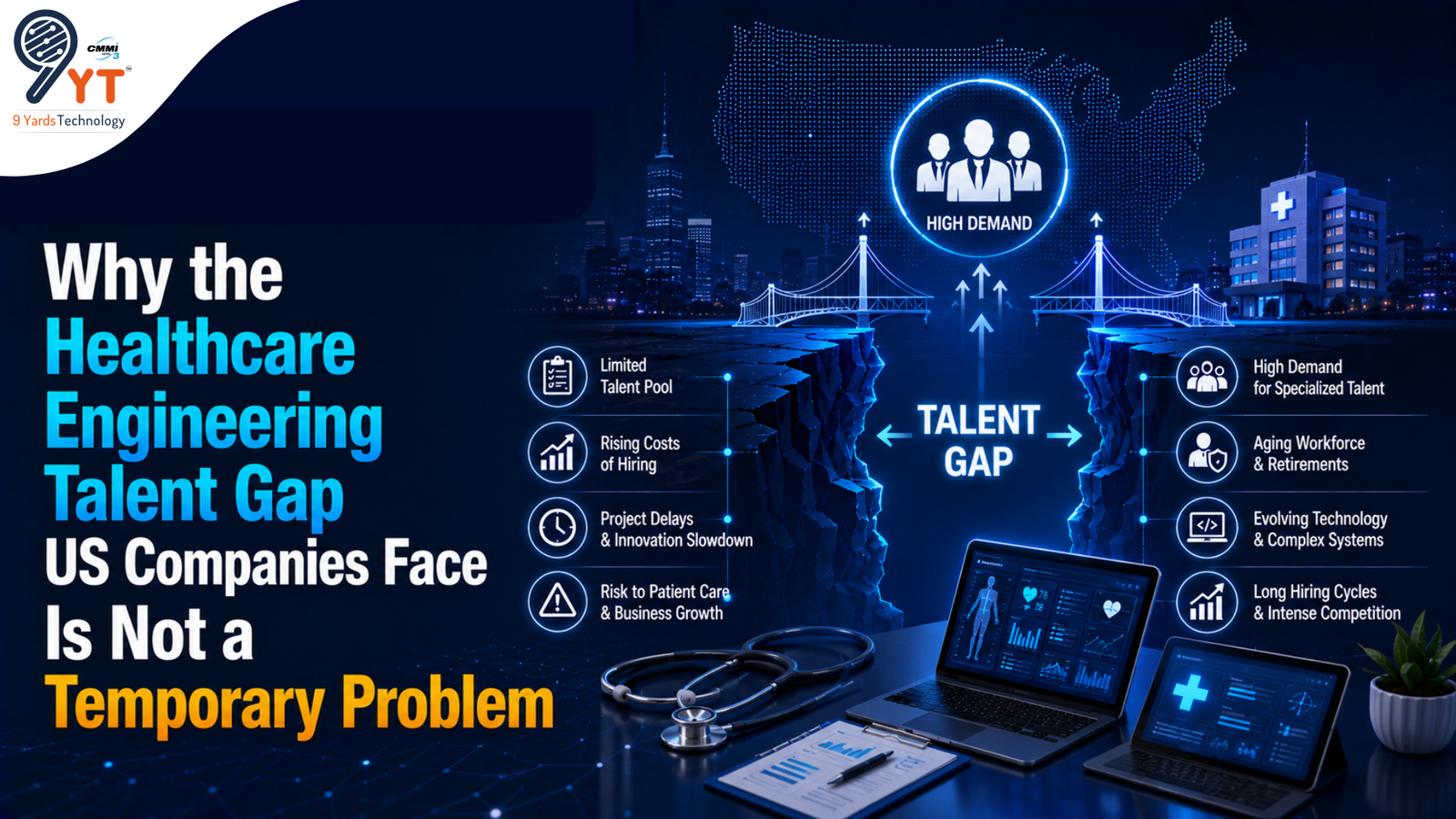
The US healthcare IT hiring market is structurally broken for specialized engineering roles. There is a surprising shortage of tech and IT professionals in healthcare who can help provide the necessary skills for the sector’s technological advancements. That shortage compounds year on year. CMS and ONC interoperability rules require health systems to expose FHIR R4 APIs and support patient data access at scale, and integration engineers with expertise in FHIR, SMART on FHIR, and bulk data are in high demand, with mandate deadlines that are not moving due to staff shortages.
The engineering roles most health-tech companies cannot fill locally are precisely those India’s talent pool has trained for at scale: FHIR R4, HL7 v2.x, interface engine configuration (Mirth Connect, Rhapsody, InterSystems), Epic SMART app development, and security engineering for ePHI environments. All are well-represented in India’s engineering graduate cohort. The problem is not talent availability. Most US health-tech buyers simply have not found a vendor with the compliance infrastructure to deploy that talent safely.
For a senior FHIR/HL7 integration engineer, US local compensation runs $165,000–$205,000 annually. The same seniority through 9Yards Technology’s India delivery hub costs $38,000–$52,000. That difference lets you hire one engineer locally or deploy a four-person integration team for the same annual budget.
What FHIR HL7 EHR Integration Engineers in India Actually Deliver
India’s healthcare engineering talent is specific and documented. The most in-demand healthcare IT roles in 2026 include EHR analysts and trainers for Epic and Oracle Health, HL7/FHIR integration engineers, cybersecurity and HIPAA compliance specialists, and AWS/Azure cloud architects with healthcare-specific compliance experience. All exist in India’s engineering market at a competitive scale.
FHIR R4 work demands more than generic API development. FHIR is the modern standard for healthcare API development, using RESTful APIs with JSON or XML payloads, unlike HL7 v2’s message-based approach. Engineers deploying into this stack must understand resource profiling, SMART on FHIR authorization flows, CDS Hooks, and bulk data export patterns. These are teachable skills, but ramping a general-purpose API developer on this stack takes 4–8 weeks minimum. Pre-vetted Indian engineers already fluent in this stack skip that entirely.
FHIR is the required standard for the ONC Cures Act patient access APIs, and every certified EHR must expose FHIR R4 APIs conforming to the US Core Implementation Guide. Every health-tech company building on Epic, Oracle Health, or athenahealth has FHIR R4 work on its roadmap right now, whether it has the engineers or not.
Hire dedicated software engineers with pre-verified FHIR and HL7 experience through a structured deployment process, not a contractor marketplace where vetting is self-declared.
How Healthcare Software Staff Augmentation vs Outsourcing Should Actually Be Evaluated
The staff augmentation versus outsourcing distinction carries real weight in healthcare. Outsourcing transfers accountability for a deliverable to an external team. Staff augmentation deploys an engineer under your direct management, inside your security perimeter, accountable to your sprint cadence and architecture decisions. For PHI-adjacent work, that distinction has compliance implications.
| Evaluation Criterion | Healthcare Outsourcing | 9Yards Technology Staff Augmentation |
|---|---|---|
| HIPAA accountability | Vendor-side, in their SOW | Client-controlled; engineer operates under client’s BAA and security controls |
| Healthcare engineering talent gap US (time-to-fill) | 4–12 weeks for project kickoff | Pre-vetted profiles in 48–72 hours; deployment in 2–3 weeks |
| Engineer management | Vendor PM-mediated | Direct client management, same as internal hire |
| Replacement if underperforming | Renegotiation required | 7-day replacement SLA, no extra cost |
| NDA and IP protection | Varies by vendor contract | 100% NDA adherence, enterprise-grade governance |
| Engagement flexibility | Fixed scope or long-term contract typical | T&M, FTE, or BOT model; no minimum term |
| Retention signal | Rarely published | 95% client retention rate, verifiable |
For a CTO building a FHIR integration layer or standing up a HIPAA audit remediation team, the management model matters as much as cost. Engineers embedded directly in your team learn your stack, your data architecture, and your PHI handling procedures. An outsourced team optimizes for its own metrics.
What Makes an India Staff Augmentation Vendor Safe for HIPAA-Sensitive Work
Compliance is not a geography question. The Department of Health and Human Services explicitly states that Business Associates can be anywhere; HHS cares about safeguards, not borders, making HIPAA-compliant offshore development completely legal. The requirements are structural, not geographic.
When an Indian company signs a BAA with a US healthcare client, they become a Business Associate and must implement HIPAA Security Rule safeguards, protect PHI confidentiality and integrity, report security incidents and breaches, ensure subcontractors are compliant, and allow HHS audit access if required.
Three things to verify before any vendor touches your PHI environment:
First: a signed Business Associate Agreement. This is non-negotiable. Every HIPAA-compliant staff augmentation relationship requires a BAA, and whether your developers sit in Boston, Manila, or Bangalore does not change this requirement. Any vendor that hedges on this should not handle health-tech work.
Second: 100% NDA adherence with documented enforcement. A vendor with a documented retention rate and a replacement SLA has financial skin in the compliance game, not just a checkbox. A 95% client retention rate is not marketing cherry-picking; it is an audit trail of engineers who stayed, performed, and handled client data without incident.
Third: a replacement SLA with a specific day count. HIPAA penalties range from $100 to $50,000 per violation, capped at $1.9 million per year per violation category. A vendor unable to commit to a written replacement timeline should not handle PHI-adjacent engineering work. 9Yards Technology’s 7-day replacement SLA is a public commitment, not a courtesy.
Read More: Offshore Staff Augmentation for US Companies Hiring from India: The Compliance-First Guide
The 9Yards Technology Deployment Process for Healthcare Engineering Roles
Speed without structure is the staffing industry’s most common unspoken risk. 9Yards Technology’s Talent Deployment Matrix runs in a fixed sequence:
- Requirement received: role specification submitted, including FHIR/HL7 experience level, EHR platform familiarity, and any HIPAA training requirements.
- Talent mapping: internal matching against the pre-vetted bench, filtered for healthcare domain experience.
- Screening: initial qualification against role-specific compliance and technical requirements.
- Technical assessment: structured evaluation of FHIR resource handling, HL7 interface engine configuration, or relevant security engineering skills.
- Client interview: the client team meets shortlisted engineers directly.
- Deployment: engineer joins the client team, operating under client security controls and the BAA framework.
- Performance monitoring: ongoing tracking with a 7-day replacement guarantee if the bar is not met.
The headline commitments are fixed: profiles in 48–72 hours, full deployment in 2–3 weeks, replacement within 7 days. For a health-tech company with an EHR go-live in 10 weeks or an ONC mandate deadline approaching, those numbers are the difference between shipping and missing.
9Yards Technology Proof Point: Talkdesk, a US-headquartered SaaS company, needed scalable India engineering with aggressive timelines and seamless US team collaboration. 9Yards Technology established Talkdesk’s India engineering hub in 3 months, deployed 45+ engineers across Engineering, QA, Security, ERP, and Business Analysis, and delivered 80% faster hiring with a 50% reduction in talent costs. The partnership remains active and expanding. That is a governed, structured staff augmentation deployment at enterprise scale, not a contractor marketplace, but a delivery partnership with written SLAs.
When Healthcare IT Staff Augmentation in India Makes Sense and When It Does Not
Staff augmentation is not the answer to every engineering gap. It is the right model when:
- Open requisitions have been unfilled for 60 days or more, and a US local hire is not closing in the next 30 days.
- The required skills are narrow and specialized: FHIR R4, SMART on FHIR, Epic SMART apps, HL7 interface engines, ePHI security engineering.
- The company is Series B or beyond, has internal engineering leadership to manage augmented engineers directly, and needs bench depth rather than an outsourced deliverable.
- A mandate deadline (ONC Cures Act, CMS-0057-F) is creating timeline pressure that internal hiring cannot solve.
It is the wrong model when a company needs a fully managed QA or DevOps function handed off end-to-end. That is a Managed Services engagement. 9Yards Technology offers both; the distinction matters because the governance structure, BAA placement, and management overhead differ significantly.
Read More: Staff Augmentation Contract India: What to Verify Before Signing
Why Specialized Healthcare IT Talent Is Becoming Harder to Hire
Ambient clinical documentation, revenue cycle automation, and AI-assisted prior authorization are moving from pilot to production in 2026, and deploying these tools responsibly inside a healthcare compliance environment requires both AI/ML engineering skills and clinical workflow knowledge, a rare combination. That combination exists in India’s engineering market. Finding it requires a vendor with the vetting process to surface it in 48 hours, not 90 days.
Offshore engineering partnerships in healthcare are expanding because compliance frameworks, specifically the BAA structure and HIPAA’s Business Associate obligations, have matured enough to make them safe for PHI-adjacent work when the vendor is structured correctly. The US Bureau of Labor Statistics projects software developer employment to grow 15% through 2034, with healthcare IT among the fastest-growing sub-sectors. Demand is structural. Supply is not catching up locally. The NASSCOM India Tech Talent Report documents India’s position as the primary global supply source for the engineering specializations that US health-tech companies cannot hire fast enough domestically.
Filling a FHIR integration gap or a HIPAA security engineering role via local US hiring takes roughly 90 days, the industry average. 9Yards Technology delivers a pre-vetted profile in 48–72 hours and a deployed engineer in 2–3 weeks, recovering 69 days of productivity per hire, per role, per sprint cycle, per ONC mandate that does not get missed.
Need pre-vetted engineers in 48–72 hours? Talk to a 9Yards Technology specialist with no obligation and no generic shortlist.
Frequently Asked Questions
What is healthcare IT staff augmentation in India, and how does it work for US health-tech companies?
Healthcare IT staff augmentation in India means deploying pre-vetted Indian engineers, specializing in FHIR, HL7, EHR integration, or security engineering, directly inside a US health-tech company’s existing team. The engineers work under the client’s management, security controls, and BAA framework, not as an outsourced function. 9Yards Technology delivers shortlisted profiles in 48–72 hours and full deployment in 2–3 weeks, with a 7-day replacement SLA backing every engagement.
Are HIPAA-compliant developers in India a viable alternative to US local hires for PHI-adjacent engineering work?
Yes, provided the vendor structure is correct. HIPAA applies extraterritorially; Indian engineers handling US patient data must operate under a signed Business Associate Agreement, with administrative, physical, and technical safeguards enforced by the staffing partner. Geography does not determine HIPAA compliance; governance does. 9Yards Technology operates with 100% NDA adherence and requires a BAA for any healthcare engagement involving PHI-adjacent engineering work.
How do FHIR HL7 EHR integration engineers in India compare to local US hires in terms of skill depth and cost?
India’s FHIR and HL7 engineering talent pool is deep across FHIR R4, SMART on FHIR, HL7 v2.x, interface engines (Mirth Connect, Rhapsody, InterSystems), and Epic/Oracle Health platform engineering. A senior FHIR integration engineer costs $165,000–$205,000 annually via US local hiring. The equivalent through 9Yards Technology’s India delivery hub runs $38,000–$52,000 annually, a saving of $113,000–$167,000 per engineer per year, with pre-vetted profiles available in 48–72 hours.
What is the difference between healthcare software staff augmentation vs outsourcing for an EHR or FHIR project?
Staff augmentation embeds a pre-vetted engineer directly inside the client’s team, managed by the client, operating under the client’s BAA and security controls. Outsourcing transfers accountability for a deliverable to an external team operating independently. For PHI-adjacent work, the distinction is significant: augmentation keeps compliance accountability with the client organization, while outsourcing creates a separate compliance chain that requires its own audit and governance structure.