

 Post by
Boundary Value Analysis in Software Testing (BVA) is a black box testing technique that intensifies testing at the edges of equivalence partitions to detect errors and defects related to boundary handling. Also, used early in development, BVA can enhance software quality, reduce costs, expedite releases, and foster customer trust, all of which contribute to business growth. Moreover, this approach of software testing is specifically effective for identifying errors and issues where boundaries are incorrect, missing, or misplaced in the implementation.
Furthermore, with the current strategic digital economy shift, the solidity of software systems determines how well a business can innovate, retain their customers’ trust, and scale. However, ranging from seamless e-commerce checkouts to uninterrupted banking transactions and error-free medical records, modern businesses depend on high-quality software to stay competitive. However, very minor glitches at critical touchpoints can reduce growth, drive customers away, and damage reputation.
Why Boundary Value Analysis is more than just Quality Assurance?
Boundary Value Analysis in Software Testing (BVA) become game changers by verifying software’s behaviour at input boundaries, where defects frequently occur. Despite its straightforward methodology, BVA remains underutilized. Also, overlooking boundary testing may result in subtle failures, such as transaction rejections or data truncation when limits are exceeded.
Used strategically, however, the Boundary Value Analysis test is more than just a quality assurance technique; it is a business enabler. Ensuring correctness at boundary conditions reduces critical failures, enhances user trust, accelerates release cycles, and optimizes testing budgets. Organizations that systematically apply BVA see fewer production defects, lower maintenance costs, and smoother user experiences.
In this comprehensive blog, we’ll explore the full breadth of Boundary Value Analysis in Software Testing, from its definition and core principles to head-to-head comparisons with equivalence partitioning. We’ll dive into practical applications, walk through a step-by-step implementation guide, highlight benefits and common pitfalls, and illuminate how Boundary Value Analysis in Software Testing integrates with modern agile and DevOps practices. We’ll also examine how automation amplifies its impact, show how it drives business growth, and look ahead at how AI-powered testing is transforming BVA’s future.
Finally, we’ll wrap up by reinforcing why Boundary Value Analysis testing isn’t just a testing technique; it’s a secret weapon for sustainable business growth.
BVA is primarily a functional testing technique – it validates that a system behaves correctly at input boundaries.
What is Boundary Value Analysis?
Boundary Value Analysis (BVA) is a structured black box testing technique that targets the end points or “boundaries” of input domains. The rationale is simple: software often fails at edge cases more than in mid-range input values. For example, if a system accepts ages from 18 to 60, test values like 17, 18, 19, 59, 60, and 61 should be prioritized because errors typically lurk at or around these limits.
Born from the general principle of equivalence partitioning, BVA shifts focus to boundary points rather than representative values from each partition. Moreover, it is based on empirical observations that defects cluster at the extremities, such as input size limits, thresholds, or comparison operators that improperly handle equal signs or off-by-one logic.
What sets Boundary Value Analysis in Software Testing apart is its efficiency. It allows testers to uncover high-impact issues using minimal test cases. Despite its simplicity, it’s a high-yield technique: often, a handful of well-designed boundary tests uncover bugs that would otherwise slip into production.
When BVA reveals a boundary failure, teams track it through the defect life cycle in software testing, from discovery to verified closure.
For Example, consider a banking app with transaction limits set between $100 and $50,000. Without BVA, a user might face a failure only when attempting a transfer of exactly $50,000, even though it’s within limits. By explicitly testing $99, $100, $101, $49,999, $50,000, $50,001, testers can catch such edge failures pre-release.
Boundary Value Analysis in software testing is widely applicable in forms, APIs, databases, file uploads, numeric fields, and more. It’s a smart, cost-effective testing strategy that offers high defect discovery with fewer test cases, making it invaluable for businesses striving to ensure software reliability and customer satisfaction.
Core Principles of Boundary Value Analysis Testing in Software Testing
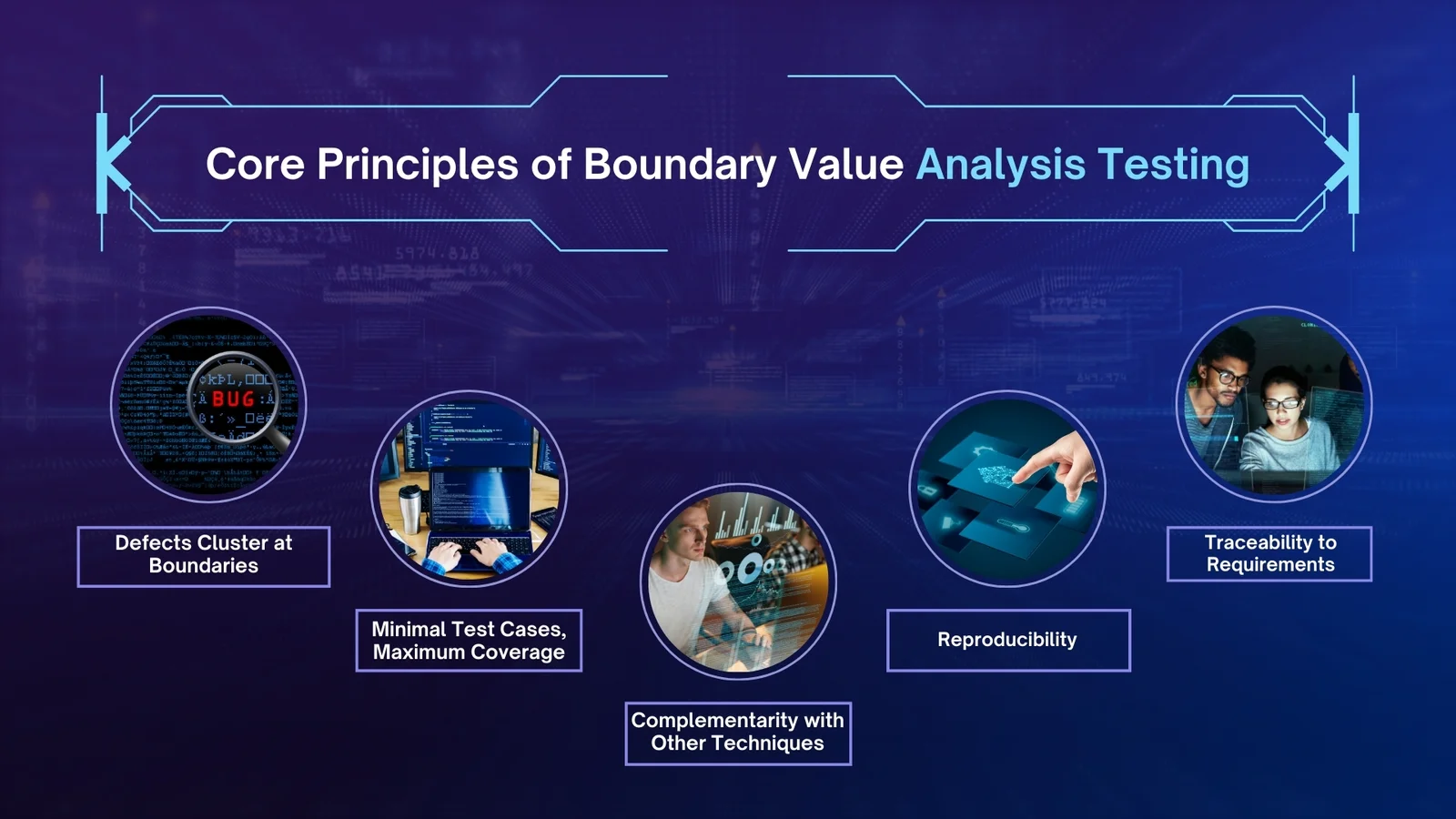
Boundary Value Analysis in Software Testing is guided by several foundational principles that explain why it works so effectively:
- Defects Cluster at Boundaries: Software errors frequently manifest at the extreme’s minimum, maximum, or just beyond. Logic conditions, array indices, buffer capacities, comparison operators, and off-by-one errors all tend to surface at these points.
- Minimal Test Cases, Maximum Coverage: By zeroing in on input boundaries, Boundary Value Analysis in Software Testing achieves a high return on testing investment. Rather than exhaustively testing every value, a small set of boundary-centric cases captures the highest-risk inputs.
- Complementarity with Other Techniques: Boundary Value Analysis testing is ideally combined with equivalence partitioning, which selects critical values from each equivalence class, ensuring both broad and focused coverage.
- Reproducibility: Well-defined boundary tests are easy to automate, allowing teams to consistently verify edge behaviour across releases and versions.
- Traceability to Requirements: Each boundary test maps directly to a specific requirement or constraint. This makes validation transparent and auditor-friendly, especially in regulated domains.
For example, in a file upload feature allowing sizes from 5 MB to 50 MB, testers should include 4.9 MB, 5 MB, 5.1 MB, 49.9 MB, 50 MB, and 50.1 MB. These tests ensure upload failures aren’t caused by minor precision or rounding issues.
By anchoring testing around these principles, teams ensure their processes are not only efficient but also aligned with business requirements and quality objectives.
Boundary Value Analysis vs Equivalence Partitioning
Equivalence Partitioning (EP) and Boundary Value Analysis (BVA) are both black box testing techniques, but they serve different purposes and work best when used together.
Equivalence Partitioning divides input data into groups (equivalence classes) expected to be treated similarly by the system. For example, an input field accepting integers 1–100 may be partitioned into:
- Valid class: 1–100
- Invalid class: below 1
- Invalid class: above 100
Testing involves selecting representative values from each class, for example, 1, 50, 100, 0, 101.
Boundary Value Analysis test, in contrast, presses on the edges of those classes: 0, 1, 2, 99, 100, and 101. By testing near these boundaries, BVA increases the likelihood of uncovering off-by-one and boundary logic defects.
Key differences:
- Scope: EP focuses on representative inputs; BVA focuses on extremities.
- Aim: EP ensures wide coverage; BVA ensures depth at high-risk points.
Complementary Usage: The best test strategies use both: apply equivalence partitioning to map input ranges broadly, then use BVA to hone in on boundary points within those ranges.
For Example,
For a username length validation that accepts 6–20 characters:
- EP yields partitions: <6, 6–20, >20
- Tests: choose one mid value per class, 3, 10, 25.
- BVA adds: 5, 6, 7, 19, 20, 21.
By combining both techniques, you achieve efficient test coverage across the spectrum and focus on edge cases at the same time.
Practical Applications of Boundary Value Analysis in Software Testing
Boundary Value Analysis finds application across domains and technologies:
- Form Validation: Ensuring minimum and maximum input constraints (such as password length, age limits, cart quantities).
- API & Service Limits: Testing pagination parameters like Page Number=0, 1, 2 or Page Size=99, 100, 101.
- Banking & Financial Systems: Validating transaction thresholds, account balance limits, EMI slabs.
- Healthcare Tools: Checking patient age limits, dosage ranges, and medical record inputs.
- E-commerce: Applying discount logic for cart values near thresholds or validating promotional codes that trigger at specific purchase amounts.
- Telecom Billing: Testing data usage caps or service renewal boundaries.
- IoT & Embedded Systems: Verifying sensor reading limits or configuration value thresholds.
Example
API Pagination:
If Page Size must be between 1 and 100:
- BVA would test: 0 (invalid), 1 (lower boundary), 2 (inside), 99 (inside), 100 (upper boundary), 101 (invalid).
Example
File Upload Feature: If the maximum upload is 10 MB:
- Tests: 9.9 MB, 10 MB, 10.1 MB.
These applications showcase how BVA helps validate real-world scenarios where input constraints directly impact user success and system resilience.
Step-by-Step Guide to Applying Boundary Value Analysis Testing
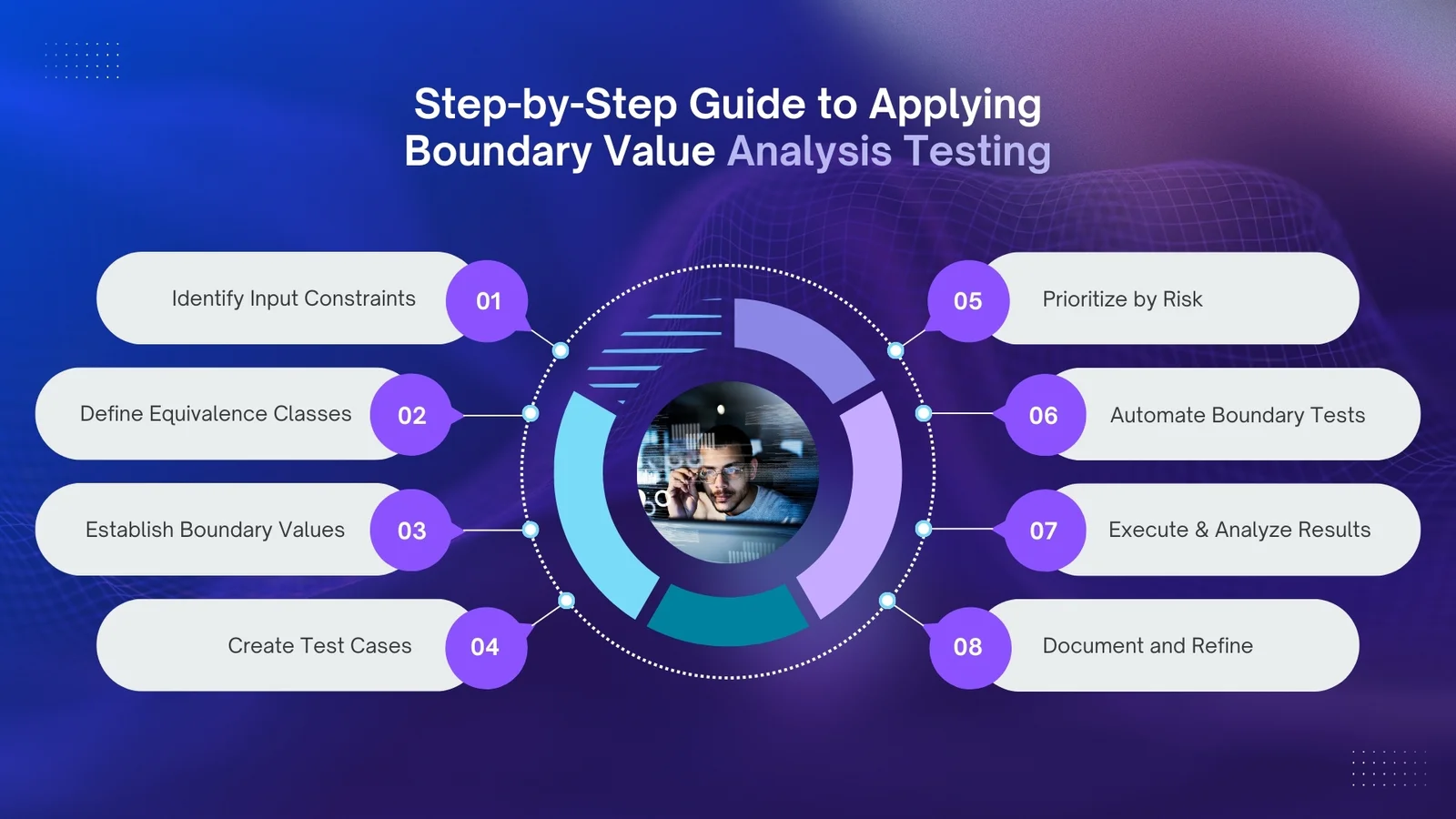
Implementing Boundary Value Analysis effectively involves a clear process:
- Identify Input Constraints: Review requirements, designs, and user stories to catalogue numeric, date, string length, and enumeration limits.
- Define Equivalence Classes: Partition inputs into valid and invalid groups corresponding to requirement boundaries.
- Establish Boundary Values: For each equivalence class, define minimum, just above minimum, maximum, and just beyond maximum.
- Create Test Cases: For each boundary, prepare test cases: lower bound – 1, lower bound, lower bound + 1, upper bound – 1, upper bound, upper + 1.
- Prioritize by Risk: Rank tests by business impact, frequency of use, and criticality (such as payment flows higher than profile update fields).
- Automate Boundary Tests: Use test frameworks (JUnit, PyTest, Selenium) to parameterize test cases and integrate into CI pipelines.
- Execute & Analyze Results: Run tests in staging environments, capture failures, and trace them back to code logic or requirement gaps.
- Document and Refine: Log test results, note anomalies, update requirements or code as needed. Maintain test cases for regression testing.
By following this process, teams systematically catch boundary-related defects, reduce rework, and maintain high software quality with leaner test suites.
Benefits of Boundary Value Analysis for Businesses
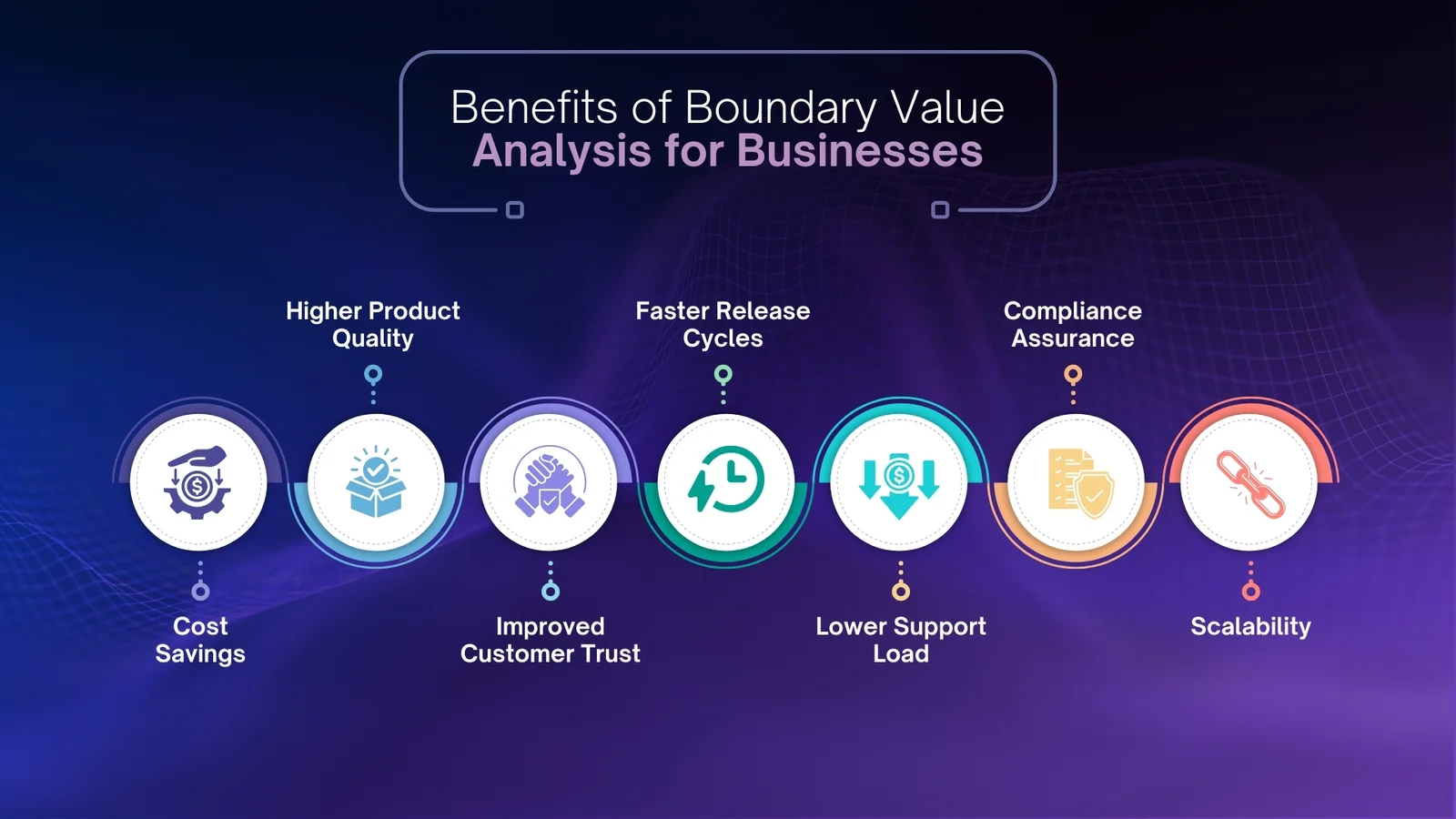
Boundary Value Analysis in Software Testing delivers multiple business advantages:
- Cost Savings: Early bug detection significantly reduces expensive production fixes. According to IBM, post-release defect fixes can cost up to 15 times more than those caught during development.
- Higher Product Quality: BVA tests are focused and shallow, they often uncover deep-seated bugs that might elude broader testing.
- Improved Customer Trust: Minimizing edge-case failures boosts user confidence and enhances brand reputation.
- Faster Release Cycles: With efficient test suites, teams can validate critical functionality quickly, supporting agile delivery and frequent releases.
- Lower Support Load: Preventing user-facing boundary errors reduces support tickets and operational costs.
- Compliance Assurance: In regulated industries like healthcare and finance, ensuring boundary controls are properly tested supports audit readiness.
- Scalability: When systems evolve, keeping boundary tests updated helps ensure new features don’t break existing constraints.
Let’s take an example of a Real-World ROI scenario:
Suppose a fintech company discovered through Boundary Value Analysis that a loan application module failed at the upper credit score threshold. After fixing the issue pre-release, loan approval errors dropped by 40%, improving revenue and customer satisfaction.
Common Mistakes and How to Avoid Them
Even with its benefits, BVA can be misapplied:
- Ignoring Out-of-Range Values: Some teams test only valid boundaries and skip invalid / just-beyond limits. Always include these to catch off-by-one errors.
- Overlooking Multi-Parameter Interactions: In systems with multiple inputs (e.g., age and tenure), testing parameters one at a time misses combined boundary defects. Use combinatorial BVA.
- Manual-Only Testing: Manual BVA is time-intensive and error-prone. Automate tests to reduce human error and improve repeatability.
- Unclear Requirement Boundaries: Ambiguous or undocumented limits lead to misidentified boundaries. Collaborate with business analysts and stakeholders to clarify.
- Skipping Updates When Requirements Change: Boundary logic evolves with features. Review and update test cases whenever requirements are modified.
Avoid these pitfalls by adopting a disciplined approach and automate, cross-validate requirements, and keep boundary tests current.
The Role of BVA in Agile and DevOps
In Agile and DevOps environments, responsiveness and quality are critical. BVA fits seamlessly:
- Shift-Left Testing: Boundary conditions should be identified during requirement grooming or backlog refinement. Acceptance criteria can explicitly include boundary tests.
- Definition of Done (DoD): Incorporate boundary test completion as part of the DoD for user stories, ensuring edge-case logic is always validated.
- Continuous Integration (CI) Pipelines: Automate boundary tests so any code change triggers boundary validation. Failures act as early alerts to edge-case regressions.
- Feature Flags and Canary Releases: Use feature flags to enable boundary tests in production-like environments or deploy to a subset of users first to validate behaviour under real-world conditions.
- Fast Feedback Loop: In Agile sprints, catching boundary defects early avoids downstream rework that can derail release schedules.
Furthermore, by embedding BVA into Agile and DevOps practices, teams maintain high quality without sacrificing speed, and boundary testing becomes part of the natural workflow, not an afterthought.
Boundary Value Analysis and Automation Testing
Automation amplifies the value of Boundary Value Analysis:
- Parameterized Unit Tests: Use frameworks like JUnit, pytest, or TestNG to input boundary values through data-driven tests that easily scale.
- API Testing Tools: Use Postman, REST-assured, or Katalon to automate boundary API parameters, and automate tests such as Page Size=99, 100, 101 in pagination APIs.
- UI Automation: In Selenium, Cypress, or Playwright, automate input of boundary values into forms (e.g., username length or file upload limits) and capture validation messages or behaviour.
- CI Integration: Include boundary test suites in smoke tests to run with every build, fast feedback prevents edge-case bugs from landing in production.
- Reporting and Monitoring: Automated boundary tests generate clear pass/fail reports. Integrate with dashboards like Allure or Jenkins to track boundary test health over time.
Automation ensures boundary tests run consistently across teams, platforms, and releases, saving time, reducing human error, and preserving software quality at scale.
How Boundary Value Analysis Fuels Business Growth?
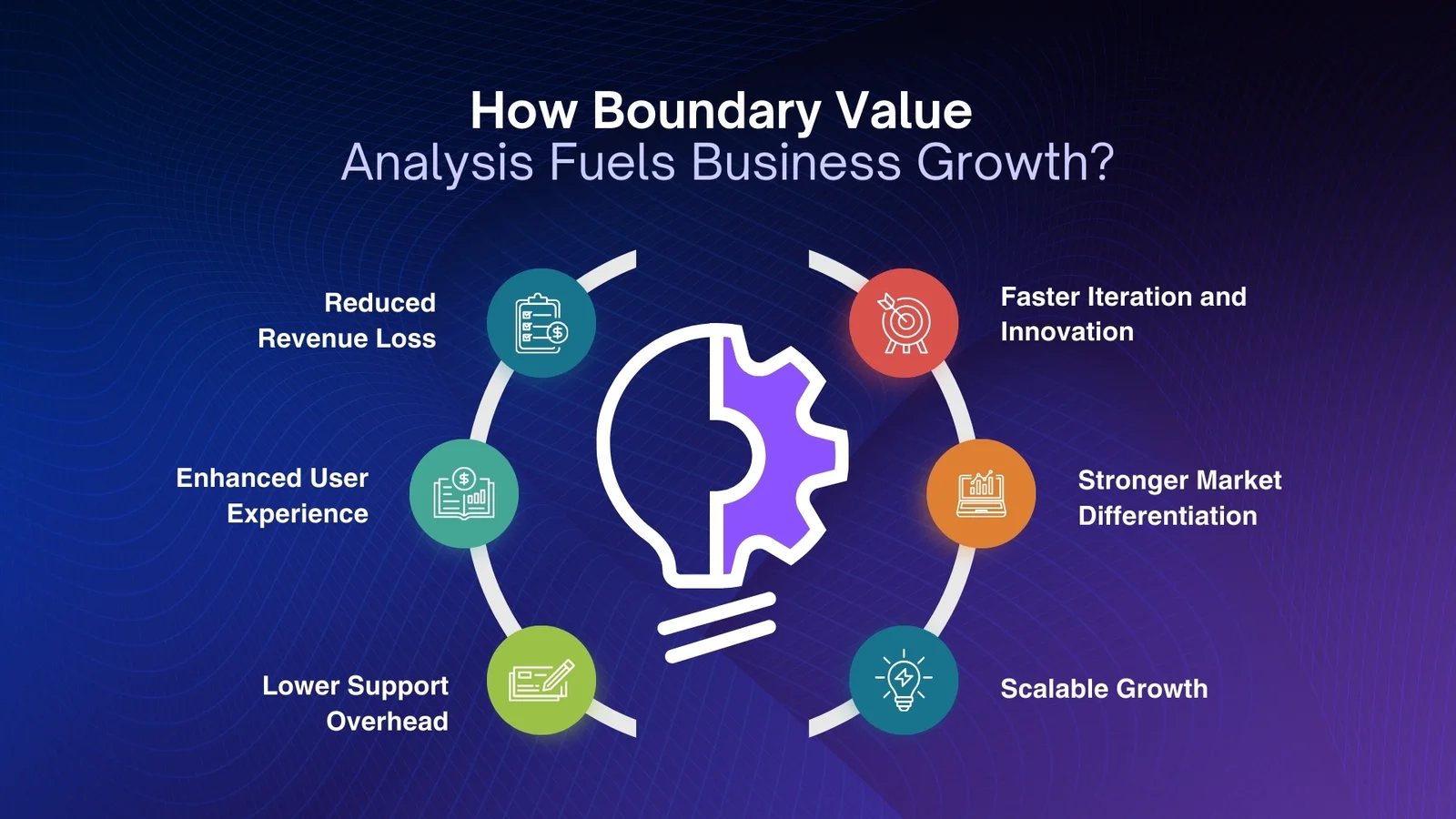
Boundary Value Analysis does more than improve testing, it fuels tangible business outcomes:
- Reduced Revenue Loss: By preventing failures like declined transactions at boundary values, BVA safeguards revenue streams.
- Enhanced User Experience: Ensuring seamless behaviour at edge cases builds customer trust, leading to retention and referrals.
- Lower Support Overhead: Fewer boundary-related incidents translate into fewer support tickets and cost savings.
- Faster Iteration and Innovation: Lean, precise test suites free up QA bandwidth for exploratory testing and new feature validation.
- Stronger Market Differentiation: In highly competitive markets, reliability becomes a selling point, products that work at edge conditions stand out.
- Scalable Growth: As product complexity grows, having a structured approach to validate boundaries ensures growth without sacrificing quality.
In essence, while BVA is a testing practice, its consistent application makes a powerful contribution to business goals, enabling cost savings, building trust, accelerating delivery, and driving sustainable growth.
Future of Boundary Value Analysis in AI-Driven Testing
As testing evolves in the era of AI and machine learning, Boundary Value Analysis is itself becoming smarter:
- AI-Generated Boundary Test Cases: Tools like Test.AI or Mabl can analyse code paths and automatically generate boundary value inputs based on constraints extracted from code, APIs, or data models.
- Predictive Boundary Detection: Machine learning can detect where boundary conditions are likely to fail and prioritize test cases, accordingly, optimizing test coverage.
- Self-Healing Tests: In UI automation, AI can adapt test scripts when the UI changes, maintaining boundary tests even as forms or constraints evolve.
- Performance Boundary Monitoring: AI tools can continuously monitor system behaviour at operational boundaries (e.g., CPU, memory, load) and automatically escalate anomalies.
- DevOps Feedback Loops: Intelligent pipelines can detect boundary failures in staging and even roll back deployments without manual intervention.
AI-driven testing doesn’t replace BVA, however, it enhances it, making boundary testing more intelligent, adaptive, and future-proof. For businesses, this means faster feedback, fewer regressions, and higher confidence in software behaviour at scale.
Key Takeaways
Boundary Value Analysis in Software Testing is not just a niche technique; it is a strategic lever for ensuring quality, reducing costs, and differentiating in crowded markets. Also, by concentrating on the vulnerable edges, BVA finds high-impact defects with minimal effort, enhancing reliability and resilience.
In a business context, this translates directly to cost savings, faster delivery, better user experiences, and stronger brand reputation. Moreover, when properly integrated into agile workflows, DevOps pipelines, and automated test suites, BVA amplifies team velocity and releases confidence.
Looking ahead, as AI and automation technologies become more sophisticated, Boundary Value Analysis in software testing will not just be executed, it will evolve. However, smart tools will automate boundary detection, healing, and performance monitoring, making edge-case assurance smarter and more scalable than ever.
To remain competitive, businesses must adopt Boundary Value Analysis in Software Testing not as a one-off technique but as a foundational practice, built into requirements discussions, acceptance criteria, test designs, and continuous delivery pipelines. Also, when BVA is treated as a strategic asset, it transforms quality assurance into a growth engine.
In the digital era, Boundary Value Analysis (BVA) truly becomes a secret weapon for developers, QA teams, and business leaders alike.
Read More: Top Quality Assurance Trends in 2025: Stay Ahead in QA Innovation

0 Comments
Leonel Evorn
September 05, 2025, at 6:03 pmI really liked the comparison you added between equivalence partitioning and boundary value analysis testing. Very useful!
David
September 10, 2025, at 5:20 amBest blog for boundary value analysis testing and explained in a very simple and clear way.
Ritu
September 17, 2025, at 2:22 amThe post explains boundary value analysis well, but adding a few more real-world examples of BVA in action could make it even more relatable for beginners.
Scott
October 04, 2025, at 6:24 amThe step‑by‑step section is useful. Especially the part about combining boundary value analysis with equivalence partitioning — many people forget that using both gives much better coverage than either alone.
Simran saini
December 19, 2025, at 10:23 amclear explanation on Boundary Value Analysis in Software Testing focusing on boundaries really simplifies complex test planning.
Sonu
December 19, 2025, at 10:23 amcomparison of Boundary Value Analysis with equivalence partitioning made software testing concepts much easier to grasp.
Priya
December 19, 2025, at 11:47 amNice detail on efficient test case design with Boundary Value Analysis in Software Testing to improve software reliability and reduce bugs.
Aryaman
December 22, 2025, at 7:16 amWell written guide for boundary value analysis for learning