

 Post by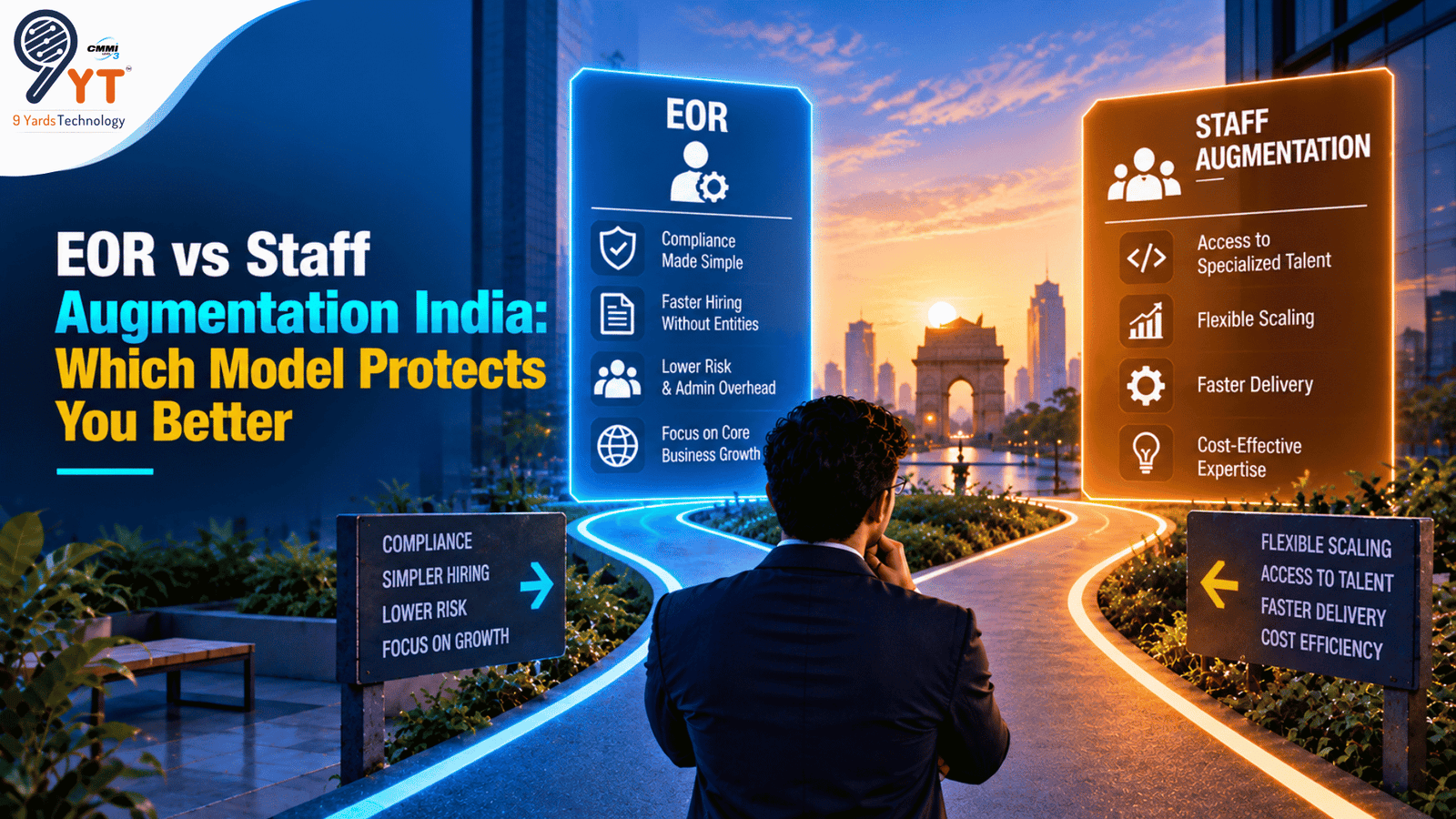
The EOR vs. staff augmentation India debate that most companies have is framed incorrectly. Both models solve the “how do we hire in India without setting up an entity” problem. The question that actually matters is: which model keeps your engineering team under your direction while someone else absorbs the compliance and delivery risk?
If your open roles have sat unfilled for 60 to 180 days, you already know the cost of getting this choice wrong. The wrong model does not just slow you down; it hands control of a critical part of your product team to a party whose incentives do not align with yours. This article makes the distinction concrete, with specific criteria so you can match the right model to your actual situation.
What the EOR Model Actually Does, and Where It Stops
An Employer of Record is a third-party legal entity that formally employs engineers on your behalf in India. The EOR files taxes, processes payroll, handles statutory benefits such as PF and ESIC, and absorbs the employment liability that would otherwise require you to register an Indian legal entity.
That is genuinely useful for one specific problem: hiring one or two individuals in India without the six-to-twelve-month overhead of incorporating a subsidiary.
Read More: Offshore Staff Augmentation for US Companies: The Compliance-First Guide
What EOR does not do is screen, vet, or manage engineering performance. You find the candidate, run the interview, and manage delivery. The EOR is a payroll and compliance wrapper, nothing more. If the engineer underperforms, you bear the cost of identifying the problem, sourcing a replacement, and absorbing the delay. There is no replacement SLA. There is no pre-vetted bench.
For a VP of Engineering scaling a ten-person team across product, QA, and DevOps, that gap is not a minor paperwork inconvenience. It is a delivery risk with no backstop.
According to Deloitte’s global workforce research, compliance and employer-of-record complexity rank among the top operational concerns for companies expanding engineering capacity across international markets, but compliance alone does not produce delivery outcomes.
What Staff Augmentation in India Actually Delivers
Staff augmentation embeds pre-vetted engineers directly into your existing team. They report to your sprint, use your tools, attend your standups, and operate under your engineering direction. The augmentation partner is responsible for sourcing, vetting, deploying, and replacing engineers, not just processing their payroll.
The distinction is ownership of quality. With IT staff augmentation, the vendor’s reputation and contractual exposure are tied to how well the deployed engineer performs. That changes the incentive structure entirely.
9Yards Technology’s position on this is direct: a 7-day replacement SLA is the most honest thing a staffing company can offer, because it is a public bet on your own vetting process. If you are not willing to put a specific number of days next to your replacement commitment, you do not actually have confidence in how you screen engineers.
The Talent Deployment Matrix 9Yards Technology runs across every engagement, moving from requirement receipt to profiles in 48–72 hours and full deployment within 2–3 weeks, a timeline that does not require you to source the candidate yourself, unlike EOR.
Comparing Offshore Staffing Models: EOR vs. Staff Augmentation Side by Side
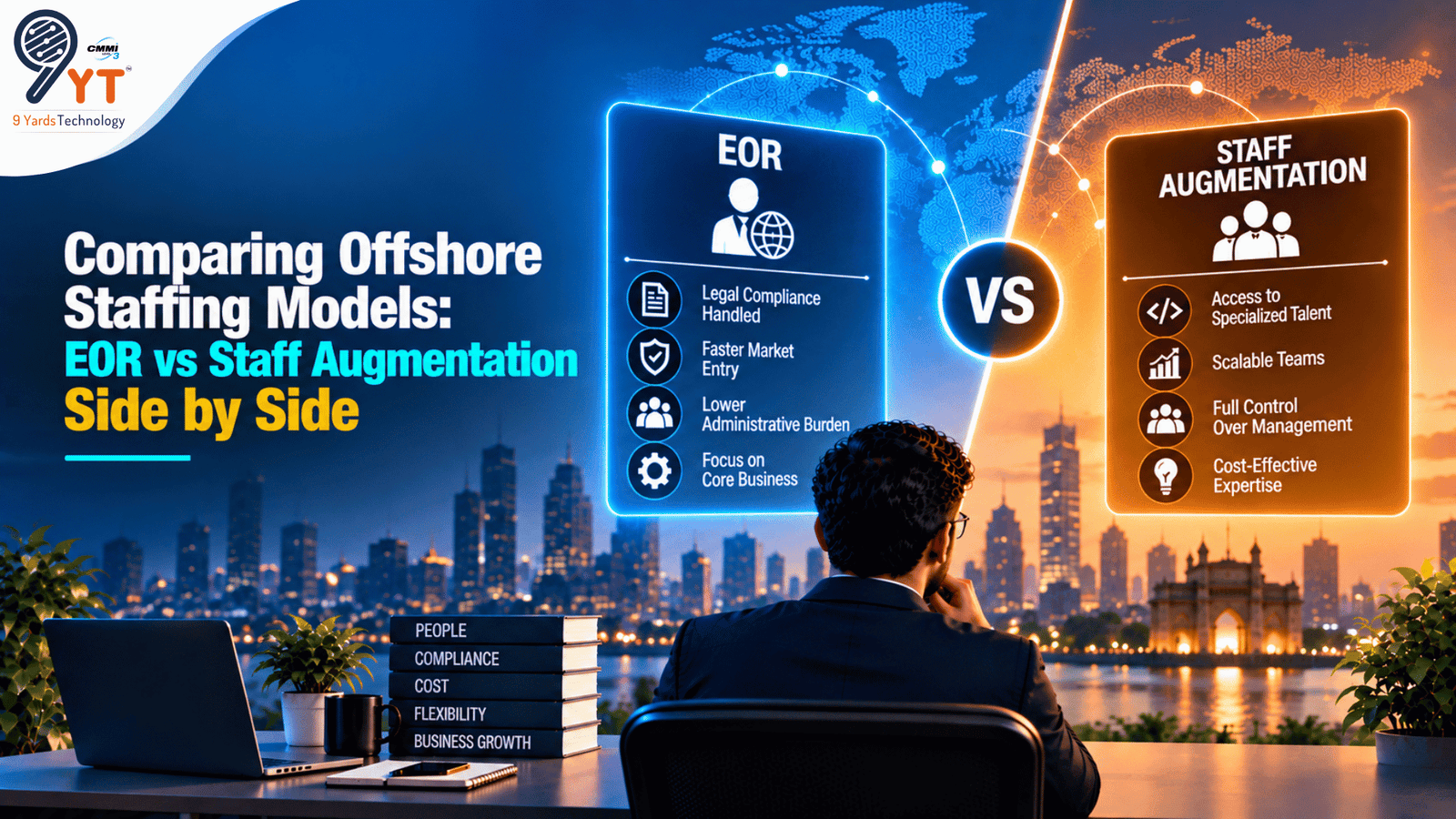
Companies evaluating offshore staffing models often treat EOR and staff augmentation as substitutes. They are not. They solve different problems at different points in a company’s growth.
| Evaluation Criterion | EOR Model | 9YT Staff Augmentation |
|---|---|---|
| Who sources the engineer? | You (EOR only hires who you find) | 9YT (pre-vetted bench, 48–72 hr profiles) |
| Compliance and payroll | Handled by EOR provider | Handled by 9YT as part of the engagement |
| Replacement if underperforming | No SLA, your problem to solve | 7-day replacement SLA, no renegotiation |
| Vetting and technical screening | None, you run all interviews | Multi-stage assessment before client interview |
| Team integration | Directly report to you, isolated | Embedded in your sprint, monitored for quality |
| Speed to first profile | Days (if you have a candidate) | 48–72 hours from requirement receipt |
| Ongoing performance oversight | None | Performance monitoring is included in the engagement |
| Best fit | 1–2 individual hires, known candidates | 5–60+ engineers, sustained team scaling |
| Retention data | No published figure | 95% client retention (industry avg: ~70%) |
LinkedIn’s 2024 Global Talent Trends report identifies speed-to-productivity and post-hire retention as the two metrics talent acquisition leaders most commonly fail to measure, both of which staff augmentation partners with an enforceable SLA are structurally better positioned to influence than EOR providers.
The Compliance Argument for EOR Is Real, but Overstated for Scale
The strongest case for EOR is compliance simplicity for small-scale, individual hiring. If you have identified a specific engineer through your own network and need a legal entity to employ them in India, EOR is a clean, low-overhead solution.
Read More: Staff Augmentation Contract India: What to Verify Before Signing
At scale, the compliance argument flips.
A certified staff augmentation partner operating in India already handles statutory compliance, NDA enforcement, payroll, and HR governance for every engineer on your account. 9Yards Technology maintains 100% NDA adherence and compliance across every active engagement. When TestCrew needed to scale 50+ specialized engineers across Manual and Automation Testing, DevOps, Performance Engineering, Security Engineering, and AI/ML infrastructure in India without setting up a local entity, 9Yards Technology operated as a Zero-Footprint Engineering Center, handling every element of India compliance and HR so TestCrew retained full engineering direction with none of the operational overhead.
Zero local India infrastructure is required from TestCrew. Engineers were deployed 85% faster than traditional hiring, with 45% lower talent acquisition and operational costs. The partnership has been active for 5+ years. Zero local India infrastructure required. That is not an EOR outcome; it is a staff augmentation outcome, with compliance built into the model.
9YT Proof Point
When Talkdesk needed to establish an India engineering hub, 9Yards Technology deployed 45+ pre-vetted engineers across Engineering, QA, Security, ERP, and Business Analysis in 3 months, 80% faster than traditional hiring, with a 50% talent cost reduction. The hub is still active and expanding. That outcome required a vetted bench, a delivery methodology, and ongoing performance oversight. An EOR wrapper does none of those three things.
Read More: Staff Augmentation Engagement Models India: Choose Right
When a Hybrid Staffing Model Makes Sense
Some companies arrive at this decision mid-engagement: they started with EOR for two or three individual hires, and now they need to scale quickly across multiple functions. That transition is where hybrid staffing becomes a real consideration.
A hybrid approach uses EOR for known individuals already in your network, where the compliance wrapper is the only gap, and staff augmentation for any net-new hiring where vetting, sourcing, and delivery accountability matter.
The key is not to let the EOR relationship become the default template for scale. EOR providers are not built for rapid, multi-role deployment. They are not holding a pre-vetted bench. They are not running a structured Talent Deployment Matrix. Applying an EOR model to a 10-engineer-scale requirement stretches it past its design intent and removes the quality backstop that a staff augmentation engagement provides.
NASSCOM’s India engineering talent data shows India’s developer pool continues to expand across AI/ML, cloud, and full-stack disciplines, but quality variance between sourcing methods remains the single most operationally significant variable for enterprise clients, not compliance structure.
The right hybrid model pairs EOR’s compliance simplicity for individual known hires with a staff augmentation partner’s vetting and deployment engine for any new role. The 9Yards Technology engagement structure covers both Time and Material, Fixed Price, FTE, Managed Services, and Build-Operate-Transfer models, all of which include full India compliance and HR handling as part of the delivery, so EOR is rarely the only path to compliant India hiring at scale.
The Question Most Articles Skip: What Happens When It Goes Wrong?
Every evaluation of EOR vs. staff augmentation in India should include a stress test: what is your actual recovery path if a deployed engineer does not perform?
With EOR, you bear the full sourcing and replacement cost. You find the new candidate, run the interviews, and wait for the EOR to onboard them. There is no day count. There is no contractual backstop.
With 9Yards Technology staff augmentation, the answer is contractual and specific: 7 days. No renegotiation. No additional cost. The replacement comes from the pre-vetted bench, which means the screening is already done before the replacement starts. That is not a marketing claim; it is a public bet on a vetting process that has produced a 95% client retention rate across 300+ deployed engineers.
For a CTO whose delivery timeline is already under pressure, the difference between “we will sort it out” and “you will have a replacement within 7 days” is not a minor contractual nuance. It is the difference between a recoverable delay and a roadmap quarter lost.
We’ll put pre-vetted profiles in your inbox within 72 hours of your requirement. If we can’t, we haven’t done our job. No obligation. No generic shortlist.
Frequently Asked Questions
What is the main difference between EOR and staff augmentation in India?
EOR (Employer of Record) is a compliance and payroll wrapper. The EOR provider employs engineers on your behalf in India but does not source, vet, or manage them. Staff augmentation handles sourcing, multi-stage technical vetting, deployment, and ongoing performance oversight. With staff augmentation, your partner’s delivery accountability is contractual. With EOR, the delivery risk stays entirely with you. For teams scaling beyond two or three engineers, staff augmentation provides meaningfully stronger protection.
Which offshore staffing model gives me more control over my engineering team?
Staff augmentation gives you more engineering control. The deployed engineers work under your technical direction, inside your sprint cycles, using your tools and processes, with the same integration as an internal hire. EOR gives you more payroll and compliance control over a single known individual, but does not provide a vetted bench or a replacement SLA. For teams that need quality at scale, offshore staffing models with an enforceable replacement guarantee outperform EOR on every operational metric that matters post-hire.
Does a hybrid staffing approach work for scaling an Indian engineering team?
Hybrid staffing works when applied to the right split: EOR for one or two known individuals already in your network where only a compliance wrapper is needed, and staff augmentation for any net-new hiring where sourcing and vetting accountability matter. The risk is treating EOR as a default template for scale; EOR providers do not hold a pre-vetted bench and do not offer replacement SLAs. A hybrid staffing model only protects you if the staff augmentation component has an enforceable SLA on both profiles and replacements.
How fast can a staff augmentation partner deploy engineers in India compared to an EOR?
A staff augmentation partner with a pre-vetted bench delivers profiles in 48–72 hours and completes full deployment within 2–3 weeks. EOR speed depends entirely on how quickly you can source and interview the candidate yourself; the EOR adds no hiring velocity. For a role that has been open for 60 to 90 days, the sourcing gap between EOR and a staff augmentation partner is the single largest time variable in the comparison. The EOR model does not include the EOR model’s biggest advertised benefit, speed, if you still own all sourcing.