

 Post by
The GCC vs. BOT model in India question separates companies that are ready to own an offshore operation from those that need a proven team before they commit capital. Talkdesk needed a full India engineering hub, fast. 9Yards Technology built it in 3 months, deployed 45+ engineers across Engineering, QA, Security, ERP, and Business Analysis, and cut hiring time by 80%. That result came from a BOT engagement, not a direct GCC setup. The distinction is not semantic.
If you are a CTO or VP of Engineering weighing how to establish engineering capacity in India, the model you choose determines your risk exposure, your time to first commit, and whether you inherit a proven team or a compliance headache. Both GCC and BOT lead to the same destination: an Indian engineering capability you own. They take very different paths to get there.
What the GCC Model Actually Means
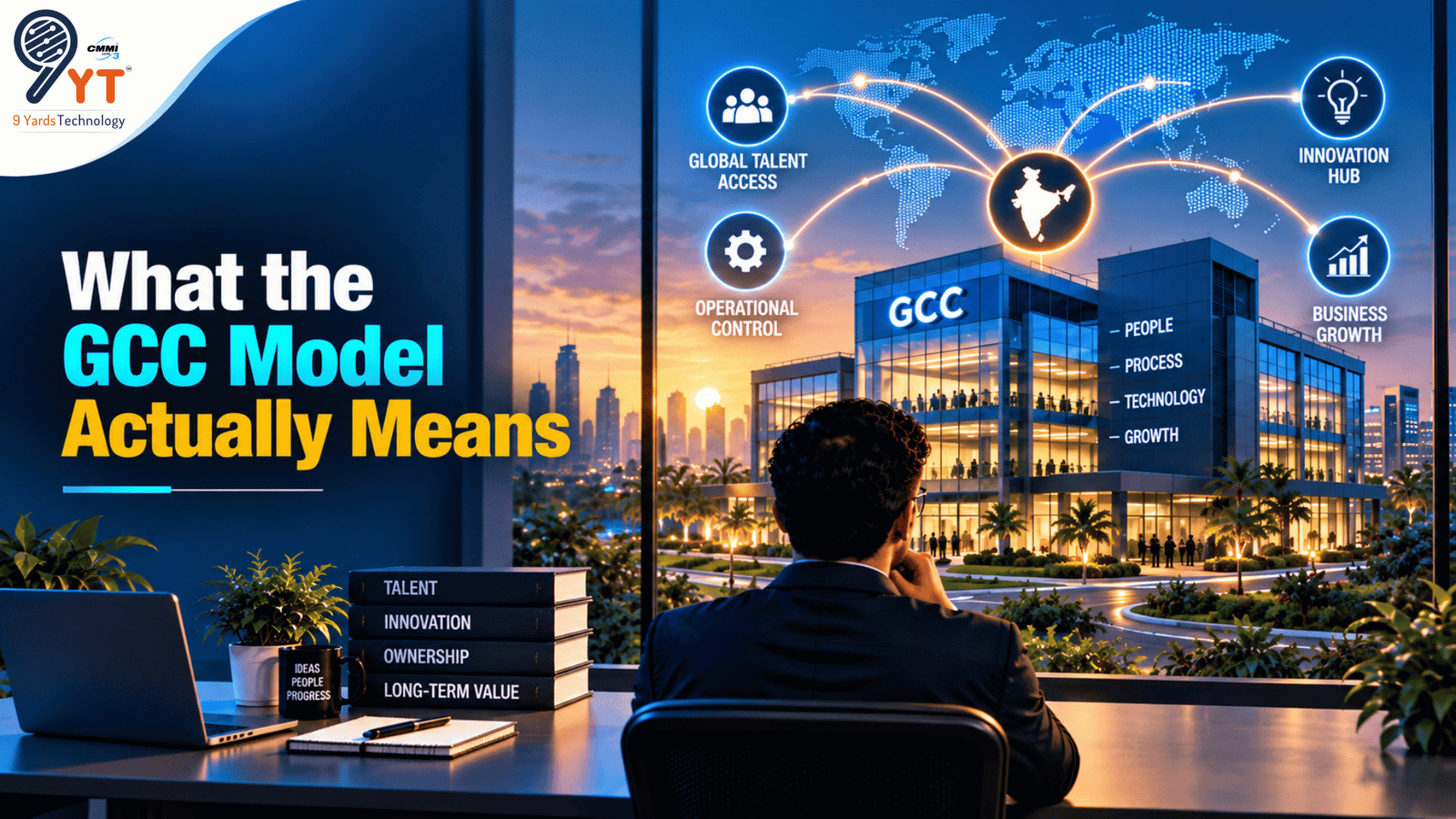
A Global Capability Center (GCC) is a wholly owned offshore unit. Your company sets up a legal entity in India, employs engineers directly, manages HR and payroll compliance, leases infrastructure, and runs the operation under your own governance from day one. The engineers carry your badge. IP ownership is unambiguous. Decisions flow through your own management chain.
This is the model NASSCOM’s GCC framework positions as a strategic extension of the parent enterprise, not a vendor relationship. That framing is accurate. A GCC is an owned operation. The talent works for you, reports to you, and builds institutional knowledge inside your organization.
The cost case is real. Senior Software Engineers in India cost $40,000–$55,000 annually against $160,000–$200,000 for equivalent US local hires. A 10-person senior engineering team saves approximately $1,050,000–$1,600,000 per year at those bands. Over a five-year horizon, the math overwhelmingly favors ownership.
The problem is the setup cost and the timeline to reach that math. Entity registration, statutory compliance, HR policy localisation, office infrastructure, and local hiring capability all arrive before your first engineer writes a line of production code. For most companies entering India for the first time, that upfront burden is where GCC ambitions stall.
How the BOT Model Works in Practice
The Build-Operate-Transfer model runs in three phases. Each phase has a defined owner and a defined exit criterion.
Build (months 1–3): The partner handles entity setup or operates under their own legal structure on your behalf. They recruit, screen, and deploy engineers against your specifications. Infrastructure, compliance, and HR overhead sit with the partner. Your engineering leadership directs the work. You get output from week one.
Operate (months 3–12+): The partner runs day-to-day operations. Your team integrates with the Indian engineers directly. Management processes, tooling, and culture align across the engagement. This phase is where velocity stabilises, typically over 4–8 weeks after each cohort onboards.
Transfer (month 12 onward): The team, processes, and optionally the legal entity transfer to your ownership. You inherit a proven, functioning unit. Attrition risk is lower because the team has already stabilised under real delivery conditions.
Read More: Build-Operate-Transfer Model India: When BOT Wins
9Yards Technology’s BOT model includes an optional transfer of the entire team to the client’s own payroll after 12 months. That is a concrete procurement term, not a vague transition promise. Talkdesk exercised exactly this path: an India engineering hub established in 3 months, now supporting ongoing engineering growth across multiple functions.
The Decision Framework: Which Model Fits Your Stage
The wrong question is “Which model is better?” The right question is “Which model fits where we are today?”
Four variables drive the answer.
Capital readiness. Direct GCC setup requires upfront legal, infrastructure, and HR investment before a single engineer is productive. BOT front-loads that cost on the partner. If your CFO needs to see proof of India delivery quality before approving a multi-year infrastructure commitment, BOT is the on-ramp.
India’s operational experience. Companies with existing India entities and local HR capability can run a captive GCC from day one. Companies entering India for the first time face regulatory, payroll, and talent-market complexity that takes months to learn. BOT buys you that learning period without betting entity setup costs on it.
Timeline pressure. A direct GCC typically takes 6–12 months from decision to first productive engineer. A BOT engagement, run through a partner with a pre-vetted bench, delivers profiles in 48–72 hours and full deployment within 2–3 weeks. If you have open engineering requisitions that have been unfilled for 60–180 days, a 6-month GCC setup timeline makes the problem worse before it gets better.
Long-term ownership intent. If you plan to run an Indian engineering operation for 5+ years, the economics of direct ownership eventually dominate. BOT is the de-risked path to that ownership, not an alternative to it.
Read More: Staff Augmentation Engagement Models India: Choose Right
Comparison: Direct GCC vs BOT Model India
| Evaluation Criterion | Direct GCC Setup | BOT Model (via 9Yards Technology) |
|---|---|---|
| Time to the first productive engineer | 4–6 months | 2–3 weeks |
| Upfront capital required | High (entity, infra, HR) | Low (partner absorbs setup) |
| IP ownership from day one | Yes | Contractually protected; full transfer at 12 months |
| India’s regulatory complexity for the client | Full burden | Partner-managed |
| Engineering management | Client-directed from day one | Client-directed from day one |
| Replacement guarantee | None (internal HR) | 7-day replacement SLA |
| Transfer to full ownership | N/A (already owned) | Optional at 12 months |
| Suitable for first-time entry into India | Rarely | Yes |
| Staff augmentation engagement types available | Limited | T&M, FTE, Managed Services, BOT |
The table above captures the structural trade-offs across both models. One line stands out: both models give you client-directed engineering from day one. The BOT model does not mean the partner controls your team. It means the partner carries the operational overhead while you direct the output.
What Competitors Don’t Tell You About the Transfer Phase
Every vendor will pitch you the build and operate phases. The transfer phase is where most honest conversations stop.
The transfer is not automatic. Engineers who have been working under a partner’s HR infrastructure, payroll system, and compliance framework need to be migrated to a new legal entity, re-contracted, and, in some cases, re-onboarded to your internal systems. Done poorly, this is where attrition spikes.
Deloitte’s GCC research consistently identifies governance continuity and talent retention during transfer as the primary failure modes in offshore center transitions. The engineering quality you built over 12 months can degrade within 90 days of a poorly managed transfer if retention is not contractually protected.
This is the question to ask any BOT vendor before signing: What is your verified client retention rate, and what is your replacement SLA during the transfer period? A vendor without a published retention number is telling you something by omission.
9Yards Technology’s 95% client retention rate is the number that answers this question. It measures whether deployed engineering teams stay intact and whether clients stay engaged, not just whether a transfer is legally completed. The 7-day replacement SLA applies throughout the full engagement, not just the build phase.
The Staff Augmentation Bridge
There is a third path that most competitors ignore because it does not fit neatly into the GCC-or-BOT framing: IT staff augmentation as a staged proof of concept.
Many companies evaluating the GCC vs. BOT model in India are not actually ready for either. They have 3–5 open senior engineering roles, a 90-day average time-to-hire in the US market, and a VP of Engineering who needs evidence that India-based engineers can integrate with their existing team before proposing a full offshore hub to the board.
Staff augmentation fills that gap. Deploy 3–5 pre-vetted engineers inside your existing team, operating under your processes and your sprint cadence. Run that for 6–12 months. Use the productivity data and the integration experience to build the internal case for a BOT engagement. That sequence reduces the political risk of the BOT proposal as much as it reduces the operational risk of the deployment.
SHL ran exactly this pattern. A staff augmentation engagement that grew to 60+ engineers deployed across Product Engineering, QA, Performance Engineering, and Business Analysis, still active after 5+ years. What started as a team extension became an ongoing strategic partnership, with 70% faster resource deployment, a 60% improvement in hiring efficiency, and a 20% reduction in talent acquisition costs compared to their previous hiring model.
Read More: Offshore Staff Augmentation for US Companies: The Compliance-First Guide
Staff augmentation is the on-ramp. BOT is the highway. A captive GCC is the destination. None of these are mutually exclusive, and the NASSCOM India GCC landscape shows that companies that skip the on-ramp have materially higher failure rates in the transfer phase.
9YT Proof Point
Talkdesk needed an Indian engineering hub with no local infrastructure, aggressive timelines, and seamless integration with a US-based product team. 9Yards Technology established the hub in 3 months, deployed 45+ pre-vetted engineers across Engineering, QA, Security, ERP, and Business Analysis, achieved 80% faster hiring than Talkdesk’s prior model, and reduced talent costs by 50%. The hub remains active and expanding. This is what a BOT engagement looks like when the partner has a pre-vetted bench and a 7-day replacement SLA backing every deployment.
The GCC vs. BOT model in India decision is ultimately a question of sequencing, not a binary choice. Direct GCC makes sense if you already have India operational experience, leadership bandwidth to manage local compliance, and the capital to absorb a 4–6 month setup period before your first productive engineer commits. BOT makes sense for every other situation: first India entry, timeline pressure, limited local HR expertise, or a need to validate the model before committing infrastructure capital.
The companies that get this right use BOT as a structured bridge to GCC ownership, with staff augmentation as the proof-of-concept step before that. According to LinkedIn’s Global Talent Trends, access to specialized engineering talent is now the primary driver of offshore expansion decisions, ahead of cost. That shift makes the quality of the partner’s vetting process, not just their entity setup capability, the most important variable in the GCC vs. BOT model India decision.
Need pre-vetted engineers in 48–72 hours? Talk to a 9YT specialist with no obligation and no generic shortlist.
Frequently Asked Questions
What is the difference between a GCC model and a BOT model in India?
A GCC (Global Capability Center) is a wholly owned offshore unit that the parent company sets up and operates directly from day one, carrying full legal, HR, and compliance responsibility from the start. A BOT model uses a partner to build and operate the center on your behalf for 12–24 months, then transfers full ownership to you. The GCC model gives maximum control immediately; the BOT model gives a de-risked path to the same destination.
How long does it take to set up a GCC in India through the BOT model?
A BOT engagement through a partner with a pre-vetted talent bench can deliver the first engineers in 2–3 weeks, versus 4–6 months for a direct GCC setup. Full transfer of ownership typically occurs at the 12-month mark, once the team has stabilised and delivery quality is verified. The speed advantage of BOT is most significant for companies entering India for the first time or facing open engineering requisitions that cannot wait for a full entity setup.
Which staff augmentation engagement types bridge the gap before a BOT commitment?
Time and Material (T&M) and Full-Time Employee (FTE) staff augmentation engagement types both serve as proof-of-concept phases before a BOT commitment. Deploying 3–10 pre-vetted engineers under your existing team for 6–12 months lets you validate India delivery quality, measure integration with your existing sprint cadence, and build an internal business case for a full BOT or GCC setup, without committing to entity infrastructure upfront.
What happens to my IP during a BOT engagement before the transfer?
IP ownership during the operation phase is governed by the contractual terms of the BOT agreement, not by default law. A well-structured BOT contract assigns IP to the client from the moment of creation, with the partner holding no residual claim at transfer. The transfer at month 12 covers the team, processes, and optionally the legal entity, but IP should never be contingent on transfer completion. Ask any BOT vendor for the specific IP clause before signing, not after.
