

 Post by
Telecom staff augmentation works when the partner doing the vetting actually understands telecom. India’s telecom talent demand-supply gap currently sits at 2.41 million workers, according to the Telecom Sector Skill Council, and is projected to grow 3.8 times by 2030. That gap is not a sourcing problem; it is a filtering problem. The engineers exist. Most staffing agencies cannot tell a 3GPP RRC protocol specialist from a candidate who typed “5G” into their CV. For telecom software engineering outsourcing in India, the vetting methodology is the product.
Most engineering teams scaling for 5G rollout, O-RAN integration, or VoIP infrastructure expansion face the same challenge: open requisitions unfilled for 60-180 days, internal HR teams lacking domain depth to screen telecom-specific roles, and shortlists from the last agency that wasted three weeks and delivered nothing usable. Telecom engineering splits into two distinct talent categories requiring different screening approaches, and conflating them is the source of most bad hires.
Why Telecom Hiring Splits Into Two Distinct Talent Pools
The single most common mistake in telecom staff augmentation is treating “telecom engineer” as one category. It is not.
Network and RF engineers work on radio access networks, drive testing, 5G RAN configuration, signal optimization, O-RAN integration, and protocol stacks such as 3GPP, MAC, RLC, and PDCP. These roles require domain-specific knowledge of vendor toolsets from Ericsson, Nokia, and Huawei, RF fundamentals, and increasingly Python scripting for automation. A general software engineer cannot fill these positions.
Telecom software engineers build or maintain OSS/BSS platforms, VoIP/SIP stacks, network management software, billing systems, and cloud-native core network applications. These roles appear closer to standard software engineering but demand knowledge of telecom protocols, IMS architecture, and carrier-grade reliability standards that most full-stack developers lack.
A staffing partner that cannot screen against these two separate bars will route software resumes into network roles and vice versa, which is exactly why telecom hiring cycles stretch past 90 days at most companies. 9Yards Technology maintains a pre-vetted bench across both categories with screening criteria built around role-specific technical assessments rather than generic coding challenges.
Read More: Generative AI Use Cases in Telecom Industry: How Gen AI Is Redefining Business Growth
How to Hire Network Engineers India: The Evaluation Framework
Most CTOs starting to hire network engineers in India ask: “Does this vendor have the right CVs?” That is the wrong question. The right question is whether the vendor’s screeners can actually evaluate a 5G core network engineer or an O-RAN integration specialist.
India’s metro cities hold the largest concentration of available telecom talent, with Mumbai, Delhi, Kolkata, and Bengaluru consistently cited as the leading hubs in TSSC’s workforce data. Access is not the differentiator.
When evaluating a telecom staff augmentation India partner, check four things before signing:
- Technical assessment specificity. Does the partner use role-specific assessments or a generic coding screen? For 5G and RF engineers in India, the assessment should cover 3GPP standards, link budget calculations, or O-RAN architecture depending on the role.
- Bench depth by sub-specialty. Can the partner separate Network Operations engineers from RAN engineers from core network engineers on their active bench? If they cannot answer with a number, the bench is not organized by specialty.
- Replacement SLA in writing. Any partner worth engaging should put the replacement commitment in the contract. 9Yards Technology’s 7-day replacement SLA is a public bet on the vetting process, not small print buried in legal language.
- Retention data. Testimonials can be cherry-picked. A 95% client retention rate cannot. Ask for the number and how it is calculated.
Electronic Design’s 2022 Salary & Career Survey found RF engineering among the hardest engineering specialties to hire for, with 33% of organizations reporting difficulty filling RF roles specifically.
The 9Yards Technology Telecom Deployment Process: What Actually Happens in 2-3 Weeks
Telecom staff augmentation in India that takes 3 months is slow hiring with a different label. The 9Yards Technology Talent Deployment Matrix runs in seven steps and delivers full deployment within 2-3 weeks from requirement receipt.
Step 1- Requirement Received. The client submits the role specification, including the sub-specialty (RAN, core, OSS/BSS, VoIP/SIP), the vendor toolchain, and the seniority level for telecom roles.
Step 2- Talent Mapping. Internal matching against the pre-vetted bench. Telecom roles are indexed by sub-specialty, certification, and vendor tool experience rather than job title alone.
Step 3- Screening. Initial qualification against role requirements. Generic screeners are excluded.
Step 4- Technical Assessment. For 5G RAN positions, this means protocol stack depth. For VoIP/SIP developer roles, it means SIP signalling, IMS architecture, and media handling knowledge.
Step 5- Client Interview. The client meets shortlisted candidates directly with no black-box filtering.
Step 6- Deployment. The engineer joins the client team. Onboarding is 50% faster than industry standard because pre-vetting has already resolved most qualification uncertainty.
Step 7- Performance Monitoring. Ongoing tracking ensures delivery quality, and if something is wrong in the first period, the 7-day replacement SLA activates with no renegotiation required.
The industry-reported average time-to-hire for specialized technical roles sits at roughly 90 days. The 9Yards Technology process brings that to 14-21 days, recovering approximately 69 days of lost engineering productivity per hire. For a telecom team scaling under 5G infrastructure timelines, those 69 days matter significantly.
Telecom Staff Augmentation vs. Traditional Hiring: The Real Comparison
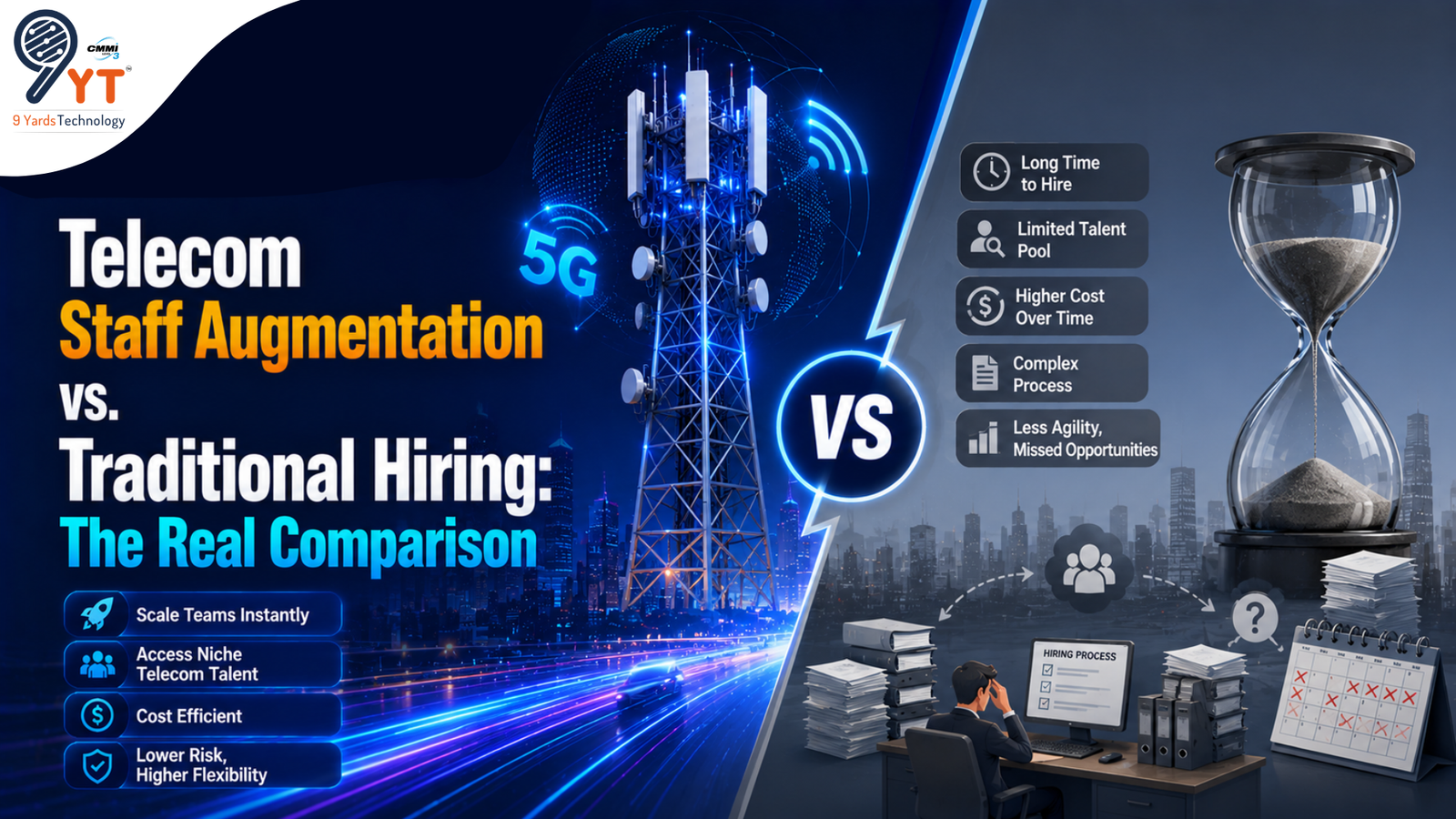
A Senior Software Engineer in the US costs $160,000-200,000 annually. The same role through 9Yards Technology’s India delivery runs $40,000-55,000 annually. For a 10-person telecom software team at senior level, that saves approximately $1,050,000 to $1,450,000 per year depending on role mix.
Cost is only one dimension. The table below covers the factors that matter most for telecom engineering teams specifically.
| Evaluation Criterion | Traditional Hiring (US/Local) | 9Yards Technology Telecom Staff Augmentation India |
|---|---|---|
| Time to first profile | 30-60 days | 48-72 hours |
| Full deployment timeline | 60-120 days | 2-3 weeks |
| 5G and RF engineers India availability | Low; specialist pool is thin locally | Pre-vetted bench indexed by sub-specialty |
| VoIP/SIP developer staff augmentation | Requires open market search, 8-12 week cycle | Available from active bench, 7-day SLA |
| Replacement if engineer underperforms | Full restart of the hiring cycle | 7-day replacement SLA, no extra cost |
| Governance and compliance | Varies by candidate | Documented, audited vetting process; 100% NDA adherence |
| Annual cost, Senior Network Engineer | $94,926-216,683 (US) | $42,000-58,000 (India via 9Yards Technology) |
| Retention rate | Industry average ~70% | 9Yards Technology: 95% |
The retention number matters most. A 70% industry retention rate means 3 in 10 engineers placed by a typical agency leave within 12 months. For a telecom team building institutional knowledge around a 5G core deployment, that turnover rate is a delivery risk.
What “Pre-Vetted” Actually Means for Specialist Telecom Roles
Every staffing agency claims pre-vetted talent. The term has lost meaning without specifics. For IT staff augmentation to deliver real value in telecom, pre-vetted must mean something technically precise.
At 9Yards Technology, pre-vetted for telecom roles means the engineer has passed a role-specific technical assessment, not a generic screen. For 5G and RF engineers in India, that assessment tests actual 3GPP protocol knowledge, vendor-specific toolchain familiarity, and practical network design problem-solving. For VoIP/SIP developer roles, it means verified depth in SIP signalling flows, RTP media handling, and IMS architecture rather than just “experience with telecom” on a CV.
This specificity explains why 9Yards Technology maintains a 95% client retention rate while the industry average sits at approximately 70%. Retention stems directly from whether the technical vetting actually matched role requirements before deployment, not from luck or cultural fit.
One additional differentiator for telecom clients: 9Yards Technology’s Build-Operate-Transfer (BOT) model includes optional team transfer to the client’s own payroll after 12 months. For telecom companies building long-term India engineering hubs, whether for OSS/BSS development or 5G network operations, this offers a concrete path from staff augmentation to full internal ownership without permanent vendor dependency or rehiring when the engagement matures.
For North America telecom clients, NASSCOM’s Technology Sector in India: Strategic Review confirms why India remains the primary sourcing destination for telecom software roles: the depth of protocol-literate engineering graduates entering the market annually cannot be replicated in other offshore geographies at this quality-to-cost ratio.
9Yards Technology Proof Point
Talkdesk needed a complete India engineering hub built from zero with pre-vetted specialists across engineering, QA, security, ERP, and business analysis. 9Yards Technology deployed 45+ engineers and established the hub in 3 months, running 80% faster than Talkdesk’s previous process and cutting talent costs 50% through offshore delivery. The partnership remains active and continues to scale across multiple functions. While Talkdesk is a SaaS company rather than a pure telecom operator, the deployment model, offshore hub build, multi-function specialist vetting, and North America integration requirements map directly to what enterprise telecom clients face when establishing India engineering capacity.
Deloitte’s Global TMT Predictions report has repeatedly flagged workforce and skills gaps as a central risk to AI-driven infrastructure investment across the technology, media, and telecom sector, a dynamic that applies directly to telecom’s 5G buildout. Staff augmentation from India, executed with genuine domain-specific vetting, is currently the fastest way to close that gap without the cost and timeline of building a local team.
Telecom is not a generalist engineering vertical. Companies that scale their 5G and software teams fastest stop treating it like one. A partner with a pre-vetted bench of 5G RAN specialists, RF engineers, O-RAN integration engineers, and VoIP/SIP developers, governed by a documented, auditable vetting process and committed to a 7-day replacement SLA, closes requisitions in 2-3 weeks. That is the operational reality 9Yards Technology has built across 300+ engineer deployments.
Need pre-vetted engineers in 48-72 hours? Talk to a 9Yards Technology specialist with no obligation and no generic shortlist.
Frequently Asked Questions
What types of telecom engineers can be deployed through staff augmentation in India?
Telecom staff augmentation India covers two main categories. The first is network and RF engineers: 5G RAN engineers, RF optimization specialists, O-RAN integration engineers, NOC analysts, and protocol engineers with 3GPP expertise. The second is telecom software engineers: VoIP/SIP developers, OSS/BSS platform engineers, IMS architects, and cloud-native core network developers. 9Yards Technology maintains a pre-vetted bench across both categories with role-specific technical assessments for each sub-specialty.
How do I hire network engineers in India for 5G projects without getting unqualified CVs?
The key is choosing a partner whose screeners can actually evaluate 5G and RF engineers in India, not just source names. Ask specifically about the technical assessment methodology for network roles. A credible partner will test 3GPP protocol depth, vendor toolchain familiarity (Ericsson, Nokia, Huawei), and practical RAN or core network problem-solving. Ask for the retention rate as a number, not a testimonial. 9Yards Technology’s 7-day replacement SLA and 95% retention rate are the verifiable proof points to benchmark against.
What is VoIP/SIP developer staff augmentation and how does the vetting process work?
VoIP/SIP developer staff augmentation places pre-vetted software engineers with specific expertise in SIP signalling protocols, RTP media handling, IMS architecture, and carrier-grade reliability standards into client engineering teams. It is distinct from general software augmentation because the technical bar is domain-specific. At 9Yards Technology, VoIP/SIP developers pass role-specific assessments covering SIP call flow design, codec handling, and IMS integration before being added to the deployable bench. Profiles are available in 48-72 hours.
How does telecom software engineering outsourcing India compare to hiring locally in North America?
For telecom software engineering outsourcing India, the cost differential is significant: a Senior Software Engineer costs $160,000-200,000 annually in the US versus $40,000-55,000 through 9Yards Technology’s India delivery. For a 10-person team, annual savings range from approximately $1,050,000 to $1,450,000 depending on role mix. Beyond cost, the 9Yards Technology deployment timeline of 2-3 weeks versus an industry-reported average of roughly 90 days for specialised technical roles is the operational advantage that matters most for teams under 5G infrastructure timelines.