

 Post by
The market for SAP talent in India is deep, but the supply crunch at the senior S/4HANA level is real and worsening. The 2027 SAP ECC maintenance deadline has pushed hundreds of enterprise migrations into simultaneous execution, and the roles that are genuinely hard to fill- data migration architects, Finance consultants certified in S/4HANA Universal Journal, clean-core BTP extension developers- are competing across dozens of live programmes at once. Vetting SAP consultants in India is no longer a checkbox exercise. It is the variable that determines whether your migration stays on schedule or bleeds months waiting for a replacement.
This guide is written for CTOs and VP Engineering at enterprise organisations that need to hire SAP engineers India fast without getting burned by unverified CVs and 30-to-60 day replacement windows that protect the vendor, not the programme.
What “Pre-Vetted” Actually Means for SAP Roles
Every staffing vendor claims to pre-vet candidates. Few describe what that means in practice for SAP-specific roles, and fewer still put an enforceable number on the guarantee.
For generalist engineering roles, pre-vetting typically covers a coding assessment and a system design interview. For SAP consultants, that baseline is insufficient. A senior S/4HANA FICO consultant needs to demonstrate configuration depth in Universal Journal, parallel ledger handling, and real experience owning cutover, not just being present during one. A vetting process that does not test these scenarios specifically will pass through consultants who have “S/4HANA” on their CV but have only supported an implementation from a distance.
The structured vetting process that 9Yards Technology runs for SAP roles follows a seven-stage Talent Deployment Matrix: requirement intake, internal talent mapping against a pre-vetted bench, initial qualification screening, module-specific technical assessment, client interview, deployment, and ongoing performance monitoring. The technical assessment stage for SAP consultants includes scenario-based questions built around the client’s specific ERP landscape and implementation phase, not a generic module quiz.
Vetting quality is only verifiable after the fact. That is why the 7-day replacement SLA exists: it is a public bet that the vetting process works. A vendor offering a 30-60 day replacement window is pricing in the probability that their vetting will fail. A 7-day replacement SLA forces tighter upfront qualification because the cost of getting it wrong is immediate.
SAP Consultant Annual Cost: India vs. North America
The cost case for India-delivered SAP talent is straightforward when the numbers are computed accurately. Most articles in this space use vague percentages or round figures that do not reconcile with actual market data. The table below uses verified annual benchmarks.
| SAP Role | US Local (annual) | 9YT India (annual) | Annual Saving |
|---|---|---|---|
| Senior SAP Consultant | $155,000-$195,000 | $40,000-$55,000 | $100,000-$155,000 |
| Senior SAP S/4HANA Developer | $160,000-$200,000 | $40,000-$55,000 | $105,000-$160,000 |
| Senior SAP ABAP / BTP Developer | $160,000-$200,000 | $40,000-$55,000 | $105,000-$160,000 |
| Senior SAP Basis / Cloud Architect | $175,000-$215,000 | $48,000-$65,000 | $110,000-$167,000 |
| Senior SAP QA / Test Automation | $120,000-$150,000 | $28,000-$40,000 | $80,000-$122,000 |
For a 10-person SAP programme team at senior level, annual savings typically range from $1,050,000 to $1,500,000 depending on role mix. The savings percentage, computed from the midpoints above, runs approximately 68-76% across SAP consultant and developer roles. That range is meaningfully higher than the 55-70% figures that circulate in published articles and understate the actual data.
One number worth anchoring to: the US local time-to-hire average is approximately 90 days for specialist ERP roles. 9Yards Technology’s average deployment runs 14-21 days. That 69-day recovery per hire has a dollar value that does not appear in salary comparison tables but is real and computable against your programme timeline.
For guidance on cost-optimised SAP deployment structures, talk to a 9Yards Technology specialist before finalising your headcount plan.
How the Deployment Timeline Actually Works
Most vendors quote a start date. Fewer quote a seven-stage process with specific SLA commitments at each gate.
The 9Yards Technology deployment process for SAP engineers runs as follows. Requirement intake happens on day one: role specification, S/4HANA phase, module, configuration depth, and time-zone expectations are all locked before sourcing begins. Talent mapping runs against an internal pre-vetted bench, not a cold job board search, which is the single biggest driver of the 48-72 hour profile delivery commitment.
Screening and technical assessment run in parallel where the bench has candidates already qualified at the required module depth. The client interview is scheduled as soon as the shortlist is confirmed, typically within the first week. Deployment follows within 2-3 weeks of requirement intake.
Two things slow this process down. The first is a poorly specified role brief: a requirement that conflates SAP FICO configuration with ABAP development, or that lists 12 equally weighted “must-have” skills, takes longer to map against the bench and produces weaker shortlists. The second is multi-round interview processes with week-long gaps between stages. For SAP talent in 2026, the best-qualified candidates at S/4HANA level are fielding multiple offers simultaneously. A structured, fast interview process is not a courtesy; it is a competitive requirement.
Performance monitoring continues after deployment. This is the stage that prevents quality drift, the gradual decline in delivery that shows up when a staffing vendor stops managing the engagement the moment a consultant is onboarded.
SAP Contract Staffing vs EOR India: Which Structure Fits Your Programme
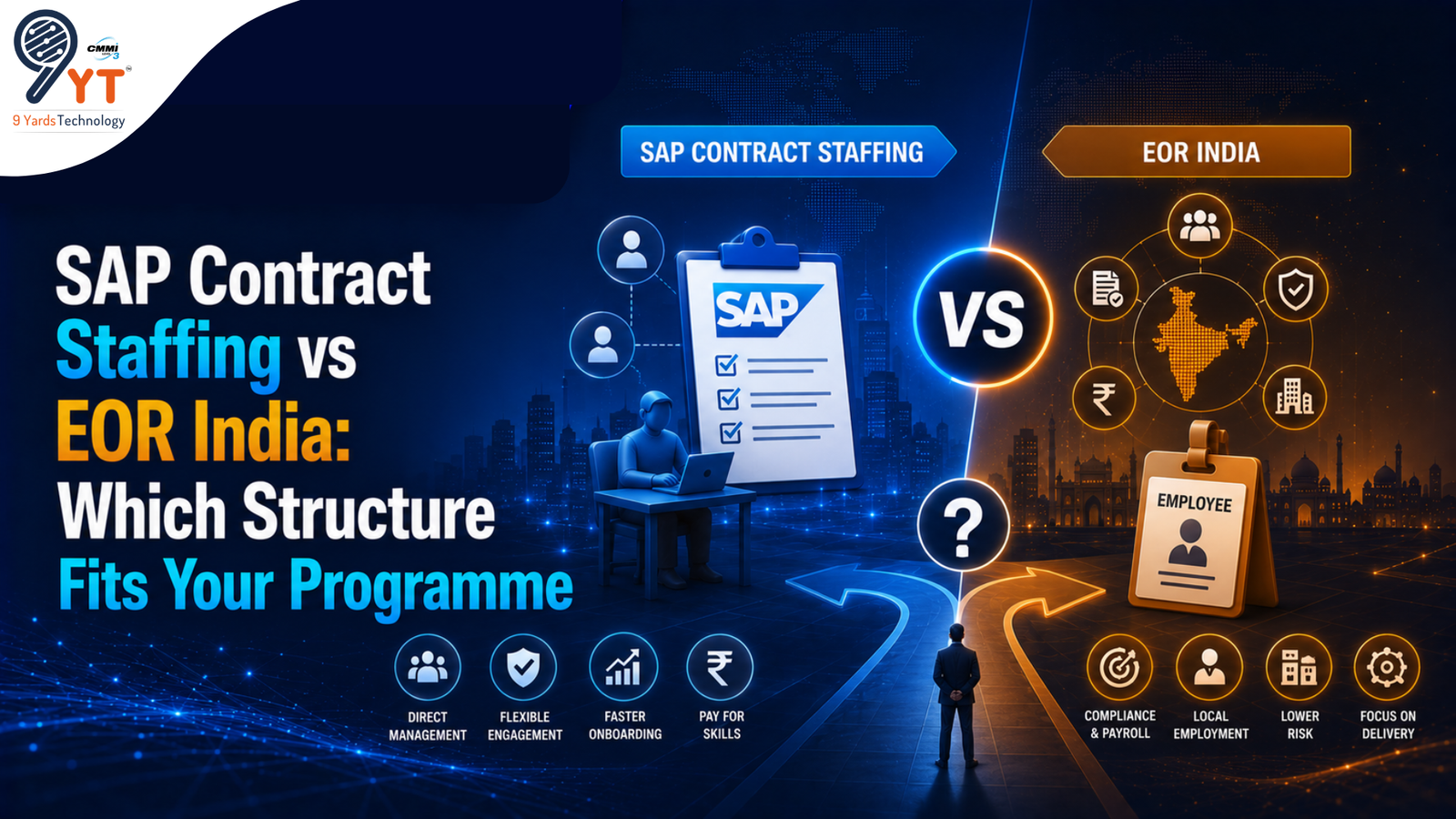
This is the question most articles skip entirely, yet it has real compliance and cost implications for enterprise SAP programmes running across international teams.
Contract staffing through a staff augmentation partner like 9Yards Technology means the consultant is employed by 9Yards Technology, deployed into your team, and working within your existing project governance. You direct the work. The staffing partner manages employment contracts, payroll, and statutory compliance in India, including Provident Fund contributions, TDS under Section 192, and ESI where applicable. This is the right structure for enterprise clients who want an engineer who operates exactly like an internal team member but without the overhead of maintaining an Indian legal entity.
An Employer of Record (EOR) model is different in one critical way: the EOR assumes the role of legal employer for a worker you have already identified. An EOR does not recruit. If you need to source and vet SAP talent as well as handle Indian employment compliance, a pure EOR is half the solution.
For most enterprise SAP programmes, staff augmentation through a vendor with embedded compliance infrastructure is the cleaner path. The 9Yards Technology BOT (Build-Operate-Transfer) model extends this further: 9Yards Technology builds and operates the SAP team for a defined period, then transfers the team to the client’s own rolls after 12 months if the client wants full internal ownership. That transfer option is a procurement-friendly differentiator that pure EOR providers cannot offer, because they do not build or operate the team. It is also the model used in the Talkdesk engagement, where a 45-engineer India team was stood up in 3 months.
NASSCOM’s Technology Sector in India: Strategic Review confirms India’s position as one of the largest global suppliers of ERP talent, with Bengaluru, Pune, and Hyderabad housing the densest concentrations of S/4HANA-certified practitioners.
What the SAP S/4HANA Supply Crunch Means for Your Hiring Window
The SAP ECC mainstream maintenance deadline is creating a narrow and worsening hiring window for experienced S/4HANA implementation talent. Organisations still running ECC landscapes face real security and compliance exposure once that deadline passes, and the competition for the specific profiles that can deliver a clean migration is intensifying with every month that passes.
The shortage is not universal. There is no shortage of consultants with “SAP” on their CV. The shortage is specific: consultants who have delivered an S/4HANA programme end-to-end, who understand Clean Core methodology, who have live go-live experience rather than just implementation participation. Hiring processes that treat all SAP experience as equivalent are increasingly producing bad outcomes.
This is where pre-vetting with a structured technical assessment earns its cost. A vendor who can confirm, before the client interview, that a candidate has hands-on cutover experience and module-specific S/4HANA configuration depth is saving the client from weeks of iteration on unqualified CVs.
The broader pattern of specialised technical skill concentration in India is well-established, reinforcing why enterprise SAP buyers are increasingly sourcing from India rather than waiting out local hiring markets averaging 90 days per role.
For North America buyers specifically, the Talkdesk proof point is the clearest evidence that India-based SAP and engineering talent can integrate seamlessly with US-based programme leadership. Time-zone support structured for US business hours is a configuration, not an obstacle.
How to Evaluate a Staff Augmentation Partner for SAP Talent
The evaluation framework most buyers use is insufficient. Checking that a vendor has “SAP experience” and reviewing three cherry-picked CVs does not tell you whether the vendor’s vetting process is reliable at scale.
Four criteria separate a vendor worth engaging from one that is not.
First, ask for the specific retention rate across SAP deployments, not the overall company figure. A 95% client retention rate across 300+ engineers deployed is a verifiable, aggregate signal of consistent vetting quality. Testimonials can be selected; a retention rate across a large population cannot be.
Second, ask for the replacement SLA in writing with a specific number of days. A 7-day replacement commitment is materially different from a 30-60 day window. The number tells you how confident the vendor is in their own vetting.
Third, ask how the technical assessment is constructed for SAP S/4HANA roles specifically. Module-generic assessments that could apply to any SAP version are a red flag for a vendor who has not invested in S/4HANA-specific qualification depth.
Fourth, ask whether the vendor maintains a pre-vetted bench or sources from job boards after receiving a requirement. The 48-72 hour profile commitment is only possible from a maintained bench. A vendor sourcing cold after intake cannot deliver in that window.
9Yards Technology Proof Point: When Talkdesk needed to establish an India engineering hub, 9Yards Technology deployed 45+ pre-vetted engineers across Engineering, QA, Security, ERP, and Business Analysis functions in 3 months. Hiring speed improved by 80% against Talkdesk’s previous approach. Talent costs reduced by 50% through offshore delivery. The team is still active and expanding.
The Deloitte Global Outsourcing Survey finds that governance maturity and outcome-based accountability are the primary gaps in how enterprises manage their extended workforce; a vendor who cannot answer the four questions above with specific, verifiable numbers is optimising for placement speed, not delivery quality.
SAP talent in India is abundant at the surface level and genuinely scarce at the level that matters for a 2026 S/4HANA programme. The buyers who get ahead of that scarcity are the ones who move fast, vet specifically, and work with a partner whose replacement guarantee reflects real confidence in their own process. Speed without quality is the staffing industry’s most expensive promise.
Need pre-vetted engineers in 48-72 hours? Talk to a 9Yards Technology specialist with no obligation and no generic shortlist.
Frequently Asked Questions
What is the typical SAP consultant hourly rate in India compared to North America?
Publishing hourly billing rates requires a confirmed utilisation and margin basis that varies by engagement. On an annual cost basis, senior SAP consultants deployed through 9Yards Technology from India cost $40,000-$55,000 per year versus $155,000-$195,000 for US local equivalents, a saving of approximately 70-74% computed from those midpoints. For role-specific annual cost comparisons, request a profile brief from a 9Yards Technology specialist rather than working from hourly rate estimates that do not reconcile with annual figures.
How do I vet SAP S/4HANA developers India to confirm real implementation experience versus CV inflation?
Vetting SAP S/4HANA developers India requires module-specific scenario questions, not generic SAP assessments. Ask candidates to walk through a specific configuration decision from a prior S/4HANA Universal Journal or Clean Core engagement, including what they recommended, why, and what the outcome was. Confirm cutover experience with specific go-live dates and the candidate’s actual ownership area. Any vetting process that does not include scenario-based questions built around your S/4HANA phase and landscape will let inflated CVs through.
What is the difference between SAP contract staffing vs EOR India for enterprise programmes?
SAP contract staffing vs EOR India are complementary, not interchangeable. A staff augmentation partner sources, vets, employs, and deploys the consultant, handling Indian payroll compliance and statutory obligations while you direct the work. An EOR assumes legal employer status for a worker you have already identified but does not recruit. For enterprise SAP programmes needing both talent sourcing and compliance infrastructure, staff augmentation through a partner with embedded compliance is the more complete solution. The 9Yards Technology BOT model adds an optional team transfer to client rolls after 12 months.
How quickly can a staff augmentation partner realistically hire SAP engineers in India for an active programme?
A partner maintaining a pre-vetted bench of SAP engineers can deliver qualified profiles in 48-72 hours and complete full deployment in 2-3 weeks. This timeline assumes a clearly specified role brief that distinguishes module, S/4HANA version experience, configuration versus development scope, and time-zone requirements. Vague or over-specified requirements extend that window. Vendors sourcing from job boards after receiving a requirement cannot commit to 48- 72-hour profile delivery, regardless of how they frame their turnaround claims.