

 Post by
Manufacturing IT staff augmentation in India is how enterprise engineering teams close the IIoT MES engineer gap that traditional hiring cannot solve in time. The average US or European manufacturing firm takes roughly 90 days to hire a senior OT/IT integration engineer locally. Production digitalization projects wait. MES rollouts slip. Plant connectivity initiatives stall. The skills shortage is real and documented: A Deloitte and Manufacturing Institute study projects a shortfall of 2.1 million skilled manufacturing workers in the US alone by 2030, with digital and automation roles hit hardest.
Most CTOs and VP Engineering leaders eventually turn to India-based staff augmentation. The real question is not whether to use it, but how to avoid the version that sends you unqualified CVs for three weeks before you give up.
What Manufacturing IT Staff Augmentation from India Actually Means
Staff augmentation in manufacturing IT is not outsourcing a project to a third-party firm and waiting for a deliverable. A vetted engineer joins your team, works inside your processes and toolchain, attends your standups, and reports to your engineering lead. The vendor supplies the person and the quality guarantee. Your team supplies the direction.
The manufacturing context adds specificity. Manufacturing IT roles span two worlds: the IT layer (ERP, cloud infrastructure, data pipelines, cybersecurity) and the OT layer (SCADA, PLC integration, DCS, MES platforms like Siemens Opcenter or Rockwell FactoryTalk). Most engineers excel in one and stumble in the other. Real plant digitalization value sits at the boundary between them.
This is where shallow vetting breaks down. A vendor running a 30-minute technical screen will place a solid Java developer who has never touched a manufacturing execution system and call it a win. Six months into your IIoT rollout, that engineer cannot reason about PLC data latency constraints. A vendor running a structured, role-specific assessment against the actual IT/OT boundary requirements will catch this in advance. The difference shows up not at interview, but in the work.
9Yards Technology’s pre-vetted bench includes engineers with direct production experience across IIoT platforms, MES implementations, and cloud-to-plant connectivity. Most competitors cannot make this claim because they do not maintain a manufacturing-specific bench.
Why the 90-Day Local Hiring Timeline Is a Manufacturing-Specific Problem
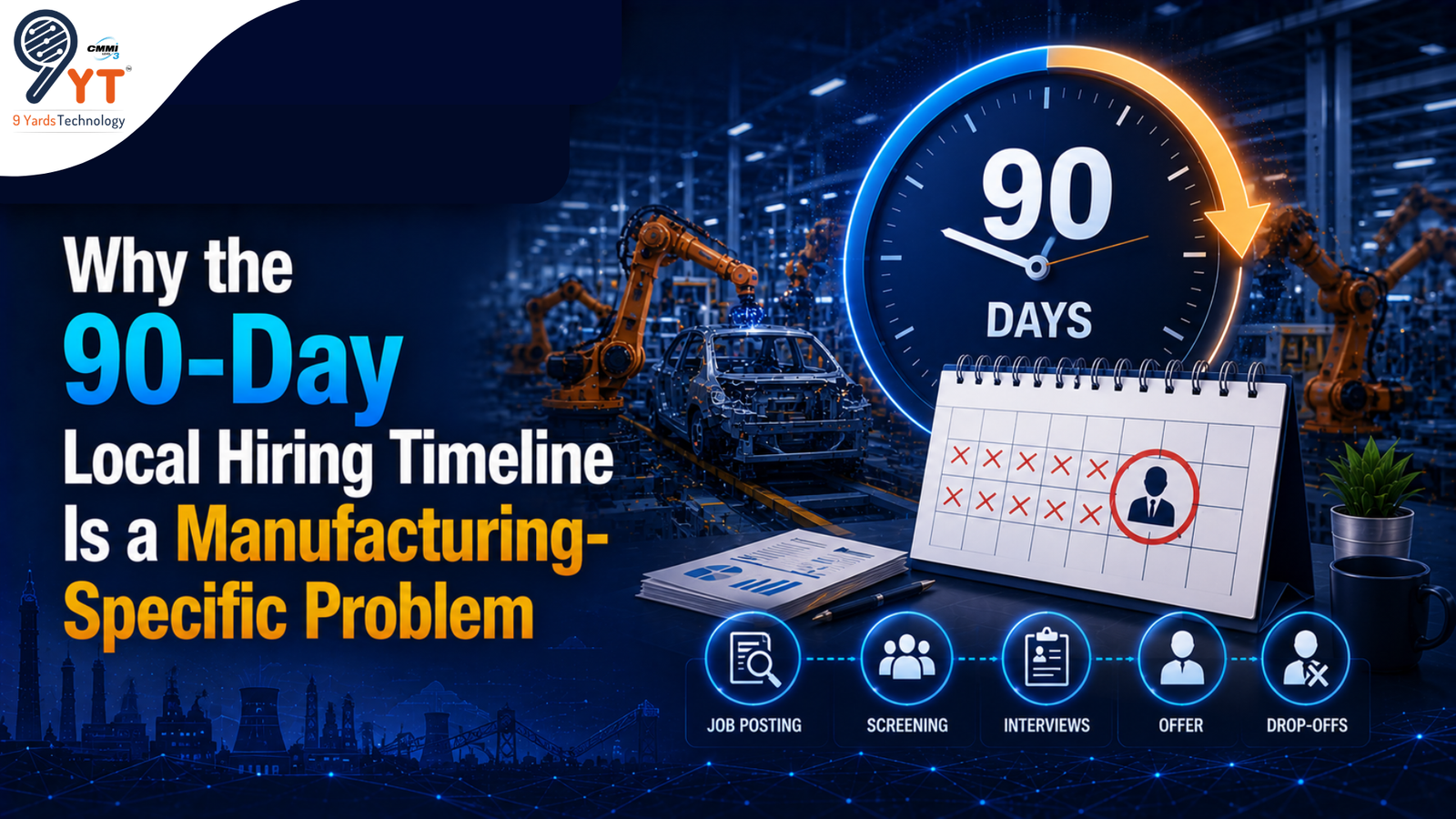
Every industry faces slow hiring. Manufacturing faces it with an added constraint: plant projects run on fixed commissioning schedules. A greenfield IIoT project tied to a new production line cannot slip six months because the MES engineer hire is stuck in a fourth-round interview loop.
The US local market average time-to-hire is approximately 90 days across all engineering roles. For senior IT/OT boundary roles, the real number stretches much longer, because the candidate pool is smaller and the overlap between IT fluency and OT domain knowledge is narrow. The overlap between IT fluency and OT domain knowledge is narrow, and IT/OT convergence talent is consistently identified as one of the hardest engineering categories to source at speed.
India’s engineering talent pool addresses this specific gap. India has deep bench strength in software engineering, cloud infrastructure, data engineering, and QA. It has growing depth in IIoT and MES platforms, driven by a decade of global manufacturing clients building India delivery teams. The question is whether the staffing vendor has done the work to map, screen, and maintain that bench before you call them, or whether they plan to start searching after you submit a requirement.
9Yards Technology maintains a pre-vetted talent pool built for rapid deployment. Profiles reach clients in 48-72 hours. That is an operationally enforced SLA that only works if bench preparation happens before the client requirement arrives.
How 48-Hour Talent Deployment India Actually Works
The 48-72 hour profile commitment sounds fast. Most CTOs who have been through a bad staffing experience hear it as a red flag because fast profiles from an underprepared vendor mean unscreened CVs dressed up as shortlists.
Here is the actual process behind the number:
Step 1: Requirement received. Client submits the role specification, including technology stack, OT/IT boundary requirements if relevant, seniority level, and timezone expectations.
Step 2: Talent mapping. Internal matching against the pre-vetted bench, not a fresh external search. Engineers on the bench have already passed a structured technical assessment. Mapping identifies candidates whose existing profile matches the requirement without starting from zero.
Step 3: Role-specific screening. A second-pass screening call validates the match against the specific client context: the MES platform version, the cloud architecture, the IT/OT boundary scope.
Step 4: Profiles delivered. Two to three shortlisted candidates, with assessment notes, reach the client within 48-72 hours of requirement receipt.
Step 5: Client interview. Client conducts their own technical interview. Most clients complete this within 2-3 business days of receiving profiles.
Step 6: Deployment. Full deployment within 2-3 weeks of offer acceptance, covering onboarding, NDA execution, and toolchain access.
Step 7: Performance monitoring. Ongoing delivery tracking against agreed metrics. If performance falls short within the engagement window, the 7-day replacement SLA is triggered automatically.
The total timeline from requirement to active engineer runs 2-3 weeks. Against a 90-day local alternative, that recovers roughly 69 days of productivity per hire.
Manufacturing IT vs. OT Integration Talent: What to Vet Differently
Not all manufacturing IT roles require OT depth. A cloud infrastructure engineer supporting a manufacturing firm’s ERP environment needs strong AWS or Azure competency and enterprise-grade security awareness, not SCADA knowledge.
But manufacturing IT OT integration talent is a specific category, and it requires a different vetting lens. When the role sits at the IT/OT boundary, these are the specific questions a structured technical assessment must answer:
Can the engineer read and interpret PLC ladder logic, even if they are not a controls engineer? Can they reason about real-time data latency constraints at the field device layer? Do they understand the security architecture differences between IT networks and OT networks, including air-gapped environments, proprietary protocols, and legacy device constraints? Have they worked with a named MES platform in a production environment, not just in a lab?
A vendor who cannot articulate this distinction in their own vetting process will not source the right engineer for an OT-adjacent role. Asking a prospective staffing partner to walk you through their specific technical assessment criteria for IT/OT boundary roles is the fastest way to separate prepared vendors from CV-senders.
| Evaluation Criterion | What to Look For | Red Flag |
|---|---|---|
| MES platform experience | Named platform (Opcenter, FactoryTalk, SAP ME) with production context | “Experience with MES systems” with no specifics |
| IT/OT boundary awareness | Demonstrates latency, protocol, and security distinctions | Describes OT as “just another network layer” |
| Vetting process | Structured technical assessment with documented criteria | Single 30-minute screening call |
| Replacement guarantee | Named SLA with specific day count (e.g. 7 days) | “Flexible support” or no written SLA |
| Retention rate | Published, audited figure (industry average is approximately 70%) | No retention data published |
| Profile turnaround | 48-72 hours from a pre-vetted bench | “We’ll start searching and get back to you” |
| Bench composition | Manufacturing IT-specific depth, named platforms | Generic software engineering bench only |
The Proof: What Enterprise Deployment at Scale Looks Like: 9Yards Technology deployed 60+ engineers for SHL across Product Engineering, QA, Performance Engineering, and Business Analysis within two months. Resource deployment was 70% faster, hiring efficiency improved by 60%, talent acquisition costs dropped by 20%, and the partnership has remained active for 5+ years. The model used was BOT (Build-Operate-Transfer), which includes an optional transition of the team to the client’s own rolls after 12 months.
The SHL engagement shows what structured, pre-vetted IT staff augmentation produces at enterprise scale. Sixty engineers in two months requires a maintained bench, a tested deployment process, and account management built specifically around staffing continuity, not reactive searching.
For manufacturing clients, the same model applies with increased technical complexity. When OT knowledge is involved, the deployment timeline does not have to stretch. NASSCOM’s engineering talent data for India confirms India produces over 1.5 million engineering graduates annually, with a growing cohort specialising in industrial automation, IIoT platforms, and embedded systems.
Manufacturing IT staff augmentation from India works when the vendor has done the pre-work. It fails when the vendor treats the client requirement as the starting point for a search that should have already happened.
Speed without a pre-vetted bench is not speed. A vendor who quotes 48-72 hours but has not maintained a manufacturing IT-specific bench will miss that window and send you unqualified profiles anyway. Verify the bench before you verify the timeline.
Need pre-vetted engineers in 48-72 hours? Talk to a 9Yards Technology specialist with no obligation and no generic shortlist.
Frequently Asked Questions
How quickly can manufacturing IT engineers from India be deployed through staff augmentation?
With a pre-vetted talent pool built for rapid deployment, 9Yards Technology delivers shortlisted profiles within 48-72 hours of receiving a requirement. Full deployment, including onboarding and NDA execution, completes within 2-3 weeks. This compares to an industry-reported average of approximately 90 days for local US hiring of senior manufacturing IT roles, recovering roughly 69 days of productivity per hire.
What skills should I look for in IIoT MES engineer staff augmentation from India?
For IIoT MES engineer staff augmentation, vetting should cover named MES platform experience (Siemens Opcenter, Rockwell FactoryTalk, SAP ME), demonstrated IT/OT boundary awareness including real-time latency constraints and OT network security, and production-environment track record rather than lab exposure. Ask the staffing vendor to walk through their specific technical assessment criteria for IT/OT boundary roles before you submit a requirement.
How does a pre-vetted talent pool enable rapid deployment for manufacturing IT roles?
A pre-vetted talent pool means engineers have already completed structured technical assessments, including role-specific screening for manufacturing IT requirements, before any client requirement arrives. When a requirement comes in, the vendor matches against an existing assessed bench rather than starting a fresh external search. This is what makes 48-72 hour profile delivery operationally possible rather than a marketing claim that collapses under pressure.
What is the difference between manufacturing IT OT integration talent from India and standard software engineers?
Standard software engineers are assessed for application development, cloud infrastructure, or data engineering competency. Manufacturing IT OT integration talent requires an additional layer: familiarity with OT protocols (Modbus, OPC-UA, PROFINET), PLC and SCADA environment constraints, MES platform configuration, and the security architecture differences between enterprise IT networks and plant-floor OT environments. Most staffing vendors do not maintain a bench with this specific depth.