

 Post by
A staff augmentation contract in India without specific numbers is not a contract. It is a set of intentions. Most disputes between enterprise clients and offshore staffing vendors trace back to the same root cause: one party signed language that sounded enforceable but contained no measurable commitment. When Talkdesk engaged 9Yards Technology, they received a written commitment that mattered. 45+ engineers deployed. An India engineering hub stood up in 3 months. SLAs from day one. If you are currently reviewing a vendor agreement or evaluating whether an existing one protects you, the termination clause notice period India vendors offer, and the specificity of their replacement language will tell you more than any sales conversation.
Most buying teams focus on rate cards and start dates. Pages 4 through 9 determine whether the engagement actually works, and most buyers never read them closely.
What a Staff Augmentation Agreement Actually Governs
A staff augmentation agreement is not an outsourcing contract. The distinction matters legally and operationally. In outsourcing, the vendor owns delivery accountability. In IT staff augmentation, your team manages the engineers day to day: you control the backlog, the tools, the architecture decisions. The vendor’s obligation is to supply pre-vetted talent that meets your bar, replace it when it does not, and protect your IP and confidentiality throughout.
The contract has three jobs. First, it defines the talent supply obligation: vetting standards, profile timelines, approval rights. Second, it governs what happens when the supply fails: replacement terms, not generic “commercially reasonable efforts” language. Third, it protects the assets your engineers will touch: code, data, system access.
Any clause using “commercially reasonable” without a number attached to it will be interpreted in a dispute by whoever has the stronger legal team. That is where you do not want ambiguity.
According to the Nasscom Indian IT Industry Overview, India’s IT services sector continues to scale rapidly. This increases both the supply of available talent and the number of vendors competing for enterprise contracts, many with template agreements drafted to protect the vendor, not the client.
The IP Ownership Clause Staff Augmentation Contracts Get Wrong
The IP ownership clause in most staff augmentation agreements reads: “all work product created by augmented personnel shall be the property of the client.” Necessary. Not sufficient.
The clause must specify two additional elements. First, the transfer trigger: IP must transfer on creation, not on final payment. Some vendor contracts gate ownership behind invoice settlement. If the engagement ends mid-sprint with a billing dispute, your code stays with the vendor until the final payment clears. That is a structural vulnerability, not a minor technicality.
Second, both the vendor entity and the individual engineers must be bound. A provider-level NDA covers the company’s obligations but does not directly bind the engineers working in your codebase. Both layers need to be signed. 9Yards Technology’s standard engagement documentation includes 100% NDA adherence as a verified governance commitment, covering individual engineers across every active deployment.
For SaaS and AI companies, the clause should enumerate background IP: any pre-existing libraries, frameworks, or proprietary tooling the vendor’s engineers bring to the project. You need a license to use background IP you did not commission, and that license needs to survive contract termination.
The Aimprosoft co-employment and IP guide confirms that explicit IP assignment clauses in both the MSA and SOW are essential, since ownership of work does not automatically transfer without them.
Read More: Offshore Staff Augmentation for US Companies Hiring from India: The Compliance-First Guide
What the Replacement Guarantee Clause Must Actually Contain
The replacement guarantee clause is where most vendor contracts become decorative. The phrase “replacement will be provided at no additional cost” appears in the majority of staff augmentation agreements but means almost nothing without three supporting details.
The clause must state a specific maximum timeline: a named number of calendar days, not business days, not “promptly,” not “within a reasonable period.” 9Yards Technology’s published replacement SLA is 7 days, a public commitment to the quality of the pre-vetted bench maintained before the engagement starts. A vendor who cannot commit to a specific number is telling you something about that bench’s depth.
The clause must define what triggers replacement eligibility. Performance failure is subjective unless the contract ties it to objective criteria: missed sprint commitments, a technical assessment score, or a documented escalation process. Without this definition, a vendor can contest every replacement request.
The replacement obligation must apply throughout the full engagement, not just within an initial trial window. A guarantee that expires after 90 days is not a guarantee; it is a trial period with extra steps.
This clause is the single most negotiable element in any staff augmentation agreement. Use 7 days as your benchmark. If the vendor cannot match it or better, ask why in writing.
SLA vs Staff Augmentation Accountability: Understanding the Difference
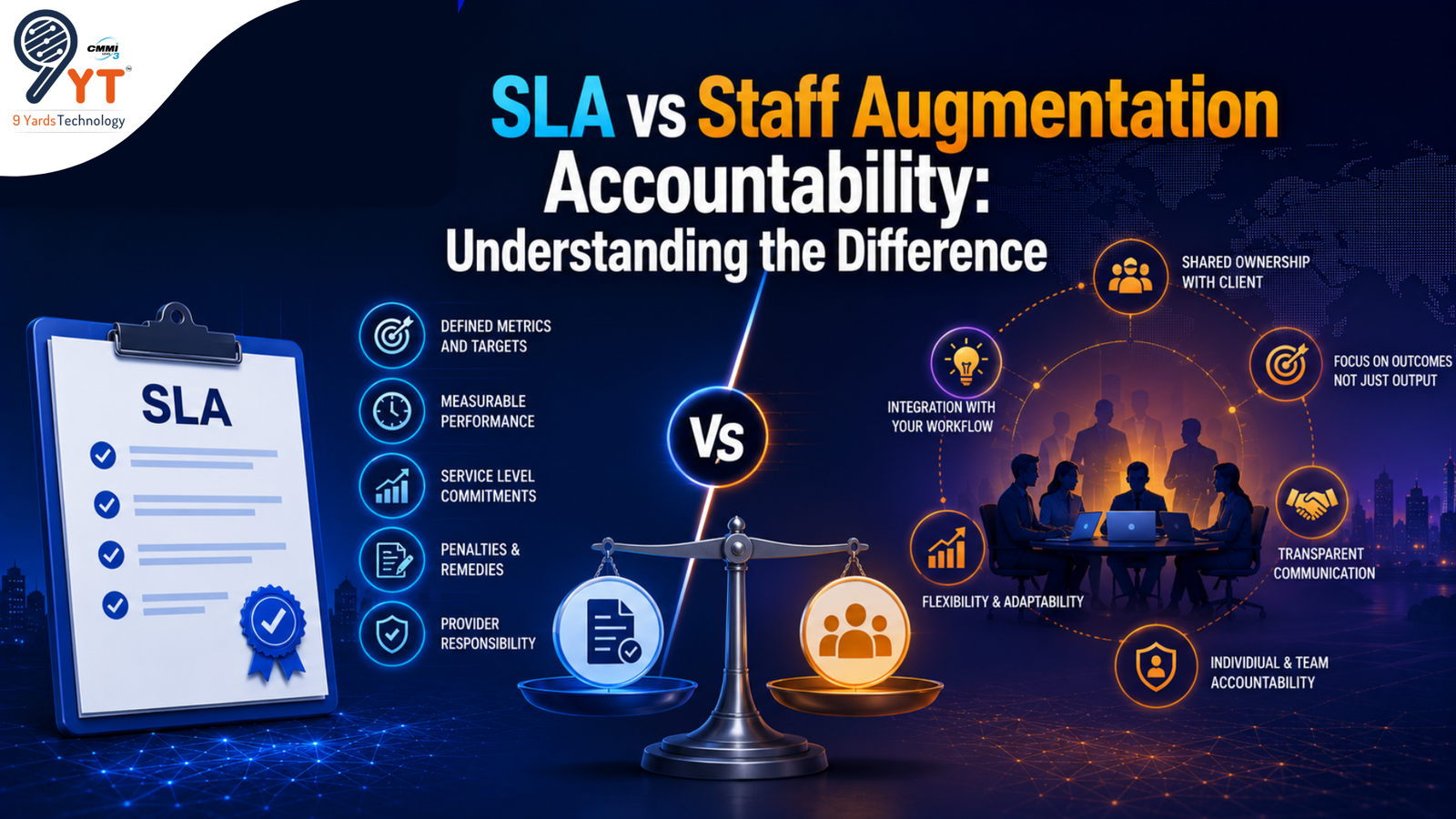
SLA frameworks originated in managed services, where a vendor owns an outcome. Staff augmentation is structurally different: the client manages day-to-day work, so the vendor cannot own engineering output the way a managed services provider can.
This creates a genuine accountability gap that most contracts do not resolve cleanly. The staffing vendor controls talent quality and supply speed. The client controls task allocation, tooling, and engineering direction. When velocity underperforms, both parties have plausible deniability.
Separate the two types of SLA in the contract. Supply SLAs are fully the vendor’s responsibility: profiles delivered within a stated timeframe (9Yards Technology commits to 48-72 hours), full deployment within 2-3 weeks, replacement within 7 days. These are measurable, binary, entirely within the vendor’s control.
Engineering performance SLAs require shared accountability. The contract should define an escalation path, not a penalty structure, since the client’s own processes are a variable. A solid contract includes a quarterly review mechanism with defined metrics both vendor and client sign up to track: sprint completion rates, defect density, onboarding time to first productive contribution.
For a deeper view on how governance frameworks apply to offshore delivery, outcome measurement and accountability alignment remain the top contract pain points in cross-border technology engagements.
The distinction between supply SLAs and performance SLAs determines whether your contract protects you or just gives you paperwork. Most competing contract guides do not draw it.
The Termination Clause Notice Period India Vendors Offer Varies Widely
The termination clause notice period India-based vendors include in their standard agreements ranges from 14 days to 90 days. The variance is not random. Vendors with shallow benches or high attrition push for longer notice periods because they need more time to backfill. Vendors confident in their supply chain can afford shorter terms.
A 30-day notice period for standard termination is reasonable and buyer-friendly. Anything beyond 45 days should trigger a direct conversation about why the vendor needs that runway. In the SHL engagement, 9Yards Technology maintained a 5+ year ongoing partnership, a different commercial dynamic than a short-term project. Even long-term engagements should not require notice periods that trap you in a non-performing relationship for months.
The termination clause should distinguish three scenarios clearly: termination for convenience (your business needs changed), termination for cause (the vendor breached a material obligation), and termination for non-performance. Each should carry a different notice requirement and financial consequence. A single catch-all termination clause almost always disadvantages the client.
Check whether the clause addresses partial termination: the right to reduce headcount by a defined number of engineers without triggering a full contract exit. This is critical for companies managing variable engineering demand across quarters.
How to Grade Your Contract in 30 Minutes
Most enterprise buyers have reviewed a vendor presentation, checked references, and signed an agreement without reading the clauses that determine what happens when something goes wrong. Use this table as a benchmark for each critical clause so you can assess any staff augmentation contract India vendor presents against a measurable standard.
| Contract Clause | What Strong Language Looks Like | Red Flag to Reject |
|---|---|---|
| Profiles turnaround | Specific number: “48-72 hours” | “As soon as reasonably practicable” |
| Full deployment timeline | “2-3 weeks from approval” | “Subject to candidate availability” |
| Replacement guarantee clause | Named days: 7 calendar days, full engagement | “Commercially reasonable efforts” or 90-day expiry |
| IP ownership trigger | Transfers on creation, not on final payment | Tied to last invoice or project close |
| NDA binding level | Vendor entity AND individual engineers | Vendor entity only |
| Termination notice period | 30 days or fewer for convenience | 60-90 days with financial penalty |
| SLA accountability split | Supply SLAs on vendor; performance SLAs shared | Single SLA covering everything with vendor owning outcome |
| Background IP | Enumerated with a license surviving termination | Silent or limited to “work product” |
9Yards Technology Proof Point
When Talkdesk needed to establish an India engineering hub from scratch, the engagement terms were built around measurable commitments from the outset. 9Yards Technology deployed 45+ pre-vetted engineers across Engineering, QA, Security, ERP, and Business Analysis functions. The India hub was operational in 3 months. Hiring moved 80% faster than Talkdesk’s previous process, and talent costs fell by 50% through offshore delivery. The engagement is still active, with deployments continuing across multiple functions. That outcome happened because of contractual rigor, not despite it.
The One Clause Most Buyers Skip That Creates the Most Risk
The non-solicitation clause is most buyers’ quick skim. It matters more than most teams realize.
A standard non-solicitation clause prevents you from directly hiring the engineers deployed to your team during and after the engagement. Language varies: some vendors impose an 18-month restriction post-engagement; others allow direct hire after a defined tenure with a fee. Neither approach is inherently unreasonable, but the terms need to be explicit and proportionate.
The risk is operational, not legal. If the contract is silent or ambiguous, an engineer you have invested 6-12 months in developing institutional knowledge can be pulled back by the vendor for a higher-margin engagement elsewhere. That is a continuity risk, particularly on long-term product engineering programmes.
9Yards Technology’s BOT (Build-Operate-Transfer) model explicitly addresses this: after 12 months, engineers can transition to the client’s own rolls. That is a concrete, procurement-friendly term, not a vague reference to a “seamless transition.” Before the commercial conversation begins, ask the vendor to show you that clause in writing.
The Gartner IT Sourcing and Vendor Management research identifies non-solicitation and conversion rights as among the most disputed terms in long-running staff augmentation relationships, and recommends resolving them at contract signature rather than renegotiation.
An engagement that scales to 60+ engineers, as the SHL partnership did over five-plus years, generates significant institutional knowledge inside your deployed team. Protecting access to that knowledge over the long term starts with the non-solicitation and transfer terms you agree to on day one.
A staff augmentation contract India vendors will happily let you sign without scrutiny rarely protects you at scale. The clauses are standard. The numbers inside them are the variable. Contracts containing specific, measurable commitments, such as a 7-day replacement SLA, 48-72 hour profile delivery, and IP transfer on creation, are contracts built by vendors confident enough in their own process to be held accountable to it.
Need pre-vetted engineers in 48-72 hours? Talk to a 9Yards Technology specialist with no obligation and no generic shortlist.
Frequently Asked Questions
What should an IP ownership clause in a staff augmentation contract include?
An IP ownership clause in a staff augmentation contract should specify three things: that all code and work product belongs to the client (not the vendor), that ownership transfers on creation rather than on final payment, and that the clause binds both the vendor entity and each engineer. If the contract is silent on when transfer occurs, some vendors can legally gate code ownership behind invoice settlement. Both the MSA and any SOW should include explicit IP assignment language.
What is a reasonable replacement guarantee clause in a staff augmentation contract?
A strong replacement guarantee clause names a specific number of calendar days, applies throughout the full engagement (not just an initial trial window), and defines objective performance criteria that trigger replacement eligibility. 9Yards Technology’s published replacement SLA is 7 calendar days. Any clause using phrases like ‘commercially reasonable’ or ‘promptly’ without a number attached is not enforceable in practice and should be renegotiated before signing.
What is the difference between SLA vs staff augmentation accountability in a contract?
SLAs in staff augmentation should be split into two categories. Supply SLAs, covering profile turnaround time, deployment speed, and replacement timelines, are entirely the vendor’s responsibility. Engineering performance SLAs are shared, because the client controls task allocation, tooling, and team direction. A contract that assigns all SLA accountability to the vendor misrepresents how staff augmentation actually works and will create disputes when engineering velocity underperforms for reasons inside the client’s own processes.
What termination clause notice period should I expect in a staff augmentation contract with an India vendor?
A termination clause notice period India vendors include typically ranges from 14 to 90 days. A buyer-friendly benchmark is 30 days for termination for convenience, with shorter or immediate terms for termination for cause. Notice periods beyond 45 days should prompt a direct question about the vendor’s bench depth, as longer notice requirements often signal higher internal attrition or shallow pre-vetted talent pools. The clause should also distinguish termination for convenience, cause, and non-performance, each with separate financial terms.