

 Post by
The staff augmentation onboarding process fails most teams before the engineer ever opens a laptop. By the time a typical augmented hire gets repository access, Slack permissions, and a first ticket, 3–5 days have evaporated. Multiply that across 10 engineers, and two to three sprint weeks vanish before a single line of code ships. The engineers 9Yards Technology deploys arrive with an integration buddy already assigned, a pre-briefed account manager, and system access provisioned the night before Day 1.
Most onboarding advice is written for the client. This piece focuses on what the staffing partner does before the client lifts a finger.
Why the Standard Advice Gets Onboarding Wrong
Read any competing guide on staff augmentation onboarding best practices, and you will find the same list: provision access early, assign a mentor, share documentation, communicate expectations. All correct. None explains who is responsible for each step when the engineer does not belong to your payroll system.
That gap is where most augmented deployments lose a week.
When an engineer joins through a body-shop model, the client inherits the full administrative burden: chasing NDA signatures, requesting system credentials, coordinating IT provisioning, and scheduling introductions. Each step has a queue. Each queue adds days.
9Yards Technology treats pre-deployment preparation as a vendor obligation, not a client task. Our Talent Deployment Matrix assigns a named account manager the moment a deployment is confirmed. That manager coordinates NDA execution, access request documentation, and the technical brief package before handoff. The client receives a ready-to-deploy engineer, not a checklist.
Industry data shows the average time to first commit is 2–4 weeks, while top-performing teams get new hires to meaningful contribution within 3–5 days. The difference is entirely process, not talent.
What the 9Yards Technology Talent Deployment Matrix Actually Does
The Talent Deployment Matrix is a seven-stage process with time targets at every step. It does not end at deployment; that is the part most staffing firms skip.
Here is how the stages map to Week 1 productivity:
Requirement Received to Profiles Delivered: 48–72 hours. The client gets pre-vetted candidates, not a raw CV pile to sort through.
Technical Assessment: Completed before the client interview, not during it. The client uses their interview time to evaluate team fit, not re-run a coding screen.
Deployment: Full team in place within 2–3 weeks of requirement sign-off.
Performance Monitoring: An active checkpoint at the end of Week 1, not a 30-day review. The account manager flags friction early, whether that is a missing repository permission or a mismatch in sprint tooling.
The 7-day replacement SLA exists because of this monitoring layer. If something is wrong in Week 1, we know about it in Week 1.
Pre-vetted engineers arrive knowing enterprise delivery norms: pull request conventions, code review etiquette, sprint ceremony expectations. That context does not need to be taught, eliminating the first layer of ramp time before the client’s onboarding checklist even begins.
Read More: How to Augment Your Software Engineering Team with India-Based Talent
Staff Augmentation Onboarding Best Practices: What Actually Moves the Needle
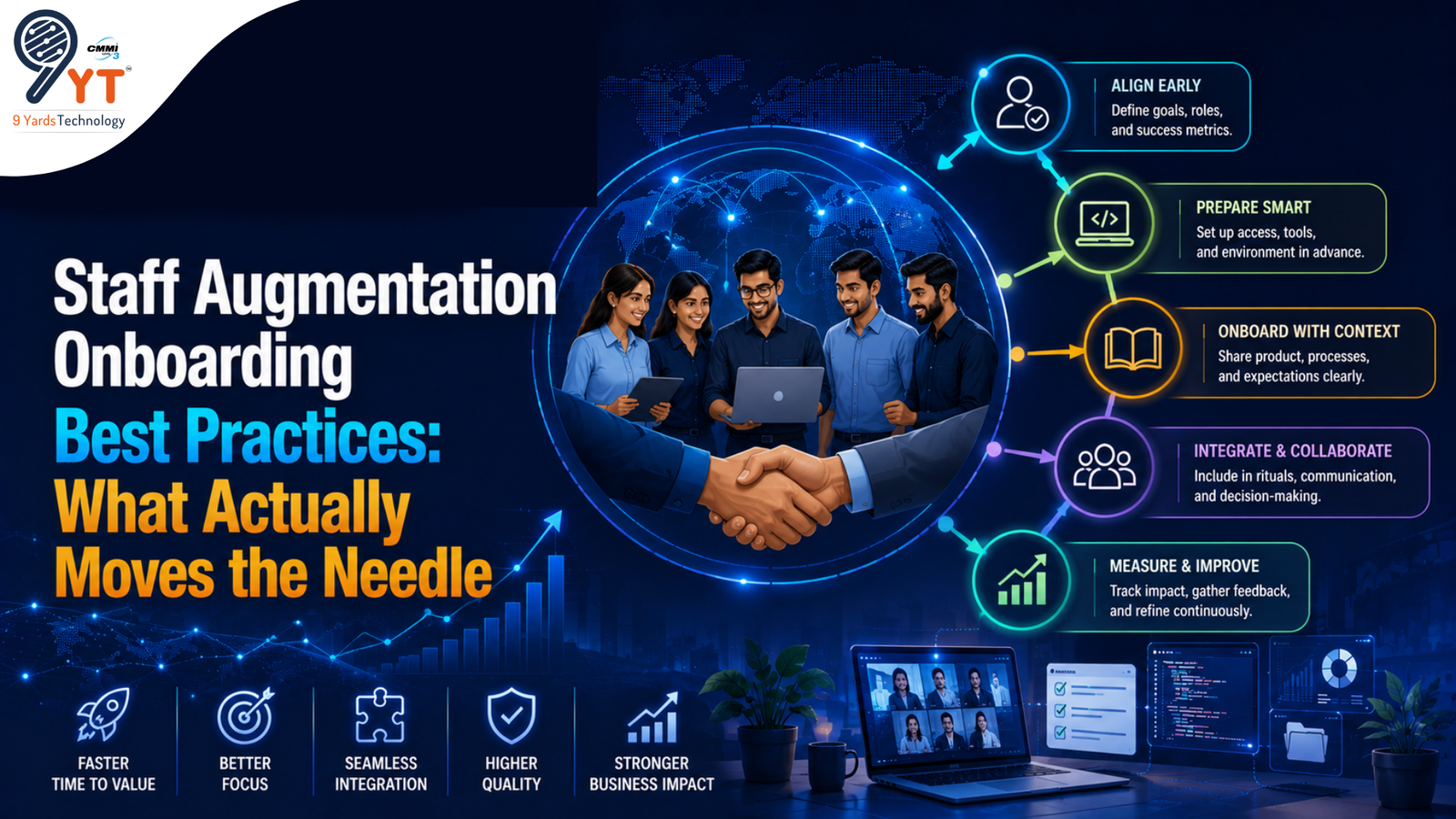
Three practices separate a Week 1 contributor from a Week 3 still-getting-settled engineer. Each one is a shared responsibility between vendor and client.
Day 1 system access, confirmed the night before. A company with manual access processes can take one to two weeks just to provision credentials. 9Yards Technology coordinates the access request documentation as part of pre-deployment. The client’s IT team receives a structured request, not a vague ask from a new contractor.
A named integration buddy, not an open-door policy. Open-door policies ask the engineer to self-identify what they do not know. A named integration buddy asks the buddy to surface what the engineer has not yet encountered. A Microsoft study found that 73% of new hires with a structured buddy reported faster productivity in their role. The buddy does not need to be senior; they need to know the team’s tooling, communication norms, and who owns what.
A first ticket scoped for Day 2, not Day 5. Waiting for the engineer to be “settled” before assigning real work extends ramp time by default. A scoped, low-risk ticket on Day 2 surfaces missing access, clarifies tooling questions, and gives the engineer a concrete win before week’s end.
Velocity typically stabilises over 4–8 weeks for any new engineer. Week 1’s goal is not full velocity. It is removing every blocker to velocity.
The Comparison Most Teams Do Not Make
Clients evaluating IT staff augmentation partners typically compare CV quality and billing rates. They rarely compare onboarding architecture, and that is the wrong comparison. Here is why it costs them.
An engineer who reaches 50% productivity in Week 1 instead of Week 3 delivers two weeks of recovered output per hire. Across a 10-engineer deployment, that is 20 engineer-weeks of output the client would otherwise lose to ramp-up.
The onboarding process is not a soft benefit. It is a quantifiable delivery variable.
| Onboarding Stage | Traditional Hiring Timeline | 9Yards Technology Staff Augmentation | Approximate Time Saved |
|---|---|---|---|
| First week productivity structured onboarding | 3–6 months to full productivity | Week 1 contributor, 4–8 week velocity stabilisation | 8–16 weeks of partial output recovered |
| Profiles/candidates delivered | 90 days average time-to-hire | 48–72 hours | ~87 days |
| Full team deployment | 90+ days per hire | 2–3 weeks | ~10 weeks per engineer |
| Day one system access augmented staff | 1–2 weeks after start date (manual IT queue) | Provisioned before Day 1 via pre-deployment coordination | 5–10 days |
| Replacement if engineer underperforms | Months (re-hiring cycle) | 7-day replacement SLA | Full re-hiring cycle avoided |
| Onboarding accountability owner | Internal HR + hiring manager | 9Yards Technology account manager + client lead | Shared, documented, SLA-backed |
The Talkdesk Proof Point
In 3 months, 9Yards Technology established Talkdesk’s entire India engineering hub: 45+ engineers deployed across Engineering, QA, Security, ERP, and Business Analysis functions, with 80% faster hiring and a 50% reduction in talent costs. The hub was built to operate in time-zone alignment with Talkdesk’s US teams from Day 1. It is still active and expanding.
Building a 45-engineer team in 3 months requires more than sourcing. It requires an onboarding architecture that absorbs multiple engineers per week without compounding delays. Every engineer who joined in that sprint went through the same Talent Deployment Matrix: pre-vetted, pre-briefed, access-coordinated before start date, and performance-monitored through Week 1.
That is not recruitment. That is delivery.
How to Evaluate a Staffing Partner’s Onboarding Process
When you interview a staffing partner, ask four specific questions. The answers will separate a structured onboarding process from a CV-delivery service.
Who owns Day 1 system access coordination? If the answer is “you coordinate with your IT team,” the vendor has handed you the hardest administrative task.
What is your replacement SLA if an engineer does not perform? A specific number of days is a commitment. “We’ll work with you” is not.
How do you monitor engineer performance in Week 1? If the vendor cannot answer beyond “our engineers are pre-vetted,” there is no monitoring.
Have you deployed more than 10 engineers simultaneously for a single client? The SHL deployment (60+ engineers in 2 months) and the Talkdesk deployment (45+ engineers, hub built in 3 months) both required coordinated onboarding at scale. Ask for named examples, not general claims.
A 95% client retention rate is the downstream result of getting onboarding right. Testimonials can be managed; retention cannot.
The One Thing Most Staffing Partners Skip
Pre-deployment briefing is the single highest-impact onboarding step that most staffing firms do not offer.
Before a 9Yards Technology engineer starts, they receive a technical brief: the client’s stack, the team’s sprint tooling, the communication conventions, and the name of their integration buddy. They have read the codebase overview. They know who the tech lead is.
This takes the account manager approximately two hours to prepare. It recovers two to five days of ramp time per engineer. Structured pre-boarding, information shared before Day 1, meaningfully compresses the time to first productive contribution. The principle applies directly to augmented deployments, where the engineer lacks informal corridor conversations to fill context gaps.
The brief is not a formality. It is the single biggest difference between an engineer who ships in Week 1 and one who is still building context in Week 3.
Week 1 productivity is not a nice-to-have. It is the clearest signal that your staffing partner’s process is real.
Need pre-vetted engineers in 48–72 hours? Talk to a 9Yards Technology specialist with no obligation and no generic shortlist.
Frequently Asked Questions
What are the most important staff augmentation onboarding best practices for Week 1?
The three practices that move the needle most in Week 1 are: day one system access confirmed before the start date, a named integration buddy assigned at deployment, and a first ticket scoped for Day 2. Most guides place these as client responsibilities. A structured staffing partner like 9Yards Technology coordinates access documentation and the pre-deployment briefing before the engineer’s first day, so the client’s onboarding checklist starts from a ready state rather than a standing start.
How does day one system access for augmented staff differ from a standard new hire?
Day one system access for augmented staff is more complex than a standard new hire because the engineer does not exist in the client’s HR system, payroll, or IT provisioning workflow. Requests must be raised manually, approved by security, and verified by the hiring manager. Without vendor coordination, this process typically takes 1–2 weeks. 9Yards Technology prepares structured access request documentation as part of the pre-deployment stage, so credentials are ready before the engineer’s first day.
What is a first week productivity structured onboarding process for augmented engineers?
A structured onboarding process for augmented engineers covers five elements: pre-deployment access coordination, a technical brief package delivered before Day 1, a named integration buddy, a Day 2 starter ticket, and a Week 1 performance checkpoint by the account manager. Industry data shows the average time to first meaningful code commit is 2–4 weeks. Teams with structured processes compress that to 3–5 days. The difference is entirely process architecture, not engineer quality.
How does an integration buddy program help augmented engineers ramp faster?
An integration buddy for augmented engineers provides immediate access to informal knowledge: team communication norms, tooling conventions, who owns which codebase area, and how the sprint cadence actually runs in practice. A Microsoft study found that 73% of new hires with a structured buddy reached productivity faster than those without. For augmented staff, the buddy is especially important because the engineer has no pre-existing relationships inside the team to draw on during Week 1.